




Quartz Countertop Designs for North Shore Kitchens
On this page
The white-and-gray default you see in most kitchen showrooms reflects what manufacturers have pushed most aggressively in recent years, not what the material can actually do. Engineered quartz is manufactured from ground quartz aggregate, resin, and pigment - the color and pattern are controlled in production, which means the range is essentially unlimited. Before finalizing a countertop selection, it is worth seeing the full range. For context on how countertops fit into the broader sequence of kitchen decisions, see our kitchen remodel design guide. Our kitchen remodeling services cover the full scope of countertop selection, cabinet sequencing, and installation coordination.
Why Quartz Works for North Shore Kitchens
The practical case for quartz in an actively-used kitchen is straightforward. Unlike granite or marble, engineered quartz is non-porous - it does not require periodic sealing and resists staining from wine, oil, coffee, and acidic foods better than natural stone. It is consistent in appearance: because the manufacturing process controls color and pattern, the sample you select accurately represents what will be fabricated and delivered. Natural stone slabs are unique; two pieces from the same lot can look different. Quartz will not.
The limitations are equally real. Quartz is not heat-resistant the way granite is - direct contact from a hot pan can damage the resin binder, discoloring or cracking the surface. This is not a minor caveat. Trivets and hot pads are required practice, not optional. Quartz is also heavier than some alternatives and requires professional installation; cabinet structure and support need to be adequate before templating.
Timing matters: templating happens after cabinets are fully installed. Fabrication from template to delivery runs 2 to 4 weeks for standard quartz. If the installation sequence gets out of order - countertop templated before cabinet installation is complete, or template delayed because of a cabinet lead-time slip - the countertop becomes the schedule bottleneck. On North Shore kitchen remodels where semi-custom cabinets already run 4 to 6 weeks lead time and custom cabinets run 10 to 16 weeks, ordering the countertop at the right moment in that sequence matters.
One additional weight consideration for pre-war homes: the older floor-joist systems common in Kenilworth and Winnetka homes built before 1930 were designed for original plaster-and-lath loads, not for engineered stone. A structural assessment of the kitchen floor framing is worth including in the scope when quartz countertops are being added to a pre-war kitchen that has never had them - particularly if the project also involves new tile flooring, a heavy island, and new cabinetry, all going in simultaneously.
What Is Actually Available in Quartz
The standard white, off-white, light gray, and medium gray options reflect what has been marketed most heavily, not what manufacturers produce. The full range is considerably broader.
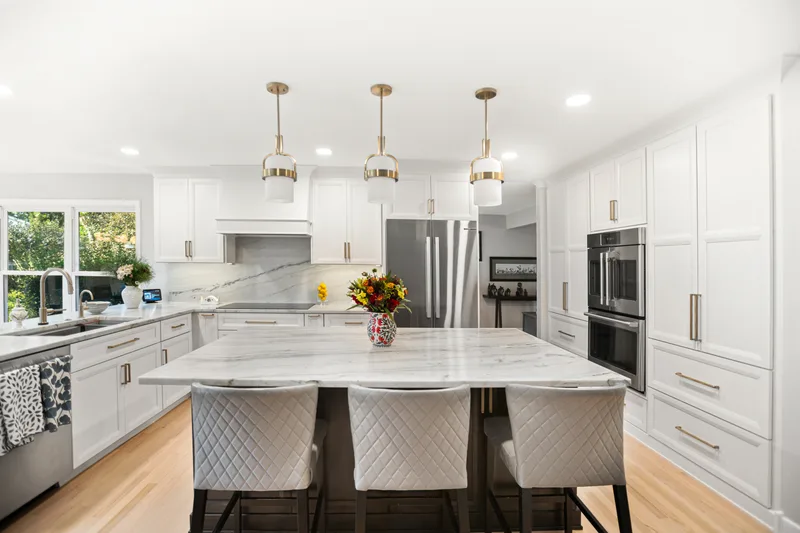
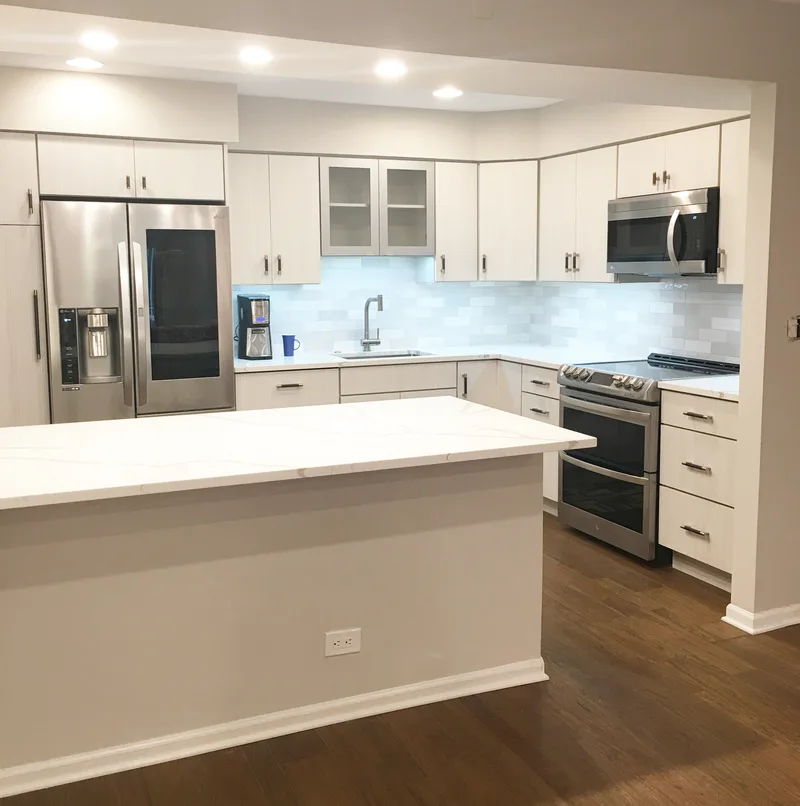
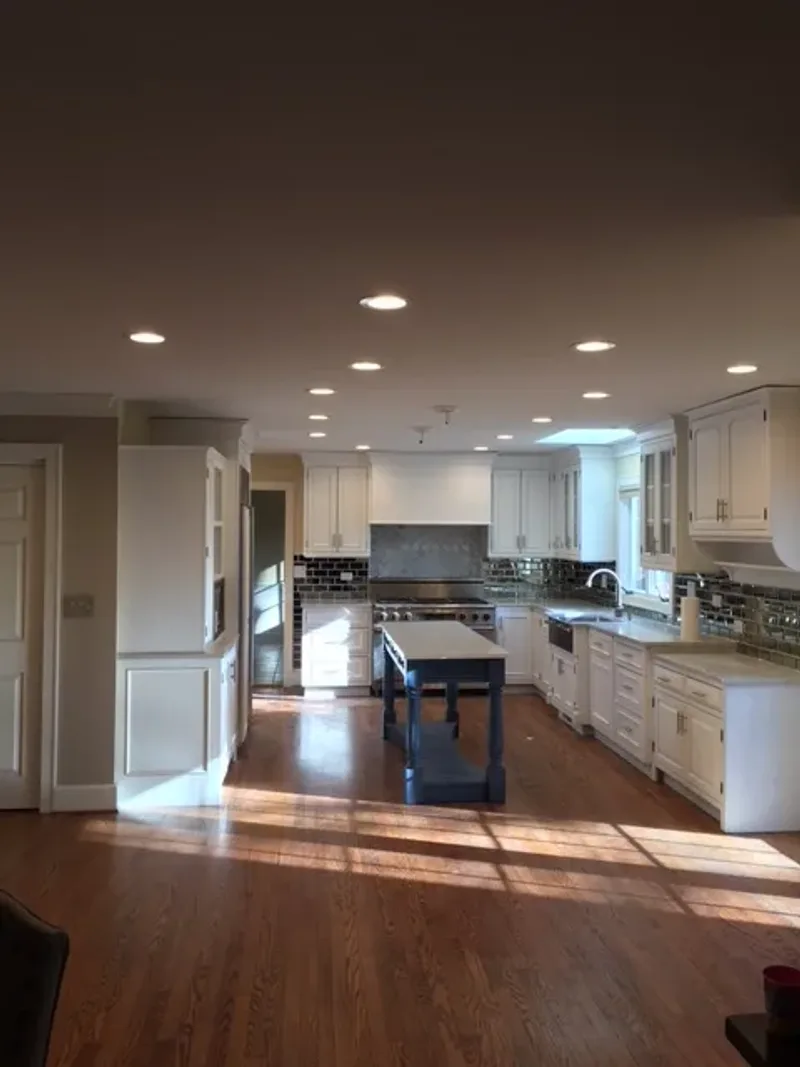
Calacatta-style veined surfaces are among the most requested on North Shore kitchen remodels precisely because they replicate the movement of calacatta marble - dramatic white-on-white veining with occasional gold or gray notes - without marble's porosity, sealing requirements, or etching sensitivity. The Lake Forest two-island estate kitchen uses calacatta-style quartz throughout both islands and all perimeter countertops. The Lake Bluff cottage kitchen uses a calacatta quartz waterfall on the oak-base island as the primary visual element. Both are surfaces that would require significantly more maintenance if executed in actual stone.
Warm neutral tones - warm taupes, muted greens, soft sands - provide neutrality without the clinical quality of pure white. These work particularly well in kitchens with wood cabinetry, where a warm-toned countertop coordinates with the wood tone rather than competing with it.
Bold colors - deep charcoal, navy, hunter green, terracotta, rust - function as statement surfaces when cabinets are neutral. A dark island with a lighter perimeter counter is a high-contrast approach that reads as a deliberate design choice. For reference: the Lake Bluff Navy + Zellige kitchen pairs white inset perimeter cabinetry with a fluted navy island and calacatta quartz waterfall. The island color does the statement work; the countertop surface remains consistent throughout.
Concrete-look surfaces reproduce the texture and color of poured concrete without concrete's porosity, tendency to crack over time, and sealing requirements. These suit industrial and contemporary kitchens and pair well with flat-front cabinetry and exposed metal.
Patterns and Textures Beyond Color
Pattern and texture are separate decisions from color, and they are often underweighted in early selections.
Subtle speckle patterns - small aggregate variations distributed across the surface - add visual depth without the directional quality of veining. At distance these read as nearly neutral; up close they have more character than a pure solid color. This is a useful middle path for kitchens where veining feels too active but solid color feels too flat.
Texture varies significantly across quartz products. Polished quartz has a high sheen that reflects light well and suits kitchens with strong task lighting and pendant fixtures over an island. It shows fingerprints and water spots more readily. Honed (matte) surfaces read as more understated, suit a broader range of kitchen styles, and are more forgiving in daily use. Some manufacturers produce lightly textured surfaces that replicate the feel of brushed stone - worth considering for kitchens where the countertop surface is the primary tactile surface (seating at the island, for instance).
Edge Profiles: A Decision That Cannot Be Made After Fabrication
The edge profile is the shape given to the countertop's exposed edges. It affects the visual weight and character of the surface more than most homeowners expect when they first see it in a sample. It also cannot be changed after the slab is cut - this decision belongs in the design phase, not as an afterthought.
Eased edge - a simple right angle with a slight chamfer - is the most common contemporary choice. Clean and minimal. Works across most kitchen styles.
Beveled edge - a 45-degree cut on the top face - adds a subtle visual detail that suits modern and transitional kitchens without the sharpness of a fully square edge.
Bullnose - fully rounded edge - is a classic, comfortable profile. Common in traditional and transitional kitchens. The softer geometry works well in older North Shore homes where hard-edged contemporary profiles would look out of place against original millwork. Tudor and Georgian estate kitchens in Winnetka's Hubbard Woods and Indian Hill neighborhoods, built primarily in the 1920s-1940s, almost uniformly have rounded or profiled edge details on original millwork; a bullnose or ogee countertop edge reads as part of the same period language where a hard mitered edge would not.
Ogee - an S-shaped ornate profile - is associated with formal traditional design. Less common in contemporary work.
Mitered edge - two pieces of quartz joined at 45 degrees to create a continuous surface that extends vertically down the face - creates the appearance of a thick, substantial slab without the weight or cost of actual thick stone. Well-suited to contemporary kitchens where the island reads as a furniture piece.
Waterfall edge - the countertop continues vertically to the floor on one or both ends of an island - is a dramatic application that uses a significant amount of material. It works best with a veined or distinctive surface because the pattern continuity from horizontal to vertical is the visual point. For a plain or near-solid surface, a waterfall edge can look like an expensive way to get a blank panel.
Coordinating With Cabinets, Backsplash, and Hardware
Quartz selection does not happen in isolation. The surface has to work with cabinetry color and style, backsplash, flooring, and hardware finishes. This coordination is where selections most often go wrong when they are made in sequence rather than together.
Dark cabinets with light countertops - or light cabinets with dark countertops - create visual contrast that reads as intentional. Both work; the choice is which element carries the room.
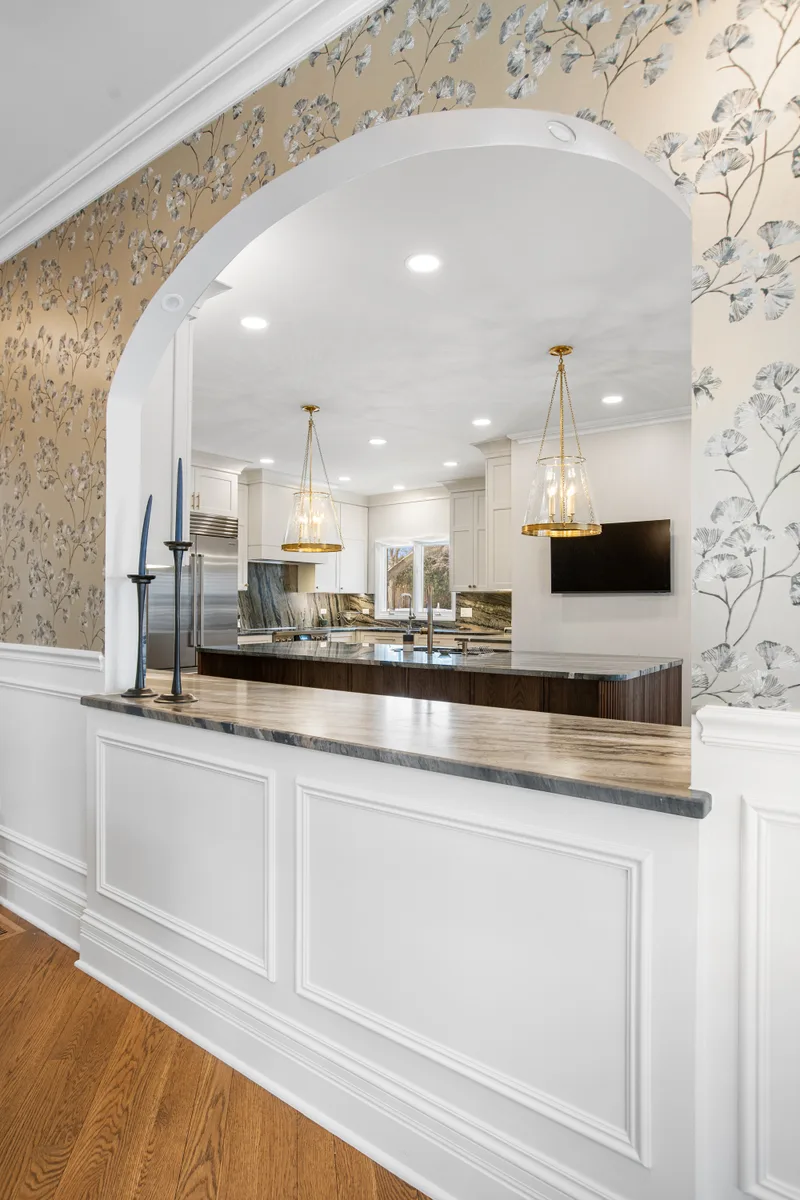
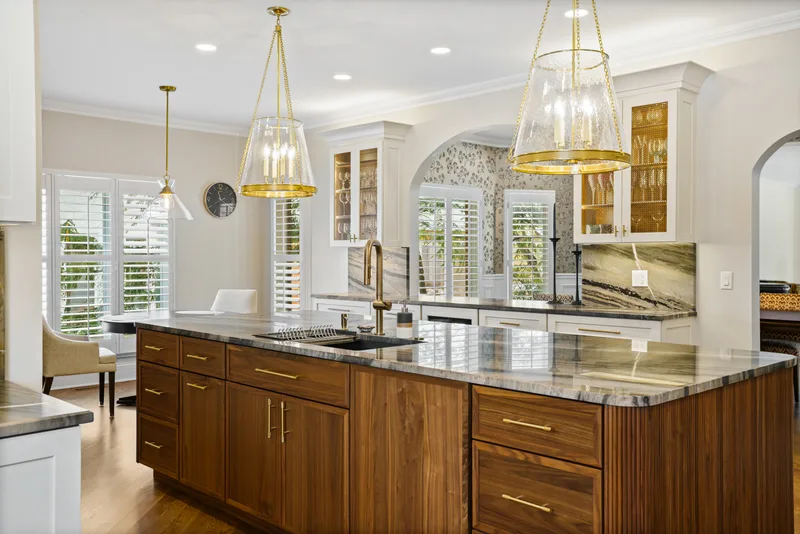
Wood-tone cabinetry (maple, oak, walnut) coordinates better with warm-toned countertops. Warm beige, taupe, or veined surfaces with warm undertones read as part of the same palette. Cool white or blue-gray quartz tends to look mismatched against warm wood, the same way a cool-white trim reads slightly off on an oak-framed window. The walnut-island Lake Forest kitchen pairs dark stone counters with the walnut millwork specifically because the warm tones of the wood and stone are in the same register. If you're also considering updating cabinet doors or hardware, our kitchen cabinet remodel ideas covers the options.
Pre-war Kenilworth and Glencoe kitchens with surviving original oak or walnut built-ins present a specific coordination challenge: the original woodwork developed patina over decades, and new countertop surfaces in the same warm family may read as slightly too fresh. Selecting a countertop surface with some tonal variation - a subtly veined warm quartz rather than a uniform solid - helps bridge the visual gap between original aged millwork and new fabricated surfaces.
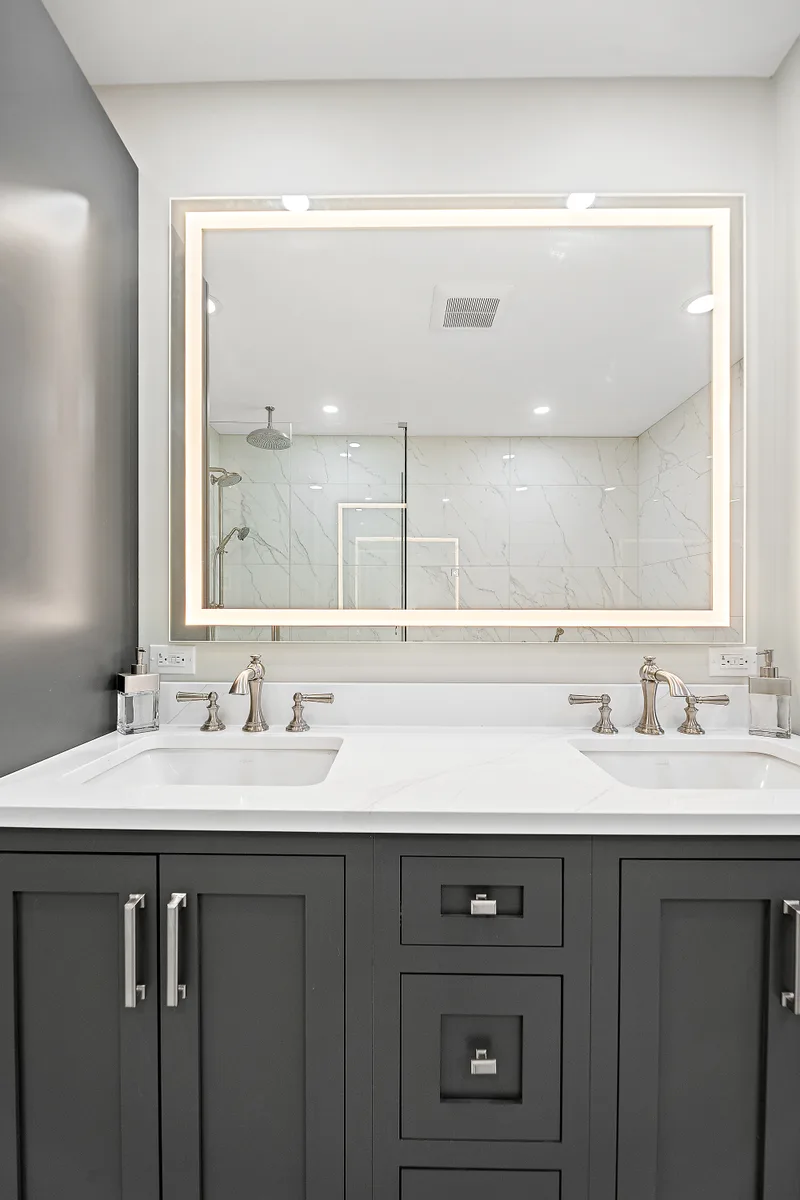
Backsplash material should be selected after the countertop is chosen, not before. If the quartz surface has strong movement or veining, a simpler backsplash - subway tile, large-format minimal tile - lets the counter read clearly. If the countertop is subdued, a more active backsplash tile adds visual interest at the wall line without competing with an already busy surface. For bathroom applications, our bathroom tile guide covers surface coordination in wet areas.
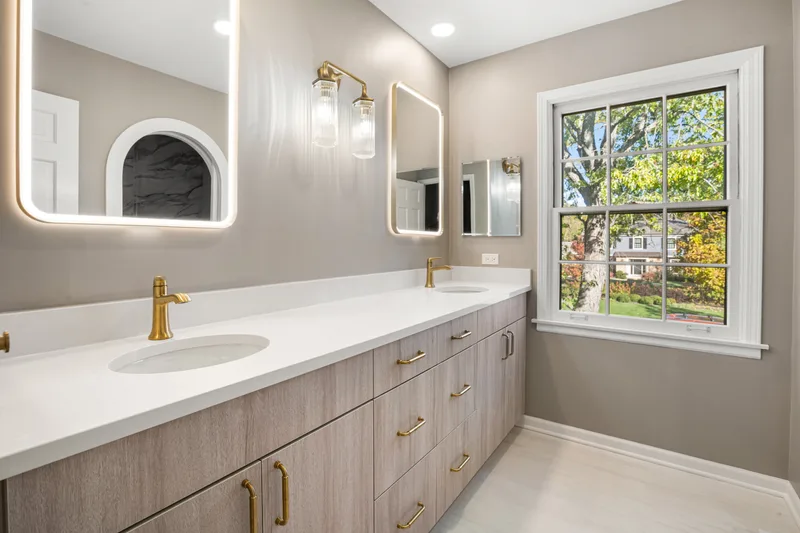
Hardware finishes tie the surfaces together. Brass and warm gold hardware works with warm-toned quartz and wood cabinetry - brushed brass gooseneck faucets are a consistent element across multiple Delta kitchen projects for exactly this reason. Matte black suits cooler, bolder surfaces. Brushed nickel and polished chrome read neutrally across most kitchen color directions.
Countertop Sequencing on the North Shore
On the North Shore, the quartz countertop schedule is rarely just a fabrication question - it is a permit and cabinet question first.
In Wilmette, where much of the Colonial Revival and Tudor housing stock dates to the 1920s-1950s, a kitchen remodel that opens walls or relocates plumbing requires a permit from the Village's Community Development Department and may trigger Appearance Review Commission consideration if any exterior-facing changes are involved. That review step can add time before construction begins, and semi-custom cabinetry already runs four to six weeks lead time - custom cabinetry in pre-war Wilmette kitchens can run ten to sixteen weeks. Quartz templating cannot happen until cabinets are fully installed. The sequencing is fixed: permits first, cabinets second, template third, fabrication two to four weeks after that. Getting any step out of order adds weeks.
In Winnetka, Georgian and Tudor estate kitchens commonly retain original butler's pantries and separate breakfast rooms, so the countertop scope is often larger than a single kitchen run - main island, secondary prep counter, and breakfast room surfaces can each require separate template measurements. The relevant early constraint is matching door profiles and wood species for any new millwork adjacent to the countertop, a specification decision that must happen before cabinetry is ordered, weeks before templating.
Selecting the countertop surface and edge profile before cabinetry is ordered is the right sequence. Once cabinets are on lead time, the countertop decision has a countdown clock on it.
If you're planning a kitchen or bathroom remodel and want to work through countertop options with a contractor who knows what holds up in daily use, contact Delta Remodels. We serve the North Shore including Lake Forest, Highland Park, Northbrook, and Winnetka. See our kitchen remodeling page or bathroom remodeling page for full scope and planning details.
Frequently asked questions
What is the difference between quartz and quartzite countertops?
Quartz countertops are engineered stone: ground quartz aggregate bound with resin and pigment. Quartzite is a natural metamorphic rock that is quarried and cut into slabs like granite or marble. Quartz is non-porous and does not require sealing. Quartzite is a natural stone that is harder than marble and requires periodic sealing to prevent staining. The two are frequently confused because the names are similar.
Can quartz countertops be damaged by heat?
Yes. The resin binder in engineered quartz is not heat-resistant the way granite is. Direct contact from a hot pan or baking sheet can discolor or crack the surface. Using trivets and hot pads is standard practice with quartz countertops.
What quartz edge profile works best for a contemporary kitchen?
An eased edge (simple right angle with a slight chamfer) is the most common choice for contemporary kitchens because it is clean and minimal. Mitered edges, where two pieces join at 45 degrees to create a continuous vertical face, produce a thick-slab look that suits modern design without the cost of genuinely thick stone. Waterfall edges on islands are a more dramatic option that uses significant material and works best with surfaces that have strong veining or pattern.
How do you coordinate quartz color with cabinet finish in older North Shore homes?
Wood-tone cabinets (common in pre-war North Shore kitchens with original oak or walnut millwork) pair best with warm-toned countertops. Warm beige, taupe, or veined quartz with warm undertones coordinates better than cool whites or blue-grays, which tend to compete with the warmth of the wood. For painted cabinetry - white perimeter with a contrasting island is one of the most common configurations on the North Shore - either warm or cool quartz tones work. Select the backsplash after the countertop is chosen.
Ready to Start Your Project?
Schedule a free consultation. We bring design ideas, material samples, and honest answers.
Get Free Consultation