



Accessible Bathroom Remodel Cost in North Shore (2026)
On this page
- Why These Bathrooms Cost What They Cost
- What $35,000 to $50,000 Buys: The Aging-in-Place Safety Upgrade
- What $50,000 to $70,000 Buys: The Integrated Universal Design Bathroom
- What $70,000 to $90,000 Buys: Full Universal Design with Custom Materials
- The Aging-in-Place Angle: What Changes in the Design Conversation
- Financial Assistance Programs
- How to Plan an Accessible or Aging-in-Place Bathroom on the North Shore
- Working with Delta Remodels
The cost of an accessible bathroom remodel in North Shore can range from basic safety upgrades to complete wheelchair-friendly renovations. In this guide, we'll break down 2026 pricing for accessible showers, grab bars, wider doorways, comfort-height fixtures, and full aging-in-place bathroom remodels so homeowners can budget accurately before starting their project.
The planning difference between a standard bathroom remodel and an accessible one is mostly about the pre-tile sequence. Before tile is set in an accessible bathroom, the walls need blocking that can carry 250 lbs in any direction, the subfloor may need structural modification for a curbless entry, the turning radius has been confirmed against the fixture layout, and the doorway width has been verified. Those decisions cost very little when made at design stage. They cost a great deal when made after walls are closed.
An accessible or aging-in-place bathroom remodel on Chicago's North Shore typically costs between $35,000 and $90,000 in 2026, with most full primary accessible bathroom projects landing between $50,000 and $75,000. The national baseline average of approximately $8,400 reflects a range that includes grab-bar-only retrofits in newer homes with no structural complications. On the North Shore, pre-war structural conditions, permit requirements, and regional labor rates move the number substantially higher for full conversion work. See our accessible bathroom remodeling services for the design-build scope.
Why These Bathrooms Cost What They Cost
A standard bathroom remodel solves layout, finish, and function problems. An accessible bathroom solves those plus a different set: shower entry without stepping over a curb, grab bar support that does not require post-installation wall repair, clear floor space for a walker or wheelchair, lever-handle fixtures, comfort-height toilet, slip-resistant flooring, lighting for older eyes, and storage at reachable heights.
The cost difference on materials and trade work between a standard bathroom and an accessible bathroom at the same finish level is often 5-10% of total budget. What changes is the planning depth. An accessible bathroom requires design thinking about how the room will be used in 5, 10, and 20 years - not just what looks good at move-in.
Pre-war North Shore homes add structural factors. Most pre-1940 bathroom doors measure 28-30 inches; widening to 32-36 inches clear may involve a load-bearing header in homes with balloon framing, common in Kenilworth (platted 1889-1890s), Wilmette (predominantly 1920s-1950s), Winnetka (1890s-1920s), and Glencoe. Galvanized supply pipes and cast-iron drain lines in these homes typically benefit from replacement when walls are opened - the right time to address them, but a real cost factor.
Doorway widening in pre-1940 homes. Most pre-war North Shore bathrooms have doors measuring 28-30 inches. Reaching 32 inches of clear width in a standard non-load-bearing partition runs $600-$2,000. In balloon-framed homes, common throughout Winnetka, Kenilworth, and Wilmette, framing requires structural review before any wall modification. Non-load-bearing doorway widening in a standard post-war home runs $600-$2,000; balloon-framed homes often require engineer review and can run higher.
Curbless shower subfloor work. A true zero-threshold shower entry requires the subfloor to be recessed roughly 1.5-4 inches depending on the drain system, per the drain-type specifics covered in our curbless shower conversion guide. In pre-war homes with wood-frame subfloors and floor joists not sized for that recess, structural review and joist modification are standard steps.
Galvanized supply and cast-iron drains. In homes with pre-1930 lead service lines, corroded galvanized pipe traps and can release lead particles when disturbed, per the EPA. When walls are opened for accessible bathroom work in pre-war homes, plumbing replacement at that location is typically the right call.
What $35,000 to $50,000 Buys: The Aging-in-Place Safety Upgrade
This tier covers retrofitting an existing bathroom to support aging-in-place without a full gut renovation. Best suited to homeowners who want safety improvements without rebuilding the entire bathroom - the layout works, but the fixtures, surfaces, and safety features do not.
What this budget includes:
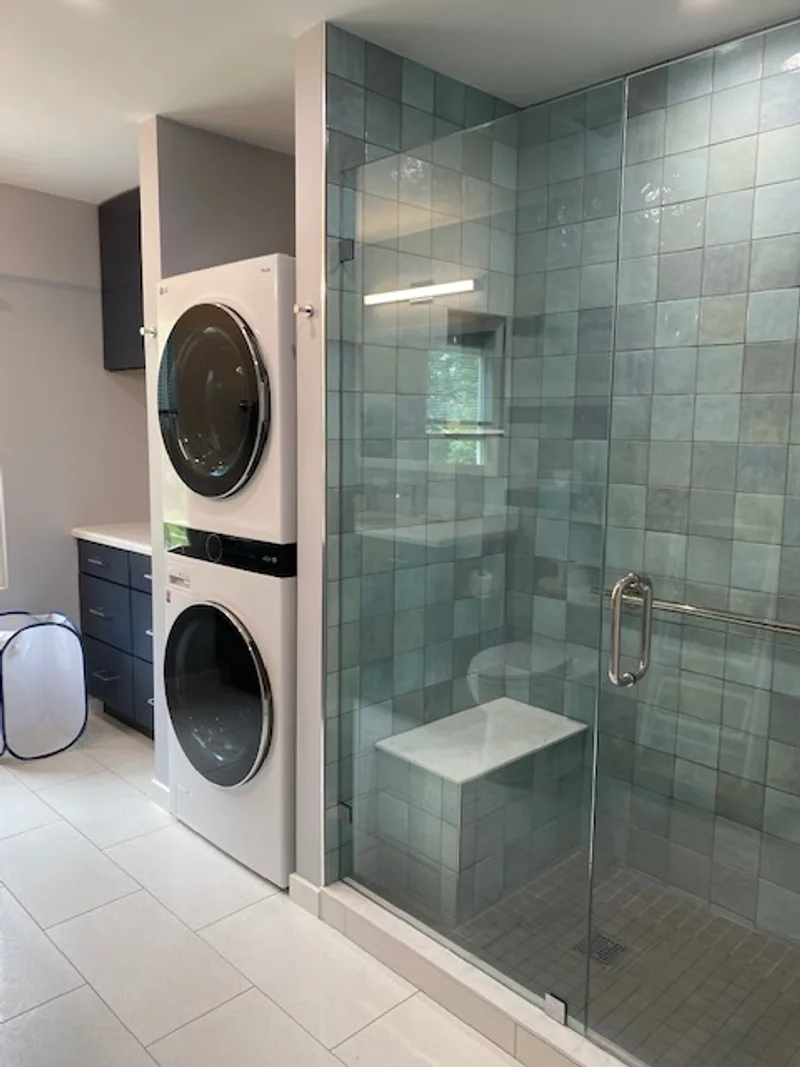
- Conversion of tub to walk-in shower or low-curb shower
- Frameless glass shower door
- Reinforced 2x10 wall blocking for current and future grab bars throughout
- Comfort-height toilet at 17-19 inches per ADA 2010 Standards
- Lever-handle faucets
- Slip-resistant flooring: textured porcelain with DCOF 0.42 or higher per ANSI A326.3, honed stone, or vinyl plank
- Improved task lighting at vanity and shower
- Handheld showerhead on a slide bar (18-72 inches adjustable range)
- Updated vanity with accessible storage layout
What this budget does not include:
- Full layout reconfiguration or wall removal
- True curbless (zero-threshold) shower entry, which often requires structural subfloor work
- Roll-under vanity with knee clearance for wheelchair access
- High-end tile or natural stone
- Heated floors
This is the right starting point when the existing bathroom layout works but needs safety and function upgrades.
What $50,000 to $70,000 Buys: The Integrated Universal Design Bathroom
This range covers a full bathroom remodel where accessibility is designed in from the start rather than retrofitted later. Most North Shore aging-in-place projects land here.
What this budget includes:
- True curbless (zero-threshold) shower with linear drain; subfloor modified to accommodate proper slope
- Frameless glass shower enclosure with no step
- Reinforced 2x10 wall blocking throughout for grab bars and shower seats
- Comfort-height toilet with bidet option
- Roll-under or accessible vanity with minimum 27-inch knee clearance per ANSI A117.1
- Full layout reconfigured for 60-inch turning radius
- Slip-resistant tile flooring (DCOF 0.42 or higher for wet areas per ANSI A326.3)
- Layered lighting: vanity, ambient, accent, night lighting
- Lever-handle fixtures
- Built-in shower seat at 17-19 inches, solid tile construction
- Heated tile floor
Representative projects at this tier (illustrative scope examples):
- A ranch-era primary bathroom reconfigured for aging-in-place, where the layout had adequate square footage but doorways too narrow for walker or wheelchair access
- A 1950s Colonial primary bath with full curbless conversion, requiring doorway widening through a non-load-bearing partition
- A mid-century hall bath supporting multigenerational living, where existing plumbing rough-ins simplified the layout reconfiguration
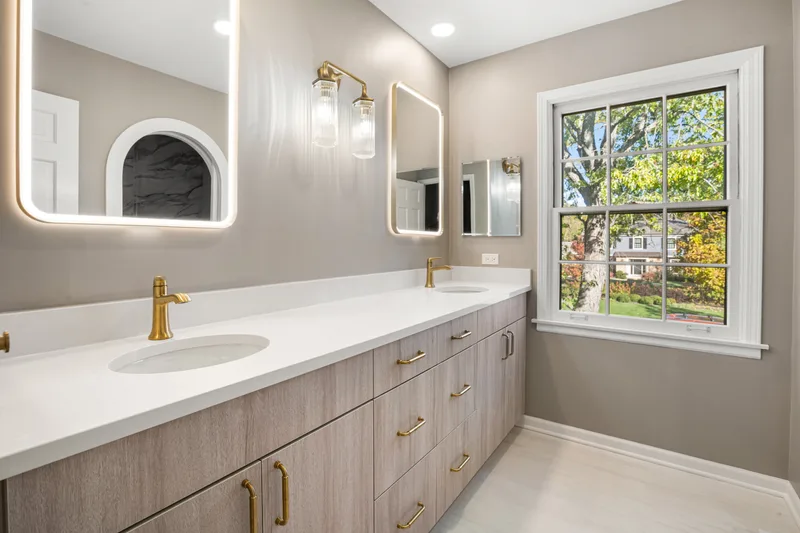
This is where the work becomes invisible. The features supporting accessibility look like considered design choices, not medical accommodations.
What $70,000 to $90,000 Buys: Full Universal Design with Custom Materials
This tier covers natural stone, slab walls, and custom-tier materials, full layout reconfiguration, and detailed design integration. Lake Forest, Winnetka, and Highland Park primary bathrooms designed around a 20-year aging plan typically land here.
What this budget includes:
- Custom vanity with full knee clearance and accessible drawer pulls
- Natural stone and high-grade tile: honed marble, slab stone walls, mosaic insets
- Curbless shower with bench, multiple showerheads, handheld, body sprays
- Steam shower with accessible controls (steam generator requires a 240V circuit planned at design stage)
- Heated floors with programmable zones
- Smart lighting with motion sensors and night-mode
- Custom millwork including linen storage at reachable heights
- Window or skylight for natural light
Representative projects at this tier (illustrative scope examples):
- A pre-war estate primary bath designed around a 20-year aging plan, where historic district design-review considerations shaped exterior window additions
- A primary bath with adjacent dressing area renovation in a Ravinia-area Colonial, where ravine-lot drainage planning was part of the scope
The Aging-in-Place Angle: What Changes in the Design Conversation
"Aging-in-place" and "accessible" describe overlapping goals, but they center them differently. Aging-in-place design is explicitly future-oriented: the question is how this bathroom will serve its users at 70, 75, 80 - not just today. That orientation changes which decisions get prioritized at design stage.
For a Winnetka or Kenilworth home built in the 1920s, the aging-in-place conversation typically addresses:
Plaster walls. Pre-war Winnetka and Kenilworth bathrooms commonly have plaster-and-lath walls rather than drywall. Plaster requires different techniques for securing new wall blocking. Opening these walls is the right time to install 2x10 blocking throughout - everywhere bars might eventually go, not just where they are needed now.
Horsehair binder and potential asbestos. Pre-1920 plaster used horsehair binders with no asbestos risk. Plaster from the 1920s through 1970s may contain asbestos in the joint compound; testing before demolition is the appropriate step in any pre-war bathroom.
Balloon framing throughout. Studs that run full height from sill to roof, without the mid-story plate of platform framing, act as open fire channels when walls are modified. Fire blocking must be added when balloon-frame walls are opened.
Original window heights. Grab bar installation at 33-36 inches AFF is standard per ADA 2010 Standards. In pre-war bathrooms with low windows or original tile wainscoting, the grab-bar layout requires more planning than in a generic bathroom.
The key design principle for a 20-year aging plan: install 2x10 blocking everywhere bars might eventually go during the remodel, not just where they are needed today. The cost during a remodel is minimal. The cost of retrofitting blocking after tile is set is substantial - it requires demolishing the tile surround, installing blocking, retiling, and matching grout.
For grab-bar blocking specifics, including cost and installation sequence, see our grab bar installation guide.
Financial Assistance Programs
The following programs may apply to accessible bathroom remodeling costs. These figures and program details change annually. Confirm current eligibility directly with each program before relying on any figure.
VA Housing Grants (veterans with service-connected disabilities):
- Specially Adapted Housing (SAH) grant: FY2026 maximum approximately $126,526
- Special Home Adaptation (SHA) grant: FY2026 maximum approximately $25,350
- Home Improvement and Structural Alteration (HISA) grant: up to $6,800 (service-connected) or $2,000 (non-service-connected); HISA is administered separately through VA health care, not through SAH/SHA
- Verify current figures and eligibility at va.gov/housing-assistance/disability-housing-grants/
Medicare:
- Original Medicare does not cover structural home modifications.
- Some Medicare Advantage (Part C) plans have covered grab bars and ramps as a supplemental benefit since 2019, but this is entirely plan-specific. There is no universal benefit amount. Check your specific plan documents and consult Medicare Interactive (medicareinteractive.org) or your plan's supplemental benefits summary.
Illinois Medicaid HCBS Waivers:
- Illinois Medicaid waiver programs may cover some home accessibility services. Which specific waiver covers structural modifications varies. Contact the Illinois Department on Aging for current information. Not an entitlement; waiting lists are common.
Illinois IHDA Home Repair and Accessibility Program:
- Up to $50,000 per household for income-qualified applicants under 80% AMI
- Demand far exceeds funding; confirm current availability directly with IHDA
Medical Expense Tax Deduction:
- If a physician documents the renovation as medically necessary for a specific condition, portions may qualify for medical expense deductions. Consult your tax advisor.
We are not tax or insurance advisors. We coordinate with your team if any portion of the project may qualify for assistance.
How to Plan an Accessible or Aging-in-Place Bathroom on the North Shore
- Think in 20-year timeframes. The bathroom you build today should support how you will use it at 75, 80, 85.
- Measure every existing door for clear width before finalizing scope. A doorway that needs widening is a structural question, not a finish question, and it needs to be on the permit drawings.
- Confirm subfloor condition under the existing tub before committing to a curbless shower detail. Discovery of rot or prior structural modification changes the scope.
- Install 2x10 wall blocking everywhere grab bars might eventually go. Do this during the remodel. Not where bars are needed now - everywhere they might eventually go.
- Test for asbestos in pre-1980 tile, mastic, and joint compound before demolition begins. This is non-negotiable.
- Confirm the turning-radius requirement against the existing floor plan before selecting fixtures. A 60-inch turning circle must be verified, not assumed.
- Make accessibility invisible. A curbless shower with slab marble looks like a design choice. A grab bar that matches the towel bar is a design element. That integration is the goal.
Working with Delta Remodels
Delta Remodels has completed 500+ residential remodeling projects across the North Shore since 1987, including accessible and aging-in-place bathrooms. Our designers approach accessibility as a residential design problem first. The result is bathrooms that look like the rest of the home and function for decades.
Schedule a free in-home consultation or call (847) 847-4148. If you are deciding between a full accessible design and a standard remodel with selected accessibility features, our accessible vs. standard remodel comparison covers the cost and design differences. For technical background on the design standards involved, see our accessible bathroom design guide.
Looking for a personalized estimate? Visit our Accessible Bathroom Remodeling service page to request a consultation and receive a detailed project quote.
Frequently asked questions
How much does an accessible bathroom remodel cost on the North Shore in 2026?
Accessible bathroom remodels on the North Shore typically range from $35,000 for an aging-in-place safety upgrade to $90,000 or more for a full accessible primary bathroom with curbless shower, roll-under vanity, and universal design throughout. Most projects in Lake Forest, Highland Park, and Winnetka land between $50,000 and $75,000 because owners want accessibility integrated into a bathroom that reads as residential design rather than a clinical retrofit. The national accessible bathroom average of approximately $8,400 reflects grab-bar-only retrofits in homes without structural complications, not full gut conversions in pre-war housing stock.
What does aging-in-place mean for a bathroom remodel?
Aging-in-place means designing a bathroom that supports independent use through changes in mobility, vision, and balance over time. Practically, that includes a curbless or zero-threshold shower entry, reinforced grab-bar blocking in walls to withstand 250 lbs of force in any direction per ADA 2010 Standards, comfort-height toilet at 17-19 inches versus standard 14-16, lever-handle faucets, slip-resistant flooring with DCOF 0.42 or higher per ANSI A326.3 for wet areas, adequate clear floor space for a 60-inch turning radius, accessible storage, and lighting designed for older eyes. The best aging-in-place bathrooms do not look clinical because the accessible features are designed in from the start.
What is the difference between ADA-compliant and aging-in-place design?
ADA refers to the Americans with Disabilities Act, which legally applies to commercial and public accommodations, not private residences. ADA 2010 Standards are useful dimensional references but residential bathrooms are not legally required to meet them. Aging-in-place and universal design use ADA-informed dimensions adapted for residential use, producing livable bathrooms that still support wheelchair access, walker access, and assistive devices.
What does a curbless shower conversion cost on the North Shore?
Curbless shower conversions on the North Shore typically run $15,000 to $35,000 as a standalone project, depending on whether the floor structure can support proper sloping without structural modification, whether the existing drain location works with a linear drain, and what tile and glass are selected. Pre-war North Shore homes with wood-frame subfloors - common in Kenilworth, Winnetka, and Wilmette - usually require structural review and subfloor modification to achieve a true zero-threshold entry.
Will an accessible bathroom hurt my home value?
A well-designed accessible bathroom does not hurt resale value and often supports it. The North Shore buyer profile increasingly values universal-design features for aging-in-place and multigenerational living. Curbless showers, comfort-height toilets, and reinforced walls have become standard in full-scope North Shore remodels regardless of whether anyone currently needs accessibility. The bathrooms that affect resale negatively are afterthought retrofits that look clinical rather than features designed into the room from the start.
Ready to Start Your Project?
Schedule a free consultation. We bring design ideas, material samples, and honest answers.
Get Free Consultation