





Grab Bar Installation Cost and Blocking Requirements: What Chicago-Area Homes Need
On this page
The gap between a grab bar installed correctly and one installed incorrectly is not visible after the work is done. Both look like a bar mounted to the wall. The difference shows up when someone grabs it to stop a fall, and it either holds or it does not.
The ADA 2010 Standards, Section 609.8 require grab bars and their mounting hardware to withstand 250 lbs of force applied in any direction. That is the load of a person using the bar to stop a fall, not just to steady balance. Standard drywall, tile over drywall, and even tile over cement board will not distribute that load to the framing reliably. What distributes it reliably is a 2x10 blocking panel installed flush between studs before the wall surface and tile are applied.
That blocking panel is the reason a proper grab bar installation during a bathroom remodel costs more than a handyman can charge to drill and toggle-bolt a bar into the same wall.
Why Standard Drywall Cannot Support 250 Lbs in Any Direction
A grab bar mounted with toggle bolts into standard 5/8-inch drywall spreads the load across a few square inches of surface that has no structural connection to the framing behind it. Under a sudden 250-lb load applied at an angle, the toggle pulls through the drywall, the bar fails, and the person goes down.
A grab bar anchored into a single stud does better, but depends on the stud being at exactly the right location for every bar position, which is rarely the case given the standard 16-inch-on-center spacing and the dimensional requirements for grab bar placement.
A 2x10 blocking panel installed horizontally between studs at the correct height provides full-wall coverage across the blocking zone. Any mounting point within that zone is solidly attached to the framing and can support the 250-lb test load in any direction. The result is a bar that is safe and a wall that can accept bar repositioning, additional bars, or a folding shower seat in the future without opening the tile.
The Northbrook Housing Context
Northbrook's housing stock is built primarily from the 1950s through 1980s, with ranch homes, split-levels, and colonials across Mission Hills, Northbrook Trails, and the Techny Road corridor. The most common bathroom configuration is a standard 5-foot-by-8-foot layout with a fiberglass tub and shower surround.
That fiberglass surround is the condition that creates the most challenges for grab-bar retrofits. Fiberglass surrounds have no framing behind them at the tub deck; they are continuous panels held at the perimeter. Anchoring a grab bar into fiberglass requires specialty core-drill anchors rated for the 250-lb load in that substrate. Those anchors are available and are the right solution for a bathroom that is otherwise in good condition and not due for remodeling. But they are more involved than drilling into a blocking panel, and the fiberglass surface around the anchor must be intact and undamaged to hold the load reliably.
For Northbrook homes in the 1960s-1980s construction window, a tub/shower combination with a fiberglass surround also falls within the era when galvanized supply pipes were transitioning to copper. If the galvanized supply is still in service, the arrival of a grab-bar project is a reasonable opportunity to assess that system. Galvanized pipe degrades from the inside out over a 40-50 year span, progressively narrowing the internal diameter and eventually producing reduced water pressure and rust-tinged water at first draw.
The Village of Northbrook Development and Planning Services Department requires licensed trade contractors to hold Village-issued licenses before pulling a permit. Any work that involves opening the wall for blocking installation and includes plumbing or electrical changes will need contractors with those Village-specific licenses.
What Proper Blocking Installation Involves During a Remodel
During any bathroom remodel that opens the walls, the correct sequence for grab-bar blocking is:
1. Map the bar positions before framing begins. Standard positions per ADA 2010 Standards include back-wall horizontal bars at 33-36 inches AFF in the shower, side-wall horizontal bars at 33-36 inches, vertical entry-grab bars at the shower opening, and toilet-side bars at 33-36 inches. Mark all of these before the framer frames out the blocking, not after.
2. Frame 2x10 blocking horizontally between studs at the correct height for each bar zone. The blocking sits flush with the face of the studs so the wall surface lands flush against it.
3. Consider full blocking panels in the entire shower and toilet zones, not just at bar positions. This allows future repositioning of bars without opening tile.
4. Install wall substrate over the blocking, typically cement board or waterproofing membrane in wet areas.
5. Tile over the blocking exactly as the rest of the wall is tiled. The bar positions are not visible.
6. Install bars after tile and grout have cured. Anchors go into the blocking panel for the full 250-lb-rated connection.
The framing labor for blocking during a remodel is typically a few hundred dollars. Retrofitting blocking after tile requires demolishing the tile in the area, adding the blocking, retiling, and matching grout to the existing. In pre-war bathrooms with original tile, matching the grout and tile is often impossible.
Costs in 2026: What Grab Bar Work Runs in the Chicago Area
The cost range depends heavily on whether blocking exists and whether tile demolition is required.
New installation during a bathroom remodel: Grab bars typically add $300-$800 to the scope of a remodel that already includes wall blocking, depending on bar count, material, and placement complexity. This is the lowest-cost scenario because blocking is being installed anyway.
Retrofit into an existing bathroom with studs accessible: When stud locations coincide with bar placement requirements, direct stud anchoring is possible. $150-$400 per bar installed by a licensed contractor.
Retrofit into fiberglass surround: Specialty core-drill anchors for fiberglass runs $200-$600 per bar depending on surround condition and contractor.
Retrofit requiring tile demolition and blocking: When blocking does not exist and the tile condition does not allow core-drilling to the required standard, opening the wall to add blocking, then retiling, runs $1,500-$4,000 per wall zone depending on tile selection. If the goal is a full set of bars throughout a bathroom, this approaches the cost of a partial bathroom renovation.
Doorway widening for wheelchair or walker clearance - another common accessible modification - runs roughly $700-$2,500 per doorway, placing it in the same cost tier as a wall-opening grab-bar retrofit.
Grab Bars That Match the Bathroom Design
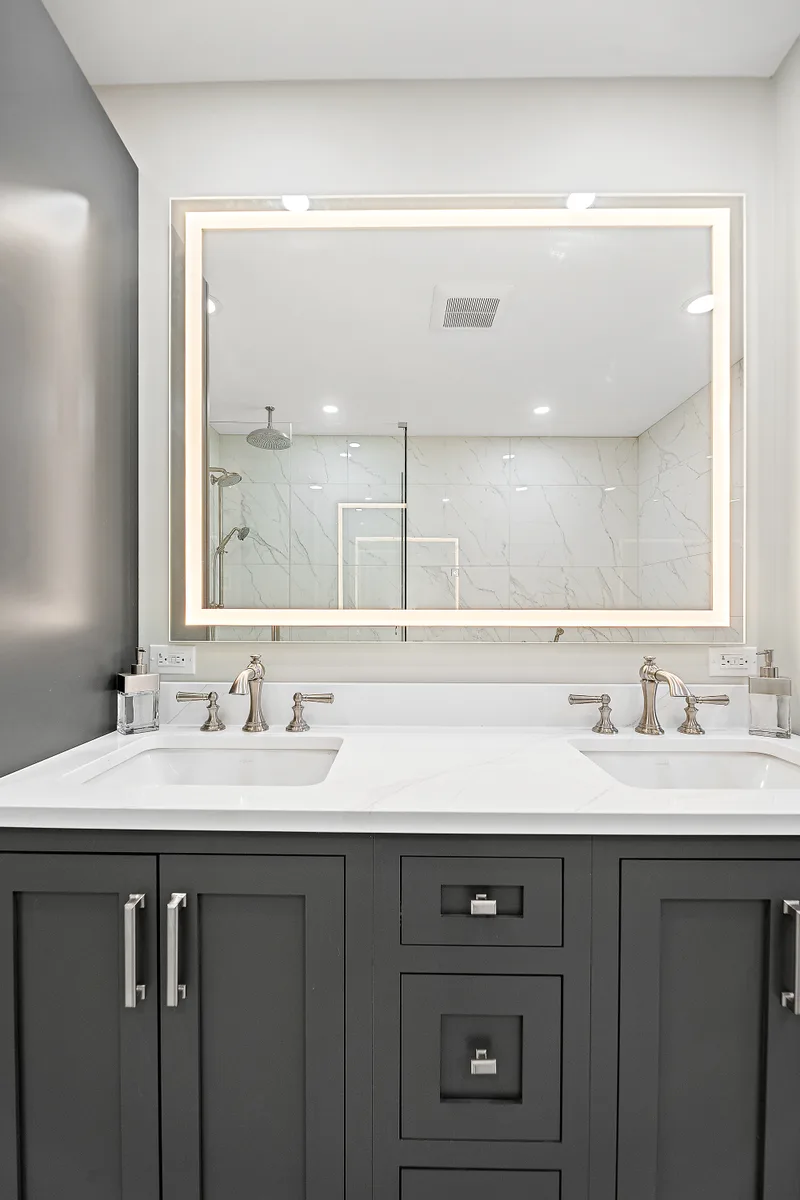
The clinical look that some homeowners associate with grab bars comes from institutional chrome bars installed without matching surrounding hardware. Contemporary grab bars are available from Moen, Delta, Kohler, and specialty manufacturers in every finish that matches towel bars, toilet paper holders, and shower accessories. A brushed nickel grab bar in the same finish family as the other hardware reads as a design element rather than a medical accommodation.
This is worth noting because a primary bathroom designed for aging-in-place in Lake Forest, Winnetka, or Northbrook should not look different from any other well-finished bathroom. The structural work is invisible after tile is set. The bar is a design choice. Those two facts together mean that an accessible bathroom in a North Shore home can be indistinguishable from a standard primary bath.
Planning Accessible Modifications in Northbrook
For Northbrook homeowners considering grab bars as part of a broader aging-in-place plan, the most efficient sequence is to assess the bathroom's overall condition first. If the surround, flooring, or vanity is due for replacement in the next several years, adding blocking during that project eliminates the retrofit problem entirely.
If the bathroom is otherwise in good condition and the need is immediate, core-drill anchors into a sound fiberglass surround are a reliable solution. The Village of Northbrook permit requirements apply to plumbing, electrical, and structural work; grab-bar installation alone typically does not require a permit, but any associated wall work or plumbing changes do.
For help planning the full accessible bathroom scope, see our accessible bathroom services page. For Northbrook-specific service area information, see our Northbrook accessible bathroom service page. For the design standards behind aging-in-place work, see our accessible bathroom design guide.
Schedule a free in-home consultation to have the wall structure and bathroom layout assessed before committing to a scope. The right answer depends on what is behind your walls.
Frequently asked questions
Why does proper grab bar installation cost more than a handyman quote?
A handyman quote typically covers drilling into the wall and anchoring the bar with toggle bolts or into a stud. That approach can support static loads but does not meet the 250-lb-in-any-direction standard that grab bars for fall prevention require per ADA 2010 Standards. Proper grab bar installation either requires pre-existing 2x10 blocking behind the tile (standard during any remodel) or, in existing tiled bathrooms, a specialty anchor system rated for the load. The structural preparation is the cost driver, not the bar itself.
Can grab bars be added to an existing tiled bathroom without tearing out tile?
In some cases, yes, using specialty anchors designed for tiled walls, or by anchoring directly into studs where stud location and bar placement happen to coincide. In most pre-war North Shore bathrooms with plaster walls and non-standard stud spacing, or in Northbrook and Deerfield bathrooms with fiberglass tub surrounds, a reliable 250-lb installation is difficult to achieve without opening the wall. If a bathroom is due for any other work in the next few years, waiting and adding blocking during that project is usually the right call.
Where should grab bars be placed in a bathroom designed for aging in place?
Standard placements per ADA 2010 Standards: a 36-inch horizontal bar on the back wall of the shower at 33-36 inches AFF; a 42-inch horizontal bar on the side wall opposite the shower entry; a 16-18-inch vertical bar at the shower entry for stepping in and out; a 36-inch bar alongside the toilet at 33-36 inches AFF. These placements assume the person is transferring from a dominant side; your designer should confirm against your specific mobility pattern. For maximum flexibility, install blocking throughout rather than only where bars go today.
What is the right grab bar diameter and material for a residential bathroom?
ADA 2010 Standards specify a gripping surface diameter of 1.25-2 inches with 1.5 inches of wall clearance. Stainless steel and solid brass with a satin or brushed finish are the most common residential choices because they do not corrode and are available in styles that match towel bars and accessories. Anodized aluminum is lighter but softer. Avoid chrome-plated zinc alloy bars sold at big-box stores for heavy daily use; the plating wears and the base material corrodes at the mounting hardware over time.
Ready to Start Your Project?
Schedule a free consultation. We bring design ideas, material samples, and honest answers.
Get Free Consultation