




Kitchen Storage Solutions for North Shore Homes
On this page
- The Storage Problem Specific to Older North Shore Homes
- Vertical Space: The Most Consistently Wasted Area
- Drawer Storage: The Most Common Planning Gap
- Corner Cabinets and the Underutilized Zones
- Islands and Peninsulas: Storage Is a Design Decision, Not a Finish Decision
- Custom, Semi-Custom, or Stock: What You Are Actually Deciding
- Planning Questions That Shape the Storage Design
Storage problems are layout problems. If counters are perpetually cluttered and drawers require excavation to find anything, the kitchen was designed with the wrong priorities - and new cabinet fronts will not fix it.
The good news: a remodel is when these decisions are cheapest to get right. Retrofitting storage solutions into finished cabinets costs significantly more than specifying them at the design stage. If you haven't finalized your kitchen's layout yet, the kitchen remodel design guide covers those decisions in sequence. Our kitchen remodeling services cover the full scope of this kind of work, from initial layout decisions through cabinetry lead times and installation.
The Storage Problem Specific to Older North Shore Homes
Most kitchen storage guides assume a tract-built home with standard 8-foot ceilings and 24-inch-deep base cabinets in predictable configurations. North Shore homes built before 1940 - Colonial Revivals in Wilmette, Tudor estates in Winnetka, Arts and Crafts homes in Kenilworth - often have none of that.
Pre-war kitchens were designed for different workflows: separate service areas, butler's pantries, no island, storage concentrated in freestanding furniture rather than built-in cabinetry. When these kitchens get remodeled for modern cooking and family use, the storage design has to account for ceiling heights that may run 9 to 10 feet, wall configurations that do not align with standard cabinet dimensions, and original built-ins worth preserving alongside new work.
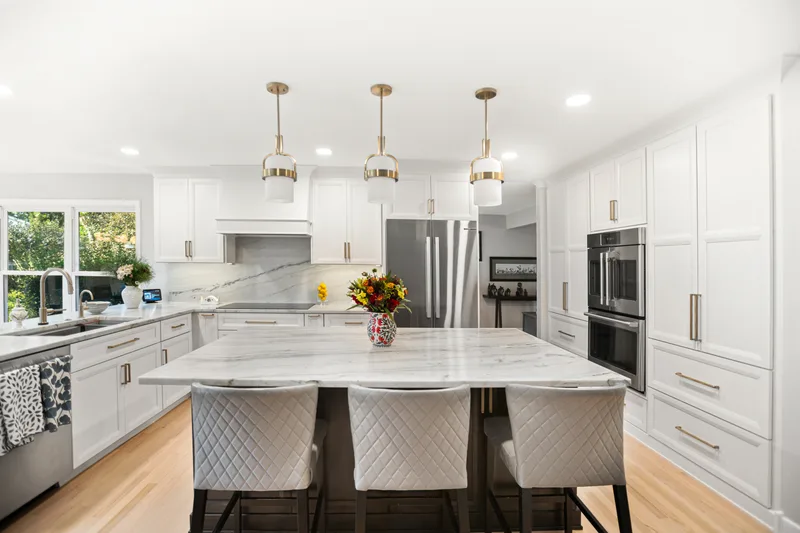
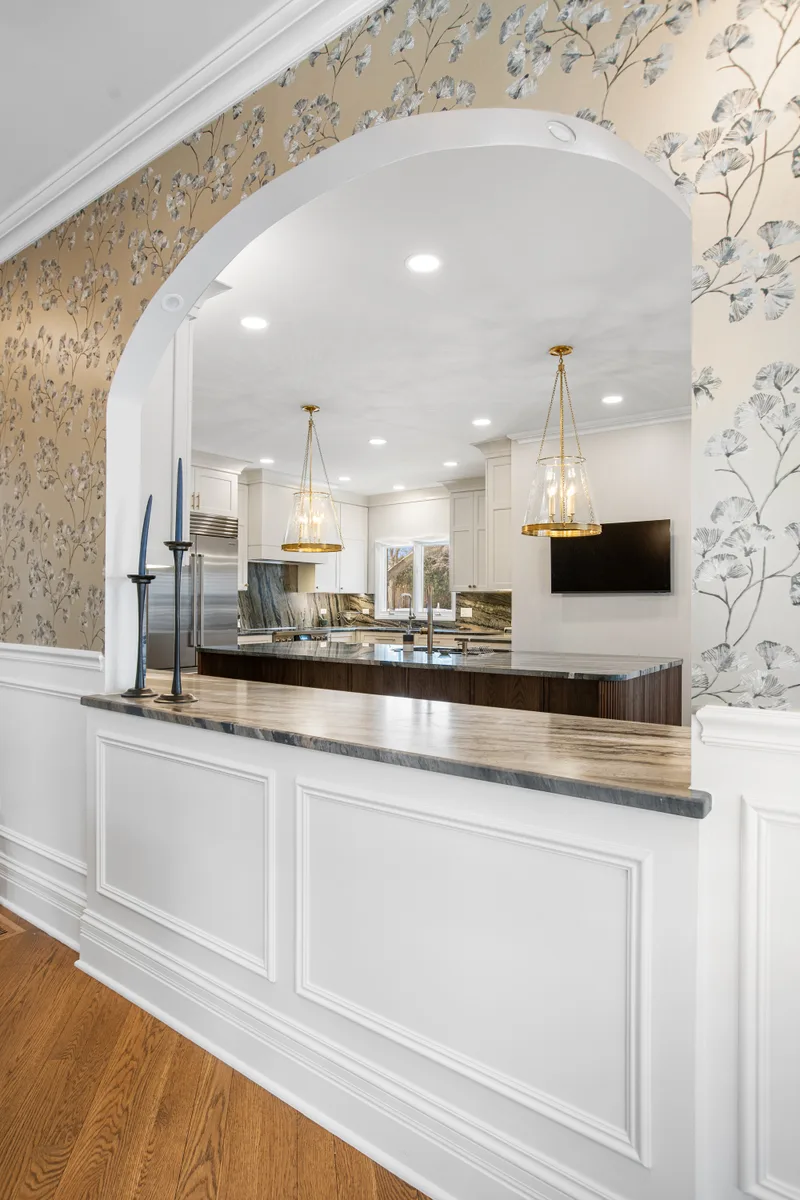
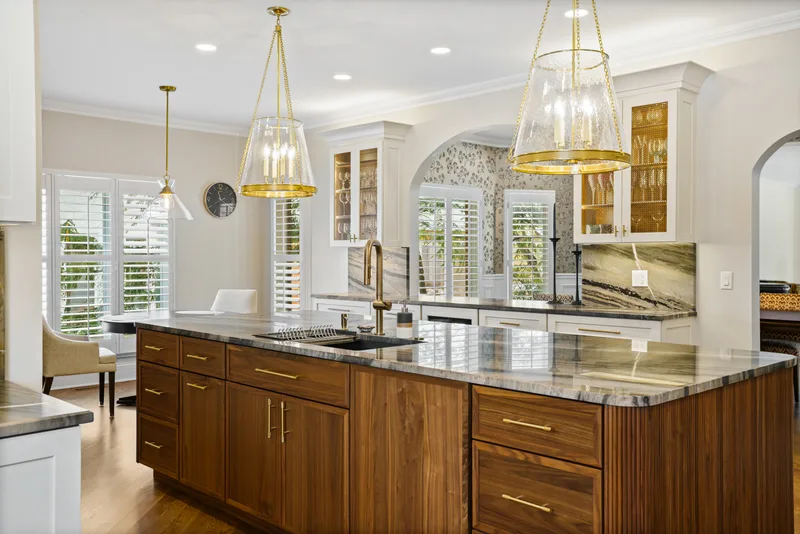
The Lake Forest walnut and butler's pantry project is a useful example: the perimeter cabinetry is white, the island is a walnut fluted millwork piece with built-in storage, and a coordinated butler's pantry extends the kitchen's storage capacity into adjacent space - a solution that preserves the home's original program while solving modern pantry and coffee-service needs. In pre-war homes that still have their butler's pantry alcove, designing storage across both spaces is almost always more effective than trying to pack everything into the kitchen footprint alone.
For postwar homes in Northbrook, Deerfield, and Glenview - ranches and split-levels from the 1960s through 1980s - the storage problem is different: standard ceiling heights, closed floor plans, and kitchens that were efficient for the era but have no pantry provisions and minimal drawer runs. Northbrook's housing stock is particularly dominated by this pattern: the Village of Northbrook Development and Planning Services Department regularly processes permits for kitchen wall-removal projects as homeowners open the closed galley layouts that were standard in the 1960s-70s ranch plans, creating the open floor area where a properly sized pantry column and a working island can both fit.
Vertical Space: The Most Consistently Wasted Area
The gap between cabinet tops and ceiling is where kitchen storage plans most often leave capacity on the table. Standard upper cabinets stop at 7 to 8 feet. Most ceilings run 9 feet or higher. That foot of dead space stores nothing and accumulates grease and dust.
Extending upper cabinets to the ceiling addresses both problems: it adds meaningful storage for less-used items - serving platters, seasonal bakeware, rarely-used appliances - and it creates a cleaner visual by eliminating the awkward gap. In pre-war North Shore homes with ceilings above 9 feet, ceiling-height cabinetry is particularly practical because the upper zone is genuinely accessible from a step stool, not from a ladder. This is a frequent design advantage of the Tudor and Colonial Revival housing stock in Wilmette, Winnetka, and Kenilworth: the 9- to 10-foot ceiling heights that are standard in these homes make ceiling-height runs a storage gain rather than purely a visual decision, unlike the 8-foot ceiling constraint in the postwar ranches of Northbrook and Glenview.
Open shelving at the upper wall works well for everyday items: dishes, glasses, frequently-used pantry staples. The visual openness makes smaller kitchens feel less enclosed. The trade-off is that open shelves require consistent organization to look right. Adding under-cabinet lighting to the undersides of upper cabinets improves visibility at the countertop regardless of which approach you choose.
Hanging pot racks mounted to the ceiling or a range hood are another vertical option worth considering for households that cook regularly with multiple heavy pans. The practical benefit is freeing lower cabinet space for other items; the visual result works well in kitchens that already carry exposed wood or warm metals.
Drawer Storage: The Most Common Planning Gap
The most consistent gap in kitchen storage plans is too few drawers and too many deep base cabinets with a single fixed shelf. Items stacked 24 inches back from the door opening become effectively inaccessible - you know something is there, but using it requires moving everything in front of it.
Deep drawers are the better solution for pots, pans, and heavy cookware. The full contents are visible at once; nothing gets buried. Replacing two or three base cabinet units with full-height drawer stacks is among the changes homeowners most frequently name as immediately noticeable after a remodel.
For smaller items, drawer dividers and inserts are what separate a functional drawer from a junk drawer. Dedicated sections for utensils, spice jars, knife storage, and small tools make daily cooking faster and cleanup simpler. A pull-out spice rack adjacent to the range is worth the cost specifically because it eliminates the reflex to leave spices on the counter.
NKBA design guidelines recommend a minimum of 1,400 cubic inches of drawer or roll-out shelf space in the kitchen - a threshold that standard base cabinets with fixed shelves routinely miss. The custom drawer configurations necessary to meet that standard cost more than standard configurations but the difference in daily function is immediate and lasts the life of the kitchen.
Corner Cabinets and the Underutilized Zones
Corner base cabinets are the storage area with the highest failure rate in standard kitchen layouts. The deep interior of a blind corner is where items migrate and do not return.
Three approaches that actually work:
Pull-out corner systems (magic corners, swing-out shelves) extend out and rotate to bring the full interior to you. More expensive than a lazy Susan, meaningfully more functional for pots and mixing bowls. In older North Shore kitchens with non-square corners, measure before specifying - the standard product dimensions assume a square-cornered cabinet opening. Pre-war kitchens in Kenilworth and Winnetka built before 1920 were often laid out before the era of standard cabinet dimensions entirely; corners can be irregular, and the plaster-and-lath walls behind them do not behave like drywall when anchoring cabinet runs. Measuring each run individually - rather than designing from a floor plan - is the right approach in any home built before 1940.
Lazy Susans and rotating carousels make corner space accessible at lower cost. They work well for canned goods, spices, and small pantry items where the circular footprint is not a constraint.
Dead corner shelving with a diagonal door is the simplest option - easier to install, lowest cost, adequate for items accessed infrequently.
Beyond corners, two specific areas in most kitchens go unused without deliberate planning: the space beneath cabinet toe-kicks and the zone above the refrigerator. Toe-kick drawers require custom installation but provide useful storage for flat items - baking sheets, pizza pans, cutting boards. Above-fridge cabinets are most useful when designed with pull-out or full-extension shelves; standard fixed-shelf configurations make that zone inaccessible in practice.
Islands and Peninsulas: Storage Is a Design Decision, Not a Finish Decision
Island storage needs to be designed at the same time as the island, not specified afterward. The base of an island is prime storage territory that gets underbuilt when it is treated as a finish detail.
Standard options that should be decided before cabinet production:
- Base cabinets with drawer runs or door-and-shelf on one or both sides
- Integrated pull-out trash and recycling frames
- Built-in wine rack or bottle storage
- Open shelving section for cookbooks or display
- Appliance garage with dedicated electrical outlet
The Lake Bluff calacatta quartz island with oak base is a good illustration: the island carries an arched display niche above the refrigerator alongside a hexagonal mosaic backsplash - design decisions that required coordination between the cabinetry, the tile installer, and the general contractor well before any finish was ordered. Storage and aesthetic are the same conversation.
The same principle applies to peninsulas. The overhang that creates seating does not require sacrificing storage - the kitchen side of the peninsula base can and should carry cabinets or drawer runs.
Custom, Semi-Custom, or Stock: What You Are Actually Deciding
The choice between custom, semi-custom, and stock cabinetry is a storage decision before it is an aesthetic one. Stock cabinets come in fixed-width increments; layouts accommodate standard dimensions, filler strips fill gaps, and interior configuration is fixed by the manufacturer. For a full breakdown of update options including refacing and hardware changes, see our kitchen cabinet remodel ideas guide.
Semi-custom cabinetry is built in a wider range of sizes and can be ordered with interior configurations - pull-out trays, spice drawers, soft-close hardware, built-in organizers. The functional difference over stock is significant; the lead time runs 4 to 6 weeks from order.
Fully custom cabinetry is built to exact dimensions around your specific ceiling height, appliance configuration, and floor plan. In pre-war North Shore kitchens with non-standard dimensions, soffits, or original built-ins to work around, custom cabinetry eliminates filler strips and dead zones that semi-custom cannot always avoid. Lead time runs 10 to 16 weeks and is typically the critical-path item in a kitchen remodel - which means custom cabinetry decisions need to happen early in the process, not after the tile and appliance selections are locked. Note that the Village of Wilmette requires a permit for projects over $25,000 involving structural work, and most full custom kitchen remodels in pre-war Wilmette homes cross that threshold; budget the permit timeline into the schedule before the cabinetry lead time begins.
Planning Questions That Shape the Storage Design
Before finalizing any storage plan, these questions need answers:
- What is used daily, weekly, seasonally? Daily items belong at arm's reach; seasonal items can go above or in harder-to-access locations.
- Where do you stand most when cooking? That position should have the densest storage concentration.
- Is there a dedicated pantry, or does the kitchen carry all food storage? If the latter, pantry-style cabinet sections - tall pull-out units or full-height pantry columns - usually prevent the counter-clutter problem that plagues otherwise well-designed kitchens.
- What appliances live permanently on the counter, and which could have cabinet homes? Appliances used twice a month do not need counter space.
These questions shape cabinet layout before a single SKU is specified. Getting them answered early - before the contractor begins the design - produces a kitchen that still works the way you actually live in it five years from now.
If you're planning a kitchen remodel on the North Shore and want storage solutions designed around your specific layout and how you actually cook, contact Delta Remodels to schedule a consultation. We serve Lake Forest, Highland Park, Winnetka, and surrounding communities. See our full range of kitchen remodeling services for more on what we offer.
Frequently asked questions
What is the most effective storage upgrade in a kitchen remodel?
Pull-out drawer inserts for base cabinets deliver the most noticeable functional improvement for most households. Standard base cabinet shelves require reaching 24 inches into a cabinet to access anything stored at the back. Pull-out drawers bring everything forward on demand, which matters every time you reach for a pot, pan, or pantry item.
How do you fix unusable corner cabinet space in a North Shore kitchen?
Pull-out corner systems (sometimes called magic corners or swing-out shelves) are the most functionally effective solution - they extend out and rotate to bring the full cabinet interior to you. In older North Shore homes with non-standard corner configurations, measuring before specifying is essential; pre-war kitchens often have corners that do not align with standard product dimensions. Lazy Susans and rotating carousels are a lower-cost alternative for lighter items. A diagonal dead-corner shelf is the simplest option for items accessed infrequently.
Is custom cabinetry worth the cost for kitchen storage?
For kitchens with unusual ceiling heights, soffits, or appliance configurations - common in pre-war North Shore homes - custom cabinetry pays for itself by eliminating filler strips and dead zones. For standard-dimension kitchens, semi-custom cabinets with pull-out trays, soft-close hardware, and built-in organizers deliver most of the functional benefits at meaningful cost savings over fully custom work. The lead-time difference matters: semi-custom ships in 4-6 weeks, fully custom in 10-16 weeks.
What kitchen storage can be added without a full remodel?
Pull-out drawer inserts can often be retrofitted into existing cabinet boxes, and toe-kick drawers can be added to the space beneath base cabinets in many kitchens. Above-fridge cabinets can be retrofitted with pull-out or full-extension shelves. Hardware and interior organizer additions are lower-cost improvements that improve function without a gut renovation.
Ready to Start Your Project?
Schedule a free consultation. We bring design ideas, material samples, and honest answers.
Get Free Consultation