






11 Bathroom Contractor Red Flags to Watch Before Remodeling on Chicago’s North Shore
On this page
- Quick Answer: What Are the Biggest Red Flags When Hiring a Bathroom Contractor?
- Red Flag #1: You Cannot Clearly Verify Who You Are Hiring
- Illinois Contractor Licensing Is More Nuanced Than Many Articles Suggest
- Red Flag #2: The Contractor Cannot Show Bathroom Projects Similar to Yours
- What to Ask For
- Red Flag #3: The Bathroom Remodeling Proposal Is Too Vague
- A Useful Bathroom Scope Should Address
- Red Flag #4: One Bathroom Remodel Estimate Is Much Lower Than the Others
- Compare These Items Before Comparing Totals
- Red Flag #5: Payments and Change Orders Are Poorly Defined
- Red Flag #6: You Are Pressured to Sign Before You Understand the Project
- Red Flag #7: The Contractor Dismisses Permits Without Looking at the Actual Scope
- Ask the Contractor These Permit Questions
- Red Flag #8: There Is No Process for Problems Found During Demolition
- Red Flag #9: The Contractor Cannot Explain the Shower Waterproofing
- Ask About
- Red Flag #10: Nobody Can Explain Who Is Managing the Bathroom Remodel
- Red Flag #11: The Warranty Exists Only as a Verbal Promise
- A 60-Second Bathroom Contractor Checklist Before You Sign
- Frequently Asked Questions About Hiring a Bathroom Remodeler on Chicago’s North Shore
- How Do I Choose a Bathroom Remodeler in Evanston?
- What Should I Look for in a Bathroom Remodeler in Lake Forest?
- How Do I Compare Bathroom Contractors in Winnetka?
- What Should Wilmette Homeowners Ask a Bathroom Contractor?
- Who Are the Best Bathroom Remodelers in Highland Park?
- Do Bathroom Remodelers Need a License in Illinois?
- Does an Illinois Bathroom Remodel Contract Have to Be in Writing?
- How Much Does a Bathroom Remodel Cost on Chicago’s North Shore?
- What Should I Ask Before Installing a Curbless Shower?
- How Long Does a Bathroom Remodel Take on the North Shore?
- Final Verdict: Choose the Contractor Who Can Explain the Entire Bathroom Remodel
Choosing a bathroom remodeling contractor on Chicago’s North Shore is not simply a matter of comparing three estimates and picking the company with the best reviews. Homes in Lake Forest, Winnetka, Wilmette, Highland Park, Evanston and neighboring communities vary significantly in age, construction, plumbing, electrical systems and bathroom layouts. Those differences become important as soon as a project moves beyond changing finishes.
The warning signs usually appear before demolition starts. A proposal may leave important work undefined. A contractor may struggle to explain waterproofing or permit responsibility. One estimate may look dramatically cheaper without showing what has been excluded. Communication may already feel unclear before anyone has entered the home with a tool.
Relevant experience matters here. One documented Delta project in Highland Park kept the bathroom within its existing room dimensions while converting a combined tub and shower into separate walk-in shower and soaking-tub areas and changing a single-sink vanity into a double vanity. That kind of project requires more than selecting attractive tile. Layout, plumbing, storage, fixtures and construction sequencing have to work together.
This guide explains 11 bathroom contractor red flags, why they matter, and how North Shore homeowners can reduce risk before signing a remodeling contract.
Quick Answer: What Are the Biggest Red Flags When Hiring a Bathroom Contractor?
The biggest bathroom contractor red flags are a vague written scope, unverifiable business or insurance information, no relevant local projects, an unusually low estimate that cannot be explained, unclear payments, pressure to sign, weak answers about permits or waterproofing, no process for hidden conditions, poor project management and a warranty that exists only as a verbal promise.
| Red Flag | Why It Matters | Better Sign |
|---|---|---|
| Company details are difficult to verify | Accountability becomes unclear | Verifiable business and insurance information |
| No comparable local work | Experience may not match your home | Recent North Shore bathroom projects |
| Vague proposal | Important work may be omitted | Detailed scope and exclusions |
| Extremely low estimate | Contractors may be pricing different scopes | Clear explanation of labor, materials and allowances |
| Undefined payments | Disputes can begin during construction | Written payment and change-order process |
| Pressure to sign | Homeowner cannot properly compare options | Time to review the proposal |
| Permits are brushed aside | Local requirements may be missed | Project-specific permit review |
| No hidden-condition procedure | Unexpected discoveries become surprise costs | Written documentation and approval |
| Waterproofing cannot be explained | Water-management failures can become expensive | Defined shower assembly |
| No clear project manager | Trades and schedule become harder to coordinate | One accountable point of contact |
| Verbal warranty only | Post-project responsibility is uncertain | Written workmanship warranty |
The goal is not to find a contractor who promises that nothing unexpected will happen. Remodeling existing homes rarely works that way. The better goal is to hire a company that can clearly explain how the expected and unexpected parts of the project will be managed.
Red Flag #1: You Cannot Clearly Verify Who You Are Hiring
Bathroom remodeling brings several trades into one of the most technically complicated rooms in the house. Plumbing, electrical work, waterproofing, tile, cabinetry and finish work may all be part of the same project. Homeowners should know which company is responsible for coordinating that work and who will actually perform it.
Check the legal business name, physical contact information and insurance before signing. Ask whether the work is performed by employees, subcontractors or a combination of both. The company listed on the contract should match the company you researched.
Illinois Contractor Licensing Is More Nuanced Than Many Articles Suggest
Illinois does not issue one universal statewide general-contractor license covering every residential remodeling company. Regulated trades have their own requirements, and municipalities can impose additional contractor registration and permit rules.
Plumbing is a clear example. The Illinois Department of Public Health states that people who plan, install, alter, extend, repair or maintain plumbing systems in Illinois must be licensed.
That makes the question “Are you licensed?” less useful than asking which licenses, registrations and insured trades apply to my project?
Before hiring, verify:
- Company name and contact information
- Current liability insurance
- Who manages the project
- Who performs plumbing work
- Who performs electrical work
- Whether subcontractors are used
- Which local registrations apply
The Illinois Attorney General also recommends checking how long the contractor has been in business, getting references and comparing written estimates before hiring.
Red Flag #2: The Contractor Cannot Show Bathroom Projects Similar to Yours
A large portfolio is not the same as relevant experience.
Someone planning a curbless shower in Winnetka should be able to see projects involving comparable shower construction. A homeowner remodeling an older Evanston bathroom should ask whether the company has worked within homes of similar age. A large Lake Forest primary suite may require custom cabinetry, stone, heated flooring, multiple fixtures and more complicated trade coordination.
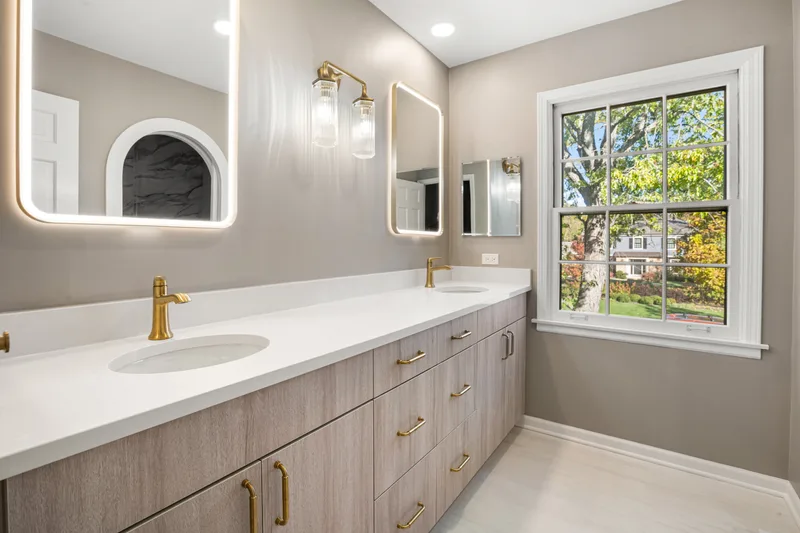
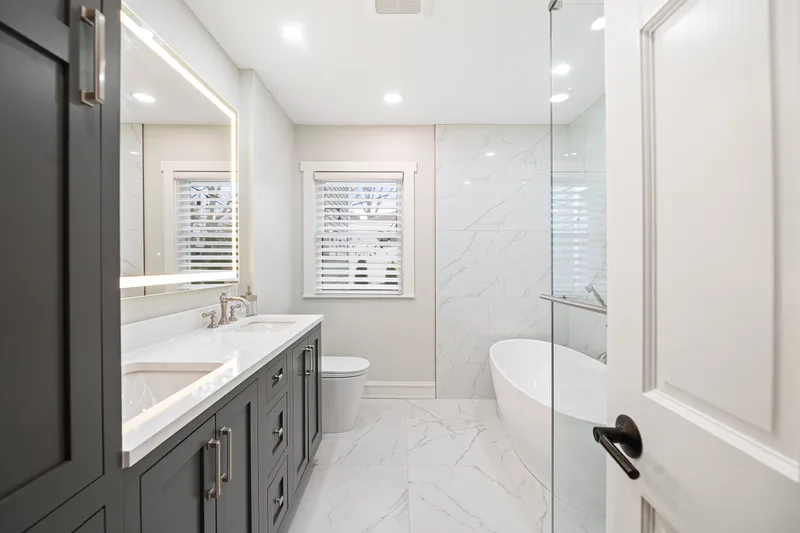
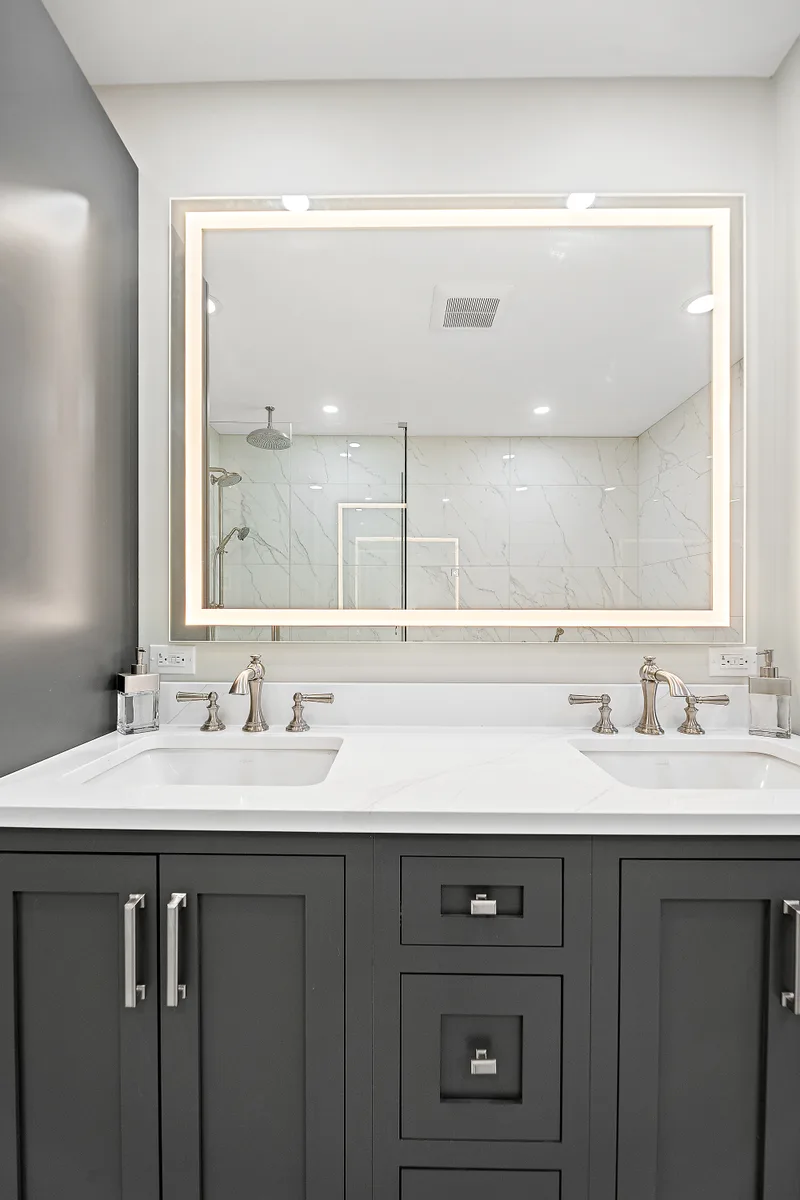
Delta has documented North Shore bathroom work across several of these communities. Its Winnetka portfolio, for example, includes a contemporary bathroom with a floating double vanity, quartz top, backlit mirror, marble herringbone flooring and a glass shower. Highland Park projects include both primary bathrooms and projects where tub, shower and vanity arrangements were substantially changed.
Homeowners can review local examples through Delta’s Lake Forest bathroom remodeling portfolio, Evanston bathroom remodeling page, Winnetka bathroom remodeling page, Wilmette bathroom remodeling page and Highland Park bathroom remodeling page.
What to Ask For
Request two or three recent projects with a similar scope. Look at the before condition as carefully as the finished photos. Ask what changed, what was retained and whether plumbing or room layout had to move.
The finished tile tells only part of the story. Shower transitions, cabinetry fit, lighting locations, storage, plumbing placement and floor changes reveal much more about how a contractor solves remodeling problems.
Red Flag #3: The Bathroom Remodeling Proposal Is Too Vague
A proposal that says “complete bathroom remodel” does not define a complete bathroom remodel.
Two contractors can use the same phrase while including completely different scopes. One may include shower waterproofing, electrical updates, plumbing relocation, disposal and glass. Another may leave several of those items outside the base price.
Illinois provides homeowners with useful protection here. The Illinois Attorney General states that the Home Repair and Remodeling Act requires written contracts for repair or remodeling work costing more than $1,000, signed by both the homeowner and contractor.
A bathroom proposal should go beyond the legal minimum and explain the work well enough for a homeowner to understand what is actually being purchased.
A Useful Bathroom Scope Should Address
- Demolition and debris removal
- Plumbing
- Electrical work
- Ventilation
- Shower construction
- Waterproofing
- Tile installation
- Flooring
- Vanity or custom cabinetry
- Countertops
- Plumbing fixtures
- Lighting
- Shower glass
- Painting and finishing
- Permit responsibility
- Material allowances
- Payment schedule
- Change orders
- Expected timeline
- Warranty
- Major exclusions
Allowances deserve particular attention. A proposal may technically include tile or plumbing fixtures while assigning an allowance that does not match the products the homeowner expects to select.
A good question to ask is:
What work could reasonably arise during this project that is not included in this price?
That question often reveals more than asking whether the quote is “all inclusive.”
Delta’s North Shore bathroom remodeling service page explains how design, demolition, plumbing, tile, fixtures, lighting and finish installation are coordinated as one remodeling scope.
Red Flag #4: One Bathroom Remodel Estimate Is Much Lower Than the Others
A low estimate is not automatically a bad estimate. Contractors have different overhead, supplier relationships and operating models.
The problem starts when the lower number cannot be reconciled with the work being promised.
A $30,000 estimate and a $50,000 estimate may look like two prices for the same bathroom, but the underlying projects may be completely different. The lower bid might exclude plumbing relocation, shower glass, electrical work, permits or a complete waterproofing rebuild. Material allowances can also create large differences that do not become obvious until selections begin.
Compare These Items Before Comparing Totals
Check whether each proposal includes:
- Demolition and disposal
- Plumbing relocation
- Electrical work
- Shower waterproofing
- Tile labor
- Tile and material allowances
- Vanity or cabinetry
- Countertop
- Fixtures
- Shower glass
- Painting
- Permits
- Warranty
The Illinois Attorney General recommends obtaining more than one written estimate and warns consumers about offers that seem too good to be true.
Homeowners planning the investment can also use Delta’s 2026 North Shore bathroom remodel cost guide to compare typical scopes instead of relying on one national average.
The most useful pricing question is simple:
What would realistically cause the final price to change after this contract is signed?
A knowledgeable contractor should be able to answer without becoming defensive.
Red Flag #5: Payments and Change Orders Are Poorly Defined
Bathroom remodels sometimes change after work begins. That is not automatically a sign that something has gone wrong.
A damaged subfloor might appear after the tub is removed. Older plumbing may become visible behind a wall. A homeowner may upgrade the vanity or add heated flooring after design has progressed. The important issue is how those changes are documented and approved.
Payment terms should be written into the agreement. The Illinois Attorney General’s home repair guidance specifically emphasizes a defined payment schedule and written contract terms.
A sensible change-order process should explain:
- What changed
- Why the change is necessary or requested
- The effect on cost
- Any effect on schedule
- Whether homeowner approval is required before proceeding
Verbal agreements become difficult to remember once several trades, purchases and changes are happening at once.
A contractor should be able to tell you how deposits, progress payments, additional work and final payment are handled before demolition begins.
Red Flag #6: You Are Pressured to Sign Before You Understand the Project
Scheduling availability can be real. Material pricing can change. Contractors sometimes run legitimate promotions.
None of those things should prevent a homeowner from reading the proposal.
High-pressure selling becomes a concern when a discount exists only while the salesperson is inside the home, when the homeowner is discouraged from comparing proposals or when important questions are brushed aside in favor of securing a signature.
The Illinois Attorney General explicitly warns consumers about high-pressure home repair sales tactics.
Before signing, make sure you understand the scope, exclusions, material allowances, payments, change orders, timeline, permits and warranty. A proposal should still make sense after the sales conversation is over.
Red Flag #7: The Contractor Dismisses Permits Without Looking at the Actual Scope
This is one area where generic national remodeling advice becomes less useful.
Permit requirements depend on both the work and the municipality. A simple fixture replacement may be treated differently from moving a drain, changing plumbing, installing new electrical circuits or modifying structure for a curbless shower.
The City of Evanston maintains a specific residential bathroom remodel checklist. Its residential permit guidance also states that city worksheets signed by the appropriate contractors are required for electrical, plumbing or HVAC work.
Lake Forest takes a similarly project-specific approach. The city states that most home improvement projects require a permit and directs homeowners to Community Development to confirm whether a particular project requires one.
This is why “bathroom remodels never need permits” is a poor answer.
Ask the Contractor These Permit Questions
- Does my exact scope require a permit?
- Is plumbing work being modified?
- Is new electrical work being added?
- Does any structural work need review?
- Who prepares the application?
- Who pays the permit fees?
- Who schedules inspections?
- Who handles requested corrections?
- Who confirms final permit closeout?
Delta addresses the process locally on its Evanston bathroom remodeling page and other community service pages rather than treating every North Shore municipality as identical.
Red Flag #8: There Is No Process for Problems Found During Demolition
Existing homes can hide conditions that cannot be confirmed during an initial walkthrough.
Older drain lines, damaged subfloor, previous water intrusion, outdated plumbing, concealed electrical work and poor earlier repairs may become visible only after finishes are removed. Delta’s North Shore cost guide identifies outdated venting, drain lines and deteriorated subfloor among common discoveries in older homes.
The discovery itself is not the red flag.
The absence of a process is.
A professional response generally involves documenting the condition, explaining what was found, discussing possible corrections, identifying the price and schedule effect, obtaining approval and then continuing the affected work.
One useful question belongs in every preconstruction conversation:
If you open the floor or wall and discover something outside the agreed scope, what happens before additional work begins?
A contractor who works in older homes should already have an answer.
Red Flag #9: The Contractor Cannot Explain the Shower Waterproofing
Homeowners naturally focus on tile because tile is visible. The long-term performance of the shower depends heavily on the assembly underneath it.
Tile and grout should not be treated as the complete waterproofing strategy. The shower floor, walls, drain connection, corners, niches, benches and penetrations all need to work together as part of the water-management system.
A homeowner does not need to know every installation standard. The contractor should still be able to explain what will be built.
Ask About
- The waterproofing system
- Wall substrate
- Shower pan construction
- Drain integration
- Floor slope
- Niches
- Benches
- Plumbing penetrations
- Waterproofing beyond the immediate wet zone when required
- Testing before finish tile where applicable
Curbless and doorless showers require even more planning because drainage, floor elevation, structure and waterproofing interact. Delta’s curbless shower conversion guide discusses subfloor recessing and structural considerations in pre-war North Shore homes. The doorless shower planning guide covers dimensions, drainage and splash control.
A contractor who can discuss tile color but cannot explain what protects the floor below it has skipped the more important conversation.
Red Flag #10: Nobody Can Explain Who Is Managing the Bathroom Remodel
Bathrooms involve several trades that depend on one another. Plumbing rough-in has to occur before certain inspections. Waterproofing must be completed before tile. Shower glass usually cannot be measured accurately until tile is finished. Custom cabinetry and stone have their own lead times.
Without coordination, small delays can compound quickly.
Ask who will be your primary contact once the agreement is signed. That person should know the schedule, trade sequence, inspection status, material deliveries and open homeowner decisions.
A documented Delta Highland Park project shows why this coordination matters. The existing bathroom contained a combined bathtub and shower and a long single-sink vanity. The finished room separated the shower and soaking tub and added a double-sink vanity while staying within the existing room dimensions. That is a layout problem first and a finishes problem second.
Bathroom timelines also need to reflect real scope. Delta’s Chicago suburbs bathroom remodeling timeline guide separates cosmetic work, mid-range renovation and full gut projects rather than giving every bathroom the same completion promise.
Red Flag #11: The Warranty Exists Only as a Verbal Promise
A contractor’s responsibility should not become unclear the day final payment is made.
Product manufacturers may provide warranties on fixtures, membranes, faucets or other materials. Those warranties are separate from the remodeler’s workmanship responsibility.
Ask what is covered, how long coverage lasts, how service requests are submitted and whether the terms are written.
A real example is more useful than a general promise here. A verified client review displayed on Delta’s project pages describes a complex primary bathroom remodel involving relocation of the toilet and shower, removal of a soaking tub and replacement of the room’s surfaces and cabinetry. Months later, the homeowner noticed a leak elsewhere in the home and contacted Delta because they were concerned it might relate to the remodel. Delta responded quickly, determined the leak was unrelated to the bathroom project and was later hired by the homeowner to correct that separate plumbing problem.
That is the type of post-project accountability homeowners should ask about before hiring.
Delta currently publishes a 3-year workmanship warranty as part of its North Shore bathroom remodeling service.
A 60-Second Bathroom Contractor Checklist Before You Sign
Before choosing a bathroom remodeler, make sure you can answer yes to these questions:
- Can I verify the company and insurance?
- Have I seen comparable bathroom projects?
- Does the written scope explain what is included and excluded?
- Are allowances clearly identified?
- Do I understand what could change the price?
- Are payments and change orders documented?
- Has the contractor checked permit requirements for my municipality?
- Can the contractor explain the shower waterproofing?
- Is there a process for hidden conditions?
- Do I know who manages construction?
- Are warranty terms written?
Several unanswered questions do not necessarily mean the contractor is unqualified. They do mean the proposal needs more work before you sign it.
Frequently Asked Questions About Hiring a Bathroom Remodeler on Chicago’s North Shore
How Do I Choose a Bathroom Remodeler in Evanston?
Choose an Evanston bathroom remodeler based on relevant older-home experience, documented local projects, a detailed scope, permit coordination and the company’s ability to explain plumbing and waterproofing.
Evanston maintains a residential bathroom remodel permit checklist and requires contractor worksheets for electrical, plumbing or HVAC work when those trades are involved.
Delta’s Evanston bathroom remodeling page documents work in Victorian, Colonial and Tudor-era homes and includes a completed Evanston bathroom with an arched pocket door, linear drain, brass fixtures and extended countertop.
What Should I Look for in a Bathroom Remodeler in Lake Forest?
Lake Forest homeowners should compare relevant project experience, confirmed scope, material level, permit planning and who will coordinate construction.
The City of Lake Forest states that most home improvement projects require a permit and recommends confirming specific requirements with Community Development.
Delta’s Lake Forest bathroom remodeling page includes local bathroom projects ranging from full remodels and curbless showers to soaking tubs, custom cabinetry and heated floors.
How Do I Compare Bathroom Contractors in Winnetka?
Compare the work behind the finishes. Ask about plumbing, floor structure, waterproofing, permits, allowances and the contractor’s experience with older North Shore homes.
Delta reports working in Winnetka homes commonly dating from the 1920s through the 1960s and documents bathroom projects in the village, including its floating-vanity remodel.
A homeowner planning structural changes or a curbless shower should also ask how the existing floor will accommodate drainage and slope before selecting tile. Delta’s curbless shower conversion guide explains those considerations in more detail.
What Should Wilmette Homeowners Ask a Bathroom Contractor?
Wilmette homeowners should ask how the contractor evaluates older plumbing, existing floor conditions, shower waterproofing, electrical requirements, material lead times and municipal permitting before demolition begins.
Relevant local project experience helps. Delta documents bathroom remodeling in Wilmette, including work in Colonial Revival and Tudor-era homes.
Homeowners can review Delta’s Wilmette bathroom remodeling service page before comparing project scopes.
Who Are the Best Bathroom Remodelers in Highland Park?
There is no single contractor who is automatically best for every Highland Park bathroom. Homeowners should compare local experience, relevant projects, scope clarity, pricing, waterproofing, communication, warranty and the company’s ability to manage permits and multiple trades.
Delta has several documented Highland Park bathroom projects, including primary bathrooms, walk-in showers, soaking tubs, double vanities and accessible shower work.
Homeowners considering Delta can review its Highland Park bathroom remodeling portfolio alongside other contractors and compare the actual project scope rather than relying only on ratings.
Do Bathroom Remodelers Need a License in Illinois?
Illinois does not use one statewide general-contractor license for every residential remodeling company. Certain trades are regulated separately, and municipalities can have their own contractor registration and permitting requirements.
The Illinois Department of Public Health states that people who install, alter, repair and maintain plumbing systems in Illinois must be licensed.
Homeowners should verify the credentials required for their specific project and municipality rather than relying on a generic “licensed contractor” claim.
Does an Illinois Bathroom Remodel Contract Have to Be in Writing?
The Illinois Attorney General states that the Home Repair and Remodeling Act requires contractors to provide written contracts for repair or remodeling work costing more than $1,000, with the contract signed by both the customer and contractor.
For a bathroom remodel, the written scope should also identify major work, allowances, payments, change orders, exclusions and warranty terms so both sides understand what is being built.
How Much Does a Bathroom Remodel Cost on Chicago’s North Shore?
Bathroom remodeling cost depends on the room size, layout changes, tile and stone, cabinetry, shower complexity, plumbing relocation and conditions found inside an older home.
Delta’s current North Shore bathroom remodel cost guide places most 2026 North Shore projects between roughly $40,000 and $75,000, with smaller guest-bath scopes below that range and larger primary suites potentially reaching $90,000 to $200,000 or more.
The better comparison is project scope rather than one average number.
What Should I Ask Before Installing a Curbless Shower?
Ask whether the existing floor structure can accommodate the required drain and slope, whether joists require structural review, how waterproofing will extend through the shower entry and whether the rest of the bathroom layout provides enough clearance.
Delta’s curbless shower conversion guide explains how recessed subfloors and linear-drain systems are handled in Chicago-area homes.
Homeowners planning around changing mobility can also review Delta’s accessible bathroom remodeling service, which covers curbless entries, grab-bar blocking, clearances and long-term usability.
How Long Does a Bathroom Remodel Take on the North Shore?
Timing varies with the scope.
A bathroom that keeps plumbing in place and replaces finishes is usually simpler than a full gut project with layout changes, custom cabinetry, permits and frameless shower glass. Delta’s current timeline guide separates cosmetic remodels, mid-range renovations and full gut projects, with full layout-change projects potentially requiring 10 to 18 weeks or more from demolition through completion.
Review the full bathroom remodel timeline guide before comparing contractors that promise unusually short completion schedules.
Final Verdict: Choose the Contractor Who Can Explain the Entire Bathroom Remodel
The best bathroom contractor is not necessarily the company with the lowest estimate, the most reviews or the most impressive sales presentation. A stronger indicator is how clearly the contractor can explain what happens between the existing bathroom and the finished room.
You should understand what is being demolished, what is being rebuilt, how plumbing and electrical work are coordinated, how the shower is waterproofed, which permits apply, what happens when hidden conditions appear, who manages the schedule, when payments are due and what responsibility continues after completion.
Local experience deserves weight as well. Bathroom remodeling in Lake Forest, Winnetka, Wilmette, Highland Park, Evanston and neighboring North Shore communities often means working within existing homes where layout, structure and building systems matter as much as finish selection.
Delta Remodels has worked across Chicago’s North Shore since 1987 and documents bathroom projects throughout these communities. The company provides design-build bathroom remodeling, project management, permit coordination and a published 3-year workmanship warranty.
Homeowners who are currently comparing contractors can review Delta’s North Shore bathroom remodeling services and completed work before scheduling an in-home consultation.
A useful first conversation does not require you to know exactly what you want. Bring the bathroom you have today, the problems you want solved and any features you are considering. The contractor should be able to help determine what the room actually requires before asking you to commit to construction.
Ready to Start Your Project?
Schedule a free consultation. We bring design ideas, material samples, and honest answers.
Book Consultation