





Sustainable Bathroom Remodel on the North Shore
On this page
The highest-impact sustainable choices in a bathroom remodel are not the most marketed ones. They are: replacing a pre-1994 toilet with a WaterSense model, specifying an ENERGY STAR exhaust fan that actually gets used because it is quiet, and choosing tile that will still be sound in 30 years. Everything else is secondary.
This covers the areas where sustainable choices deliver real, measurable benefit (water fixtures, lighting, ventilation, and material selection) without the marketing language that inflates the category. Our bathroom remodeling services page covers scope, scheduling, and what the planning process looks like for projects of this type.
Water Fixtures: Where the Measurable Savings Are
Water fixtures are the clearest opportunity in a sustainable bathroom remodel. The technology has matured to the point where water-efficient fixtures deliver equivalent performance at lower consumption.
Toilets. An older toilet installed before 1994 uses 3.5 to 7 gallons per flush. The federal standard since 1994 is 1.6 gallons per flush (GPF). Current EPA WaterSense-certified toilets use 1.28 GPF or less, with dual-flush models offering a 0.8 GPF option for liquid waste. If your bathroom has a toilet installed before 2000, replacement is one of the highest-impact single changes you can make; the math is straightforward and the technology is proven.
Showerheads. Federal law caps showerhead flow at 2.5 gallons per minute (GPM). WaterSense-certified showerheads use 2.0 GPM or less. Current air-infusion and pressure-compensation technology maintains strong spray feel at reduced flow. For a household where the shower runs daily, the difference between a 2.5 GPM and 1.8 GPM showerhead adds up to thousands of gallons per year.
Faucets. Bathroom faucets are used for shorter durations than showers, but WaterSense-certified faucets (1.5 GPM or less versus the standard 2.2 GPM) still contribute to overall reduction. The aerator on most faucets can be replaced independently of the faucet body if you want to reduce flow without replacing the fixture.
A note specific to North Shore homes. Municipal water across the North Shore comes from Lake Michigan via Chicago-area treatment plants. Lake Michigan supply runs roughly 130-150 ppm hardness (about 8 grains per gallon), hard enough that standard treatment does not remove it. Hard water accelerates mineral buildup in fixtures, particularly in the smaller orifices of high-efficiency showerheads. If you specify a 1.8 GPM showerhead in a Northbrook or Winnetka bathroom without also planning for regular cleaning (a vinegar soak monthly or a dedicated inline filter), you will experience clogging and reduced performance faster than the fixture's rated lifespan. This is not a reason to avoid efficient fixtures; it is a reason to plan for maintenance.
In older Wilmette and Evanston homes built in the 1920s through 1940s, galvanized supply pipes are a related concern. Galvanized pipe corrodes from the inside over 40-50 years, narrowing the bore and reducing flow pressure - which compounds the hardness-clogging problem in a high-efficiency fixture. If your home still has galvanized supply lines to the bathroom, that assessment belongs in the pre-remodel planning conversation alongside fixture selection.
Lighting: Long-Term Efficiency Through LED
Lighting technology has changed completely. If your bathroom has any incandescent or CFL fixtures, LED replacement is the most straightforward efficiency upgrade available.
LED performance. LED bulbs use 75 to 80 percent less energy than incandescent bulbs to produce equivalent light output, and last significantly longer, typically 15,000 to 25,000 hours versus 1,000 to 2,000 hours for incandescent. In a bathroom where lights run 30 to 60 minutes daily, this translates to years of operation without replacement.
Color temperature in bathrooms. Bathroom lighting serves two purposes: task work (grooming, makeup) and ambient use. A color temperature between 2700K and 3000K provides warm light that renders skin tones accurately without feeling harsh. Temperatures above 4000K are clinical in appearance and not appropriate for a residential bathroom.
Dimmer compatibility. LED bulbs are dimmable, but they need to be matched to a dimmer rated for LED loads. An LED bulb on an old incandescent dimmer will flicker or shorten bulb life. When installing dimmer switches during a remodel, confirm the dimmer is specified for LED use; it is a minor specification detail that is much easier to address before drywall is closed.
Knob-and-tube wiring and LED upgrades. In pre-1940 homes in Kenilworth, Winnetka, and Wilmette, knob-and-tube wiring is still present in many bathroom walls. Installing LED fixtures with dimmer switches in those circuits requires proper evaluation first: knob-and-tube has no equipment ground and its shared neutrals create complications for modern dimmer controls. A bathroom remodel that opens walls - which most substantial lighting upgrades require - is the right time to upgrade the circuit and do the LED installation correctly rather than patch onto aging infrastructure.
Natural light. A skylight or window in the shower area reduces the need for artificial lighting during daytime hours. In a bathroom remodel that involves a roof or wall modification, evaluating a skylight addition is worth the conversation. In Glencoe, where the Village Building Department maintains a House File for each structure and some properties appear on the Historic Preservation Commission's review list, a skylight that alters the roofline should be confirmed with the building department before design is finalized.
Ventilation: The Code and the Real-World Problem
Adequate bathroom ventilation is both an efficiency issue and a structural one. A bathroom that retains humidity after showers promotes mold growth, degrades paint and grout, and can cause structural damage to framing and subfloor over time. Preventing these problems through good ventilation is far more cost-effective than repairing them.
What the code requires. IRC Chapter 15 requires bathroom exhaust to be vented to the exterior at a minimum of 50 CFM for any bathroom, or 1 CFM per square foot of floor area. This is mechanical exhaust to the exterior, not into the attic, not into a crawlspace. Venting into the attic was common practice in pre-1970 North Shore construction and remains a code violation today. A full bathroom gut remodel is the right moment to correct this if it exists.
The North Shore attic-vent problem. In Wilmette, Evanston, and Glencoe, where a large share of homes date to the 1920s-1950s, it is common to find bathroom exhaust fans that duct into the attic rather than through the roof or soffit to the exterior. The result is sustained moisture accumulation in the attic, which damages sheathing, insulation, and framing. Pre-war balloon-frame construction - the standard building method in Kenilworth and Winnetka homes from the 1890s through 1920s - makes this worse because wall cavities run uninterrupted from sill to rafter, giving accumulated attic moisture a direct channel into the wall assembly. Correcting the duct run during a bathroom remodel (when the ceiling is already open) is straightforward; discovering it at a home inspection after a sale is expensive.
Northbrook and Glenview post-war construction. Ranch homes and split-levels in Northbrook and Glenview, primarily built in the 1950s through 1980s, use platform framing rather than balloon framing. The attic-vent problem still shows up regularly - ventilation codes did not catch up to installation practice until well after this era - but correcting the duct route is mechanically simpler because wall cavities are compartmentalized by floor. Where the ceiling and roof sheathing are already showing moisture damage from a fan that has been venting into the attic for decades, the repair scope should be assessed before the ventilation correction is made.
ENERGY STAR-certified fans. The EPA's ENERGY STAR program certifies bathroom fans that meet efficiency and performance standards. These fans are quieter and use less energy while providing equal or better airflow. The sones rating is worth checking; quieter fans get used more consistently, and consistent use is what delivers the moisture-management benefit.
Humidity-sensing fans. A fan with a built-in humidity sensor activates automatically when moisture rises and runs until humidity returns to ambient. This removes the human variable entirely. For households where the fan reliably gets forgotten, this is a practical and inexpensive upgrade.
Materials: Durability as Sustainability
The most sustainable material choice in a bathroom remodel is often the one that does not need to be replaced for decades. A durable tile installation that holds up for 30 years is a better environmental choice than a trendy material that looks dated and gets replaced in 10. Our bathroom tile guide covers material options and durability trade-offs in detail.
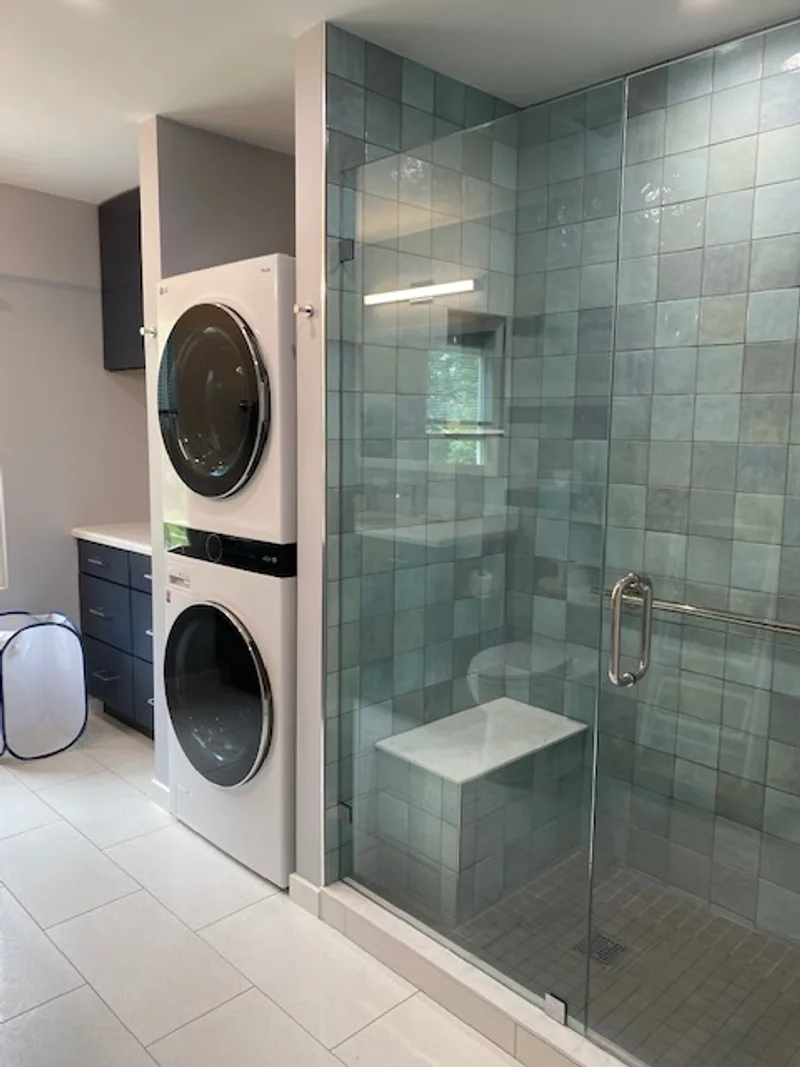
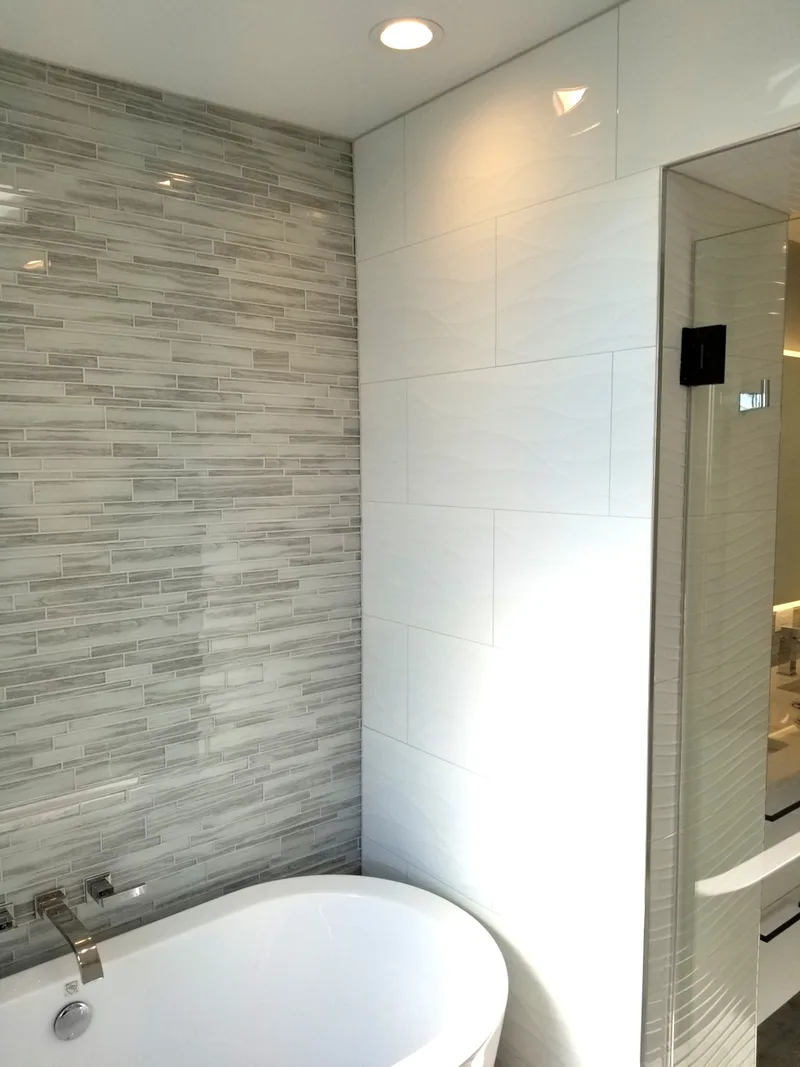
Porcelain tile. Porcelain is made primarily from natural clay and mineral materials and is extremely durable. Quality porcelain tile in a bathroom installation, maintained with basic cleaning, routinely lasts 20 to 30 years without replacement. It is stain-resistant, does not absorb water, and does not require sealing. From a lifecycle standpoint, it is one of the most practical materials available.
Natural stone. Marble, travertine, and slate are natural materials with no manufacturing off-gassing. They are durable when properly maintained, but they require sealing at installation and periodically afterward. In North Shore homes with Lake Michigan municipal supply, which runs hard, natural stone in a bathroom without regular maintenance and sealing will show etching and mineral buildup over time. This matters particularly in Winnetka and Kenilworth homes, where the character of original pre-war bathrooms often inspires a preference for marble and stone that matches the era - the material is historically appropriate, but the maintenance plan has to be built in from the start.
Substrate durability in pre-war homes. In Kenilworth and Wilmette homes built before 1940, tile was commonly installed directly over plaster-and-lath walls without cement board. That substrate can fail silently behind a surface that looks intact, causing delamination in a new tile installation. Specifying proper cement board or waterproof backer board during a remodel - not just patching over existing plaster - is the decision that determines whether the tile installation lasts 30 years or requires repair in five.
Low-VOC finishes and adhesives. Some tile adhesives, grout sealers, and bathroom paints contain volatile organic compounds (VOCs) that off-gas after installation. In a bathroom where ventilation is limited, this is worth addressing. Ask your contractor about low-VOC alternatives for adhesives and sealers; most major manufacturers offer formulations that perform comparably to standard products.
Smart Controls: Small Investment, Consistent Savings
A programmable or occupancy-sensing thermostat for heated bathroom floors means the floor heats when you need it and turns off when you do not. Running heated floors on a schedule rather than continuously reduces energy use without reducing the comfort benefit.
Occupancy-sensing light switches turn lights off when the room is empty, addressing the scenario where bathroom lights run for hours because someone forgot to turn them off.
Smart water shutoff sensors detect slow leaks at the toilet, under-sink supply lines, and near the washing machine if it is in or near the bathroom. The cost of one avoided water damage claim covers the sensor many times over. In pre-war North Shore homes with cast-iron drain lines that are approaching the end of their service life, this type of early leak detection carries added value: a slow supply-line drip in a bathroom with already-compromised subfloor framing can progress to significant structural damage before it becomes visible.
What a Sustainable Bathroom Remodel Actually Looks Like
A practical sustainable bathroom remodel on the North Shore typically includes:
- WaterSense toilet replacing a pre-2000 model
- High-efficiency showerhead (2.0 GPM or less) paired with a plan for mineral-buildup maintenance given local water hardness
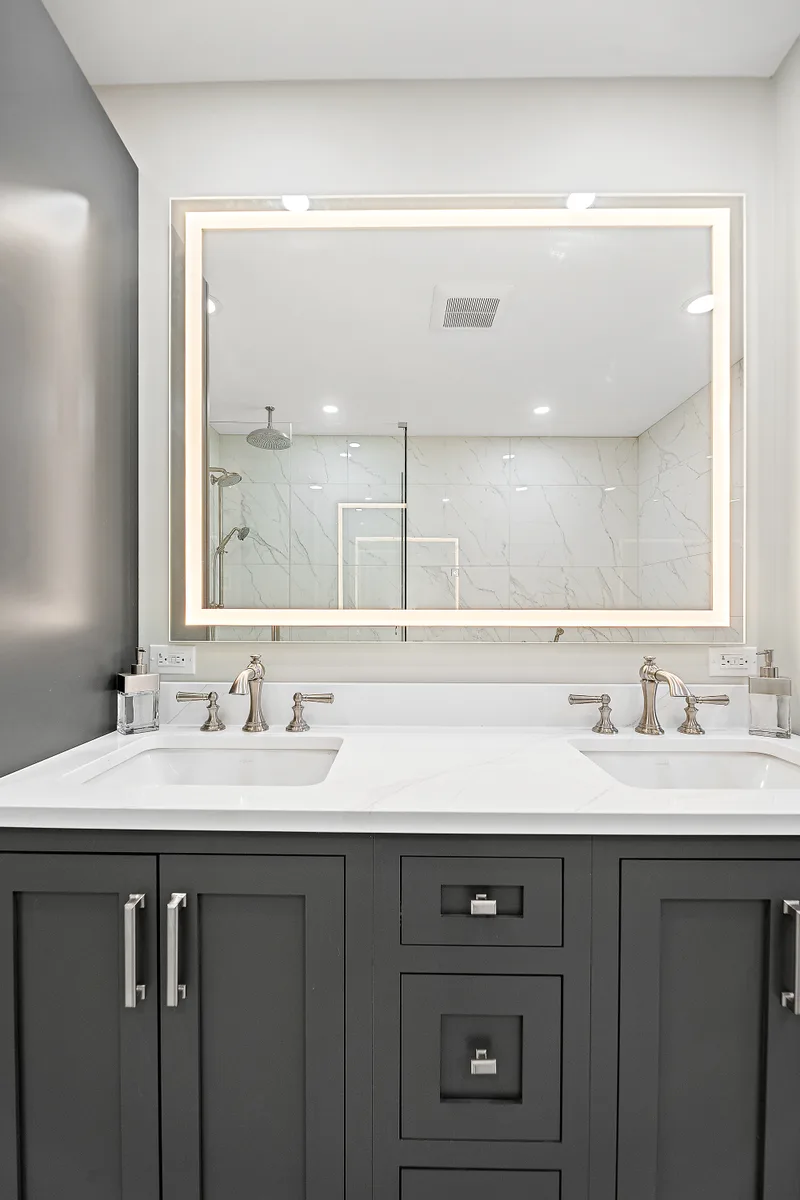
- LED fixtures throughout with at least one dimmer switch on a dimmer rated for LED loads
- ENERGY STAR exhaust fan with humidity sensor, vented to the exterior (not into the attic)
- Durable large-format porcelain tile specified to meet ANSI A137.1 DCOF 0.42 or higher for wet floor surfaces
- Low-VOC adhesives and grout sealer
- Programmable thermostat on heated floors if installed
For pre-war homes in Wilmette, Kenilworth, Winnetka, and Glencoe, two items typically precede this list: confirm whether the existing supply pipes are galvanized (a condition that affects fixture performance and water quality), and confirm that bathroom exhaust is currently vented to the exterior rather than into the attic. Both are found in a pre-remodel assessment and both affect the scope.
None of these choices require unusual materials, complicated installation methods, or an added price for green certification. They represent standard good practice in a well-executed bathroom remodel. If you are still deciding whether a remodel is warranted, see our guide on signs it is time to remodel your bathroom.
For more on our bathroom remodeling work across the North Shore, see our bathroom remodeling services. To talk through a specific project, contact Delta Remodels. We serve communities throughout the North Shore from Evanston to Lake Forest; see our service areas page for the full list.
Frequently asked questions
What is a WaterSense-certified fixture and why does it matter?
WaterSense is an EPA program that certifies fixtures meeting specific efficiency thresholds: toilets at 1.28 gallons per flush or less, showerheads at 2.0 gallons per minute or less. The certification means the fixture has been independently tested and performs comparably to standard fixtures at lower water consumption. If your bathroom has a toilet installed before 2000, replacing it with a WaterSense model is one of the most impactful single changes you can make.
Does ENERGY STAR certification on bathroom fans matter?
Yes. ENERGY STAR-certified exhaust fans use less energy than standard fans and are typically quieter, which means they actually get used. Sones (the measure of fan noise) is worth checking when selecting a fan: quieter fans get turned on more consistently, which matters for moisture management in the bathroom.
What makes a bathroom material choice sustainable?
Durability is the most important factor. A porcelain tile installation that holds up for 30 years without replacement has a lower environmental footprint than a trendy material that gets replaced in 10. Low-VOC adhesives and grout sealers also reduce off-gassing in a space with limited ventilation.
Are smart controls worth adding to a sustainable bathroom remodel?
Occupancy-sensing light switches and programmable thermostats for heated floors are low-cost additions during a remodel that deliver consistent savings. They address the most common inefficiency (lights and systems left running when no one is in the room) without requiring any behavior change from occupants.
Ready to Start Your Project?
Schedule a free consultation. We bring design ideas, material samples, and honest answers.
Get Free Consultation