





Heated Bathroom Floors on the North Shore: What to Decide Before Demo Starts (2026)
On this page
At 6 a.m. in a Northern Illinois January, the floor is the first thing you feel. That practical fact is why heated bathroom floors appear consistently in North Shore primary bathroom remodels - not as an add-on, but as a decision made at the design stage that affects daily experience for the life of the bathroom.
The post below covers what you need to know before deciding whether heated floors belong in your remodel, including the electrical-capacity questions specific to older North Shore housing stock that a generic buying guide skips entirely.
Two Types of Heated Floor Systems
All in-floor bathroom heating works by the same principle: a heat source beneath the tile warms the tile surface, which radiates heat upward into the room. There are two ways to generate that heat, and the distinction matters for this region specifically.
Electric radiant systems use heating cables or thin mats installed between the tile backer board and the mortar bed. A thermostat with a programmable timer controls the system. Electric systems are the practical choice for most bathroom remodels. They install during a standard tile job, require no plumbing modifications, and can be zoned independently of the home's existing heating. They heat up in roughly 30 to 60 minutes, which means a programmed schedule can have the floor warm before you step in without running overnight.
Hydronic systems circulate hot water through tubing embedded in the floor. They are more energy-efficient for large areas and integrate well into whole-house radiant systems, but they require connection to a boiler and involve substantially more installation complexity. For a single bathroom in a pre-war Kenilworth Tudor or a 1960s Northbrook ranch, the added cost of a hydronic system is very difficult to justify unless the home already has a radiant boiler that the bathroom can tap into. Most North Shore homes built before 1980 do not.
The Electrical Question: Pre-War Homes Are Different
This is the section that generic product guides leave out.
Pre-war homes in Wilmette, Winnetka, and Kenilworth - all of which built heavily from the 1890s through the 1940s - commonly have original electrical service in the 30-60 amp range, often with knob-and-tube wiring. Adding a dedicated circuit for a radiant floor mat is not a simple task in these homes. The electrician is typically evaluating panel capacity and, frequently, whether the panel itself needs upgrading before any new circuit can be added.
The research brief notes that Chicago-area knob-and-tube replacement runs roughly $8,000-$35,000 depending on extent. That context shapes the full cost of adding heated floors to a pre-war bathroom - the mat itself is a modest line item; the electrical work to support it in a 1928 Wilmette Colonial may not be.
1960s-1980s Northbrook ranches and Deerfield split-levels typically have 100-amp service, which is generally adequate for adding a dedicated radiant floor circuit without a panel upgrade. In these homes, the circuit question is routine and the conversation is straightforward.
The practical implication: in any pre-war North Shore bathroom remodel, the first question about heated floors is not "which mat should I buy?" It is: "what does my electrician say about panel capacity?" That answer determines whether heated floors are a $500-$1,500 addition or a much larger scope item. This is consistent with what Delta Remodels finds in practice on pre-war North Shore projects.
The City of Highland Park and the Village of Wilmette enforce the current NEC on new circuits, which means any new circuit in a bathroom renovation - including one for radiant floor heat - must meet current GFCI and, depending on the village's adopted code edition, AFCI requirements. Your electrician confirms which edition applies for your specific municipality before rough-in.
Thermal Mass: The Pre-War vs. Post-War Tradeoff
This is worth understanding before committing to a tile selection.
Stone tile - marble, travertine, thick natural stone - has high thermal mass. It absorbs heat before releasing it, which means it takes longer to warm up when the system turns on and longer to cool down after it turns off. In a bathroom with a programmed schedule, this means the warm-up window needs to be longer than with ceramic or porcelain.
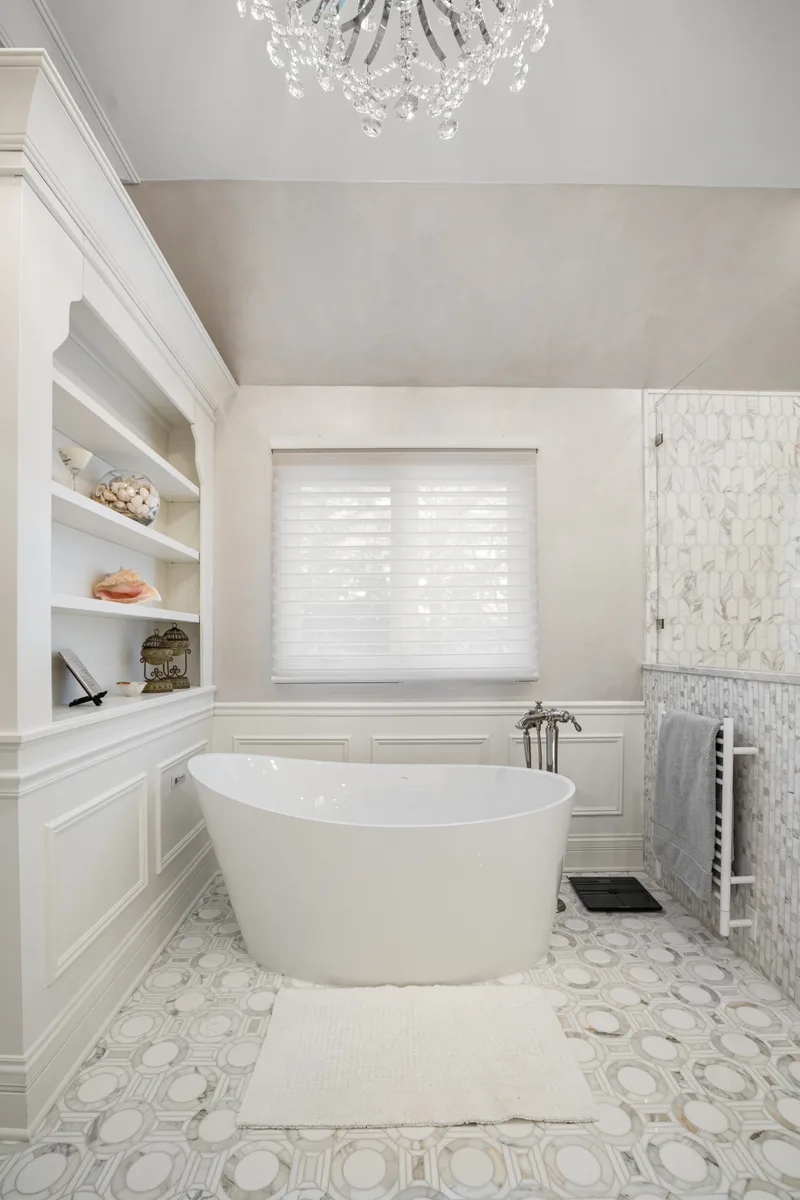
Pre-war North Shore primary bathrooms in Winnetka and Glencoe often have a strong material pull toward marble and natural stone, which pairs naturally with the Georgian and Tudor architecture. That is a legitimate choice; just account for the longer warm-up curve when programming the thermostat schedule and when sizing the mat.
Post-war Northbrook and Highland Park bathrooms with standard porcelain tile have lower thermal mass; the floor responds to the thermostat more quickly, which makes the programmed schedule more predictable.
What Heated Floors Do and Do Not Do
Comfort. Stepping out of a shower onto a warm floor in a Northern Illinois winter is a meaningfully different experience than stepping onto cold tile. This is the primary benefit and the one homeowners describe most consistently.
Even heat distribution. Forced-air bathroom heat warms air from a wall or ceiling vent. The air rises; the floor stays cold. Radiant floor heating warms the tile surface and distributes heat upward through the air column. The floor becomes the warmest part of the room, which is where you want the heat in a bathroom. This physics is well understood; it does not require an industry trade group to assert it.
They do not fully heat the bathroom in cold climates on their own. In a Northern Illinois winter with 42-inch frost depth and dozens of freeze-thaw cycles, a floor heating system warms the floor and contributes meaningfully to ambient room temperature. But in a bathroom with exterior walls and minimal or no wall insulation - common in pre-1940 North Shore homes - floor heating alone may not be sufficient on the coldest days. Most bathrooms retain a standard heat source, and the floor heating supplements it.
Moisture management. A warm floor surface dries faster than a cold one. This is a meaningful benefit in bathrooms where tile grout and caulk around the shower base are subject to repeated moisture exposure.
Operating cost. A typical bathroom radiant mat draws 10 to 15 watts per square foot. A 50-square-foot heated floor on a 4-hour daily schedule uses roughly 2 to 3 kWh per day. With a programmable thermostat, you run the system only when needed. The operating cost is real but modest.
Installation: Why Timing Is Everything
Heated floor mats and cables are installed between the tile backer board and the mortar bed. Installation happens during the tile job, after the substrate is prepared and before tile is set. You cannot add heated floors to an existing tiled bathroom without removing the tile first.
If the tile is already coming out for a planned remodel, the incremental cost of adding the heating system is meaningfully lower than it would be as a standalone project. This is the argument for planning heated floors during a full remodel rather than retrofitting afterward.
What the installation sequence involves:
- The heating mat or cable is laid on the backer board in the pattern specified for the coverage area
- Thin-set mortar is applied over the heating element before tile installation begins
- The thermostat sensor wire is run inside the floor area, typically in conduit for replaceability
- The thermostat is wired to a dedicated circuit; the electrician handles this during rough-in
- Tile is installed over the heating element in the standard way
The manufacturer typically provides a resistance test performed before and after tile installation to confirm the element was not damaged during construction. This test is standard practice and should be part of your contractor's process.
The flooring material check is not optional. Ceramic and porcelain are the best conductors for radiant heat. Natural stone works well. Wood and LVP (vinyl plank) over radiant heat require checking specific product ratings; only certain products in these categories are rated for use over in-floor heating. Confirm compatibility before materials are ordered and before the mat is purchased.
Is It Worth It?
The investment is most defensible when:
- You are already renovating and the tile is being removed
- The bathroom has exterior walls and cold floors in winter
- The home's electrical panel can support the circuit without a full upgrade, or if a panel upgrade is already part of the remodel scope
- You plan to stay in the home for several years
If you are doing a small cosmetic refresh without full tile removal, the cost-benefit is less straightforward. The mat cost plus tile demo and reset labor changes the math significantly. If a full remodel is already planned, adding heated floors is one of the lower-cost decisions relative to its daily impact.
Delta Remodels serves homeowners in Lake Forest, Highland Park, Wilmette, and throughout the North Shore and nearby Chicagoland. If you are in the planning stage and want to understand whether heated floors make sense for your specific bathroom and home's electrical system, contact us to discuss. For more on bathroom remodeling options, see our bathroom remodeling services page.
Frequently asked questions
Which type of heated floor system is right for a bathroom remodel: electric or hydronic?
For most bathrooms, an electric radiant system is the right choice. Electric mats or cables are straightforward to install during a tile job, do not require plumbing modifications, and can be zoned to the bathroom alone. Hydronic systems are more efficient at scale but require a boiler connection and are difficult to justify for a single bathroom unless the home already has a whole-house radiant system.
Can heated bathroom floors be added after the tile is already installed?
No. Heating mats and cables are installed between the backer board and the tile mortar bed, so the existing tile must be removed first. This is why heated floors make the most economic sense when incorporated into a planned bathroom remodel rather than added as a standalone project afterward.
What flooring materials work with in-floor radiant heating?
Ceramic and porcelain tile are the best conductors for radiant heat. Natural stone also works well. Wood and vinyl plank flooring require careful material selection, as only certain products are rated for use over in-floor heating systems. Your contractor should confirm compatibility before materials are ordered.
Does a heated bathroom floor require a dedicated electrical circuit?
Yes. Electric radiant floor heating requires a dedicated circuit, which the electrician handles during the rough-in phase of a remodel. The thermostat wiring and sensor are also run during this phase. Confirming the electrical scope before walls close is essential to avoid reopening finished work.
Ready to Start Your Project?
Schedule a free consultation. We bring design ideas, material samples, and honest answers.
Get Free Consultation