





Organic Bathroom Design Ideas for North Shore Homes
On this page
- Materials: What Creates the Organic Feel
- Herringbone Tile: What It Costs and Why It Works
- Steam and Heated Floors: Functional Upgrades That Fit the Direction
- Fixtures and Hardware: Finishes That Reinforce the Approach
- Lighting in an Organic Bathroom
- What an Organic Bathroom Remodel Requires From the Contractor
Organic bathroom design is less a single look than a set of material priorities: texture over polish, warmth over neutrality, finishes that reference natural surfaces rather than manufactured ones. It has become a consistent direction in North Shore primary bathroom remodels because it works well with the traditional architecture of the area, from pre-war Colonials in Wilmette to wooded-lot custom homes in Glencoe and Riverwoods, while producing bathrooms that feel current without relying on trends that date quickly. The Glencoe housing stock - primarily Colonial, Tudor, and mid-century homes built from the 1920s through the 1960s on wooded lots - creates a natural environment for this direction: earthy material palettes connect visually with the heavily treed streetscapes and the warm-toned millwork that is standard in these homes. Our bathroom remodeling services page covers how we scope and plan projects like these for North Shore homes.
This approach sits on a spectrum with high-end primary bath remodels and spa bathroom design, overlapping in some choices and diverging in others. The underlying approach is consistent: materials that have texture and warmth, tones that do not feel clinical, and a layout that feels deliberate.
Materials: What Creates the Organic Feel
The organic quality in a bathroom comes primarily from the materials chosen. These are the specific choices that work together.
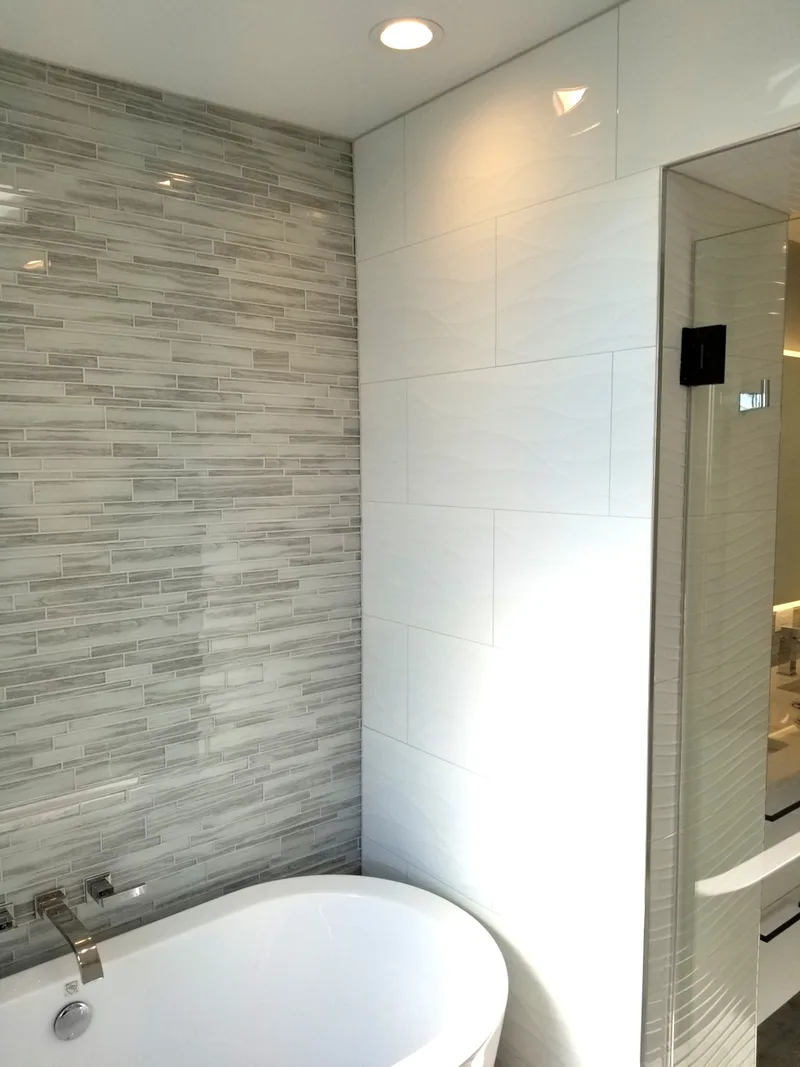
Large-format stone-look porcelain. 24x24 inches or larger, in stone-look or natural stone finishes, produces a clean contemporary surface with minimal grout lines. Less grout means less visual interruption and a more continuous surface. Stone-look porcelain in warm grays, sandstone, and warm white achieves the organic aesthetic while being more durable and easier to maintain than actual stone. The Lake Zurich primary bath with warm oak double vanity and herringbone tile accent wall shows this material at scale: the neutral stone-look tile establishes the baseline, and the herringbone pattern in the shower adds texture without introducing a second color family.
Natural stone accents used selectively. Marble, travertine, or slate used selectively rather than throughout adds texture and variation that manufactured tile cannot fully replicate. A stone shower bench, a stone-surfaced niche, or a stone vanity top brings natural material into the space without the full maintenance commitment of stone everywhere. Genuine marble requires sealing at installation and periodically afterward, and will etch with acidic cleaners or cosmetics. Porcelain marble-look in a honed finish is often the practical answer for floors and shower walls, with actual stone reserved for the vanity counter or a single accent surface where the maintenance trade-off is worth it. One pre-demolition note for North Shore homes: pre-1980 asbestos-containing materials are common in this housing stock across Wilmette, Winnetka, Kenilworth, Evanston, and Glencoe - 9x9-inch floor tile and its black mastic adhesive, pipe insulation, and joint compound are all documented locations per the EPA's asbestos guidance for homes. Testing is required before removing existing tile, and the result can affect the schedule and scope of the tile phase. Contractors familiar with North Shore housing stock include this in the planning conversation from the start.
Wood elements. Teak shower benches, wood vanity panels or frames, and wood-look tile on specific surfaces introduce warmth that tile alone does not provide. Teak is the standard species for shower benches because its natural oil content makes it stable in a wet environment. Other species need more aggressive sealing and will not hold up as well over time. Wood-look tile provides the visual warmth of wood with none of the moisture management concerns, and it appears in a number of North Shore projects in foyer-style shower floors and accent walls where the goal is warmth without the durability commitment.
Matte and honed finishes. Matte tile absorbs light rather than reflecting it, which creates a softer quality in the room. Honed stone, matte black hardware, and brushed metal fixtures work together without the reflective, polished quality that reads as a different design direction. This is not a subtle distinction: the same tile format in a glossy versus matte finish reads as two different rooms.
Herringbone Tile: What It Costs and Why It Works
The herringbone shower accent wall in the Lake Zurich primary bath is a useful example of how a pattern choice changes the room without changing the color family. The same tile in a straight stack-bond reads as calm and recessive; the same tile in herringbone reads as intentional and architectural.
The cost trade-off is real. Herringbone and mosaic patterns typically run 30 to 50 percent more in tile labor than straight-set installation. That cost belongs in the budget estimate from the start, not discovered mid-project. The layout also requires more careful tile ordering because the pattern wastes more material at cuts; your contractor should confirm the overage factor before the tile is ordered.
For the accent wall application, herringbone in a single tile type is more restrained than herringbone throughout the shower. It lets one surface carry the pattern work while the others stay clean.
Steam and Heated Floors: Functional Upgrades That Fit the Direction
Two functional features appear consistently in organic and spa-influenced primary bathrooms, and both require early planning to execute correctly.
Steam. A steam generator converts the shower enclosure into a steam room. The generator is a compact unit that mounts outside the shower enclosure, typically in a nearby closet or cabinet; the steam outlet nozzle mounts in the shower wall. For the steam function to work, the shower enclosure must be fully sealed. A frameless glass enclosure with well-sealed joints is the standard. The generator also requires a 240V circuit, which must be roughed in at the design stage before walls close. Adding it after the fact means reopening finished work. In pre-war homes in Wilmette, Winnetka, or Kenilworth with original 30-60 amp service, a steam generator's 240V circuit often cannot be added without a panel upgrade - budget that assessment and potential upgrade cost at the design stage, before the steam generator is specified and walls are planned around it.
Heated floors. Radiant floor heating is installed between the backer board and the mortar bed, before tile is set. The floor is warm to the touch without relying on forced-air heating, which matters in a bathroom designed to feel calm and restorative. The cost of the heating element scales with square footage, so a primary bathroom floor is one of the more cost-effective applications relative to the daily payoff. The full installation and electrical requirements are covered in our heated bathroom floors guide.
Both features are worth planning at the design stage, not raised as add-ons after rough-in is done.
Fixtures and Hardware: Finishes That Reinforce the Approach
In organic design, fixture and hardware finish selection has a larger effect on overall character than most homeowners expect.
Brushed brass and unlacquered brass add warmth that suits the earthy, natural-material direction of organic design. Unlacquered brass develops a patina over time; brushed brass is more stable in appearance. Both work well against stone-look tile and oak or walnut cabinetry. The Lake Forest primary bath with carrara marble counters and polished brass widespread faucets shows how a warm metal finish and a cool stone surface balance each other.
Matte black is versatile and works in organic bathrooms with darker tile or higher-contrast material choices. It reads as modern without the coldness of polished chrome.
Brushed nickel is neutral and complements most tile choices. It does not add warmth the way brass does but does not work against organic palettes.
Polished chrome tends to conflict with the organic direction. Its reflectivity and precision have a different visual character than the matte, textured surfaces that define the style.
The fixture selections with the most visual impact are the shower valve trim, the faucets, and the towel bars. These should share a finish family. Mixing warm and cool metals reads as uncoordinated rather than intentional.
Lighting in an Organic Bathroom
Lighting in an organic bathroom should feel warm and adjustable.
Recessed lighting on a dimmer gives flexibility. Full brightness for getting ready; lower levels for a steam session or evening use.
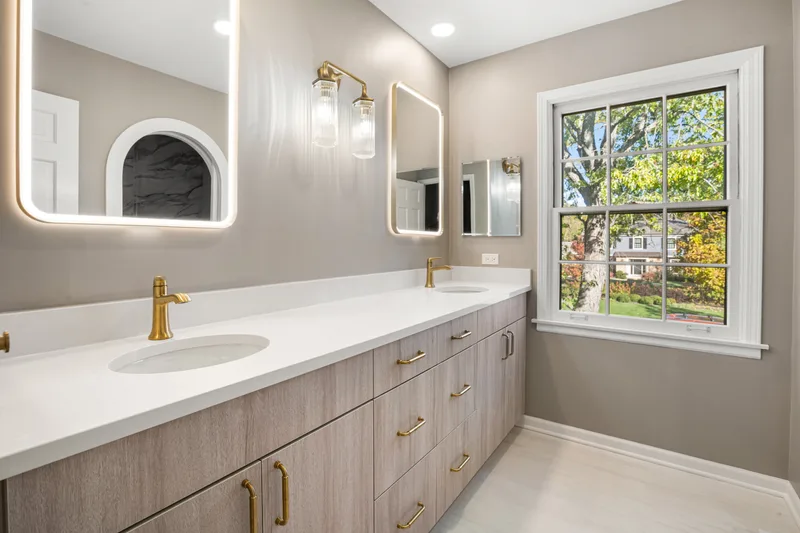
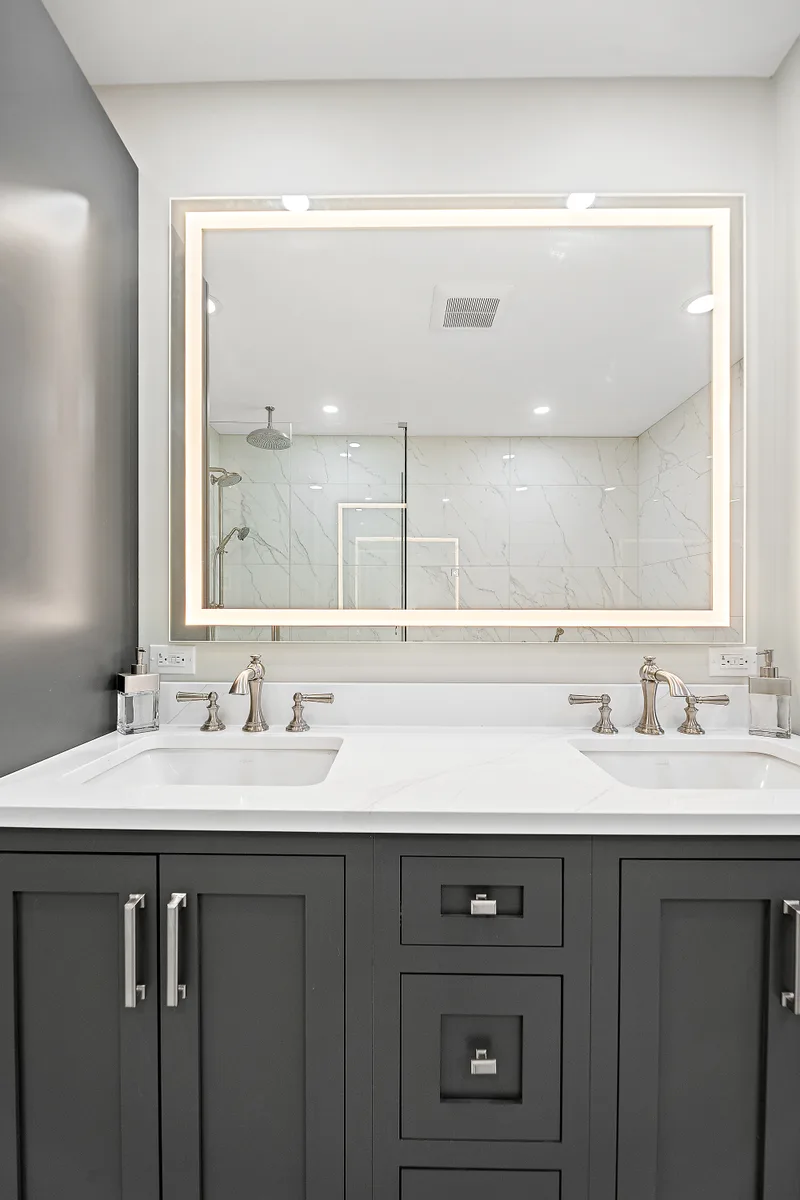
Backlit mirrors or LED mirror fixtures provide even, flattering light at the vanity. Mirrors with integrated LED lighting avoid the shadows that wall-mounted sconces can create in certain positions. The Northbrook primary bath with honey-oak vanity and smart LED-edge mirror with digital clock touch controls is an example of a vanity mirror that handles task lighting without requiring separate sconce mounting. In Northbrook's postwar ranch homes, primary bathrooms were typically built with a single ceiling fixture and no dedicated vanity lighting - the LED mirror approach is often the cleanest way to add face-level task lighting without reopening walls for a new sconce circuit.
Natural light should be maximized where the layout allows. A skylight in a primary bathroom, even a small fixed unit, produces a quality of daylight that artificial sources cannot replicate. If the bathroom is below an attic, a tubular skylight is a lower-cost option that brings daylight in without a full structural opening.
Warm-temperature LEDs at 2700K to 3000K suit organic bathrooms. Cooler bulbs at 4000K and above work against the warmth that stone-look tile and wood elements create in the room.
What an Organic Bathroom Remodel Requires From the Contractor
Large-format tile requires more careful substrate preparation than smaller tile because deflection and flatness tolerances are tighter at this scale. Steam systems require completely sealed enclosures to work correctly and to prevent moisture damage to the surrounding structure. Heated floor systems need to be planned before flooring is installed.
These are not standard work that any tile installer approaches without prior experience. Before committing to a contractor, ask to see completed projects with large-format tile, steam generators, and radiant floor systems. Confirm the contractor has installed these systems before.
For North Shore homes specifically, pre-war housing stock in Wilmette, Kenilworth, and Winnetka may have asbestos-containing materials in pre-1980 tile mastic, pipe insulation, and joint compound. Testing is required before demolition in these homes, and the result can affect the scope and schedule of the tile removal phase. The EPA's RRP Rule also requires contractors disturbing more than 6 square feet of painted surface in a pre-1978 home to be EPA-certified and use lead-safe work practices - all of the pre-war North Shore housing stock falls into that category. A contractor familiar with North Shore housing stock will include both testing discussions in the planning conversation, not surface them as surprises during demo. On large-format tile specifically: the Tile Council of North America (TCNA) sets installation standards for substrate flatness and lippage tolerances that require more precision at 24x24 inches and larger than at smaller tile sizes; in older North Shore homes where floors have settled unevenly over a century, substrate prep is a genuine scope item before large-format tile goes down.
If you are planning a primary bathroom remodel with an organic or spa-influenced direction, contact Delta Remodels to schedule a consultation. We serve Winnetka, Glencoe, Lake Forest, Highland Park, and surrounding communities. See our full bathroom remodeling services for more information.
Frequently asked questions
What materials define an organic bathroom aesthetic?
Organic bathrooms rely on natural-feeling materials: large-format stone-look porcelain, natural stone accents, wood or wood-look tile elements, and matte or honed finishes on fixtures and hardware. The goal is warmth and texture rather than the reflective, polished quality of more traditional bathroom design.
Does organic bathroom design work in smaller bathrooms?
Yes. The principles apply regardless of size. Large-format tile actually helps smaller bathrooms feel more spacious by reducing grout lines, and matte finishes and warm neutrals work just as well in a compact space as in a large primary bath.
What fixture finishes work best in an organic bathroom?
Brushed brass, unlacquered brass, matte black, and brushed nickel all complement organic palettes. Polished chrome tends to conflict with the matte, textured surfaces that define the style. Fixture finishes do not need to match exactly, but they should share a finish family.
Can steam and heated floors be added to an organic bathroom?
Both are well-suited to an organic bathroom and are among the most appreciated functional upgrades in primary bath projects. A steam generator mounts outside the shower enclosure and requires a fully sealed frameless glass enclosure to work correctly. Radiant floor heating is installed before tile and works with most tile formats.
Ready to Start Your Project?
Schedule a free consultation. We bring design ideas, material samples, and honest answers.
Get Free Consultation