





Kenilworth Kitchen Remodel: What 1890s Housing Stock Means for Your Budget
On this page
A century-old kitchen in Kenilworth starts a remodel in a different place than a 1970s Northbrook ranch or even a 1930s Wilmette Colonial. The older stock was built differently, with materials that behaved differently, and the conditions inside the walls when demolition starts are predictably more complex. That complexity is not a reason to avoid remodeling. It is a reason to plan the budget honestly.
Kenilworth was platted in 1889-1890s, making it the oldest planned community on the North Shore. That founding date shapes almost every aspect of a kitchen remodel in the village today.
Our kitchen remodeling services cover the full scope of a design-build project, and the Kenilworth service area page details what working in the village specifically involves.
What the 1889-1890s Founding Date Means in Practice
Kenilworth was built out primarily through the early 1900s and into the 1920s and 1930s. Many homes date to before 1920. Nearly all predate 1940. The construction methods common in that era produced homes that are structurally sound and architecturally distinctive - Tudors, Georgians, Prairie-style homes, and Arts and Crafts designs on the Kenilworth Avenue grid and the Sheridan Road lakefront corridor. They also produced homes with systems that were standard at the time and that now require updating when walls are opened.
The four conditions found in nearly every pre-1940 Kenilworth kitchen:
Balloon framing. Before platform framing became standard in the 1940s, most homes used balloon framing where wall studs run continuously from the foundation sill to the roof rafters without horizontal fire breaks at each floor. The problem with balloon framing is that open stud bays act as vertical fire chimneys - a fire that reaches a wall cavity can travel unobstructed from basement to attic. Building code requires fire blocking when these bays are opened during renovation. That work is straightforward but adds to scope, and it requires an engineer to evaluate any wall before it moves because load paths behave differently than in platform-framed homes.
Knob-and-tube wiring. Common from roughly 1880 through the 1940s, knob-and-tube is ungrounded and uses separate hot and neutral conductors run through ceramic knobs and tubes in open air. Modern kitchens require grounded circuits, GFCI protection on all countertop and wet-area receptacles, and enough circuit capacity for dishwashers, refrigerators, microwaves, and garbage disposals on dedicated lines. Knob-and-tube can support none of that reliably. Chicago-area knob-and-tube replacement runs approximately $8,000-$35,000 depending on extent, according to industry sources. Many homeowners insurers will not write or renew policies on homes with active knob-and-tube, so the kitchen remodel sometimes triggers a conversation with the insurance company about the full-house electrical situation.
Galvanized supply pipes. Zinc coating corrodes from the inside over 40-50 years, reducing flow and discoloring water. In homes that had lead service lines - standard before roughly 1930 and banned in 1986 - corroded galvanized pipe can trap and release lead particles, per the EPA. Any galvanized supply pipe reached during a kitchen remodel should be replaced at that location. This is the right time to do it.
Horsehair plaster walls. Pre-1920 plaster used animal-hair fiber binder - no asbestos risk, but the material is harder to cut cleanly, prone to cracking when adjacent work vibrates, and requires more careful demolition technique than drywall. Homes built in the 1920s through 1970s may have plaster with asbestos-containing joint compound; testing is appropriate before demolition in any home of that era.
The Kenilworth Permit Layer
The Village of Kenilworth Building and Planning Division handles standard permits for kitchen remodels involving plumbing, electrical, and structural work. That is no different from any other North Shore village.
What is different is the December 2023 amendment to the Village demolition ordinance. Properties identified on the Village Historic Survey Key Findings list now require Building Review Commission consideration before demolition or substantial work, with associated escrow fees. This step does not apply to every Kenilworth home, but on Kenilworth Avenue and the lakefront corridor where the historic housing concentration is highest, it applies to a meaningful share of the stock. The review is not an obstacle to remodeling - it is a design-quality gate that has protected the character of the village for decades. But it adds administrative time and cost that neighbors in Wilmette and Northbrook do not face on equivalent kitchen scopes.
Confirm with the Building and Planning Division at the outset whether a specific property is on the Historic Survey list. That question should be answered before design work is finalized, not after permits are applied for.
What Kenilworth Kitchen Remodels Actually Cost
Kenilworth kitchen remodels typically range from $80,000 at the mid-range end to well over $200,000 for fully custom scopes with structural work and full system remediation. Those figures reflect industry ranges for the North Shore and are not Delta pricing - each project requires an in-home assessment to quote accurately.
The variables that push the number:
System conditions discovered during demolition. Knob-and-tube requiring panel upgrade and kitchen circuit replacement adds $8,000-$25,000 on average. Galvanized supply that serves multiple kitchen fixtures adds $3,000-$8,000 to replace at those locations. Subfloor rot under the sink or dishwasher area from slow leaks adds $700-$3,500 to the scope. Where floor joists are structurally compromised, sistering each affected joist typically costs $150-$325 in combined labor and materials.
Structural work. Load-bearing wall removal with an engineered beam - the most common structural scope in a Kenilworth kitchen that homeowners want to open - adds approximately $3,000-$10,000 before finishes, per industry estimates. In a balloon-framed home, structural engineering is mandatory rather than optional before any wall is touched.
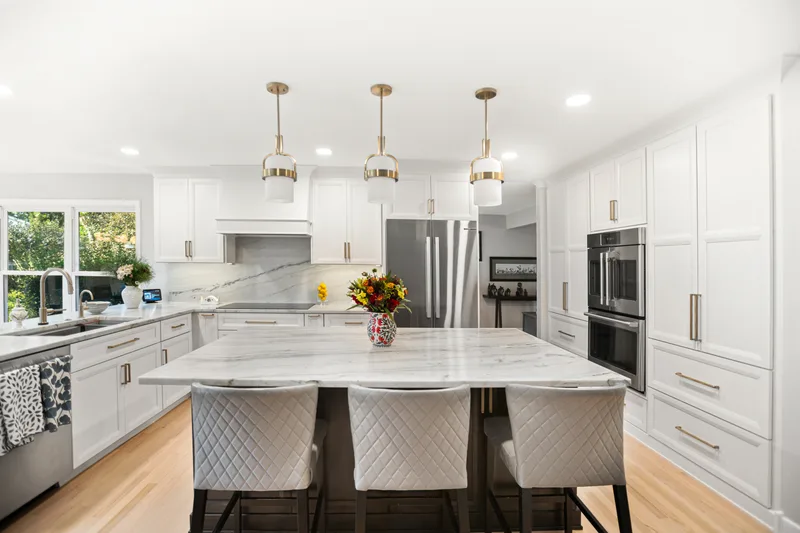
Cabinetry tier. Cabinetry is the single largest swing factor in a kitchen budget, typically running 29-40% of total cost. Custom inset cabinetry suited to a Kenilworth home's architectural character - the option that looks proportionate and period-appropriate in a Tudor or Arts and Crafts kitchen - runs $500-$1,200 per linear foot. Semi-custom runs $150-$700. Stock is $100-$300 but rarely the right choice in a home where the cabinet profiles will sit against original millwork and leaded glass.
Appliance package. A mid-range package runs $20,000-$35,000. A professional suite with Sub-Zero refrigeration and a Wolf or La Cornue range - common in Kenilworth homes where the kitchen scope matches the home's overall quality standard - runs $45,000-$80,000 or more.
Planning a Kenilworth Kitchen: What to Do First
Before finishes, before cabinet selections, before appliance research: have the existing kitchen assessed for its systems. That assessment answers the questions that matter most to the budget.
The pre-demolition checklist that protects Kenilworth kitchen budgets:
Identify the panel and electrical service. A 30-60 amp service cannot support a modern kitchen. Panel upgrade to 200 amps is required. Confirm whether the kitchen circuit run is knob-and-tube and how far it extends.
Have a plumber camera the drain lines. Cast-iron drain lines common in pre-war homes are not automatically failed, but knowing their condition before walls close prevents surprises.
Look up the Historic Survey status. The Village Building and Planning Division can confirm whether the property is on the Historic Survey Key Findings list. If it is, the design review step goes into the project schedule from day one.
Identify which walls are load-bearing. In a balloon-framed home, no wall should be assumed non-load-bearing without engineering review.
Set a contingency of 15-20%. The conditions that drive overruns in pre-1940 Kenilworth kitchens are not knowable from the outside. A contingency is not pessimism - it is accuracy.
The Interior That Earns the Investment
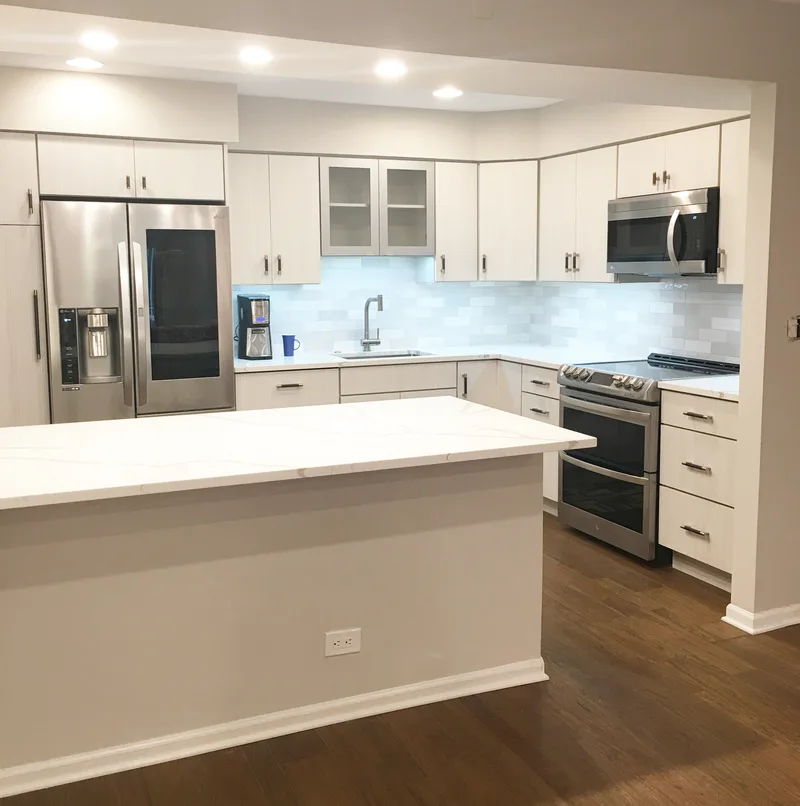
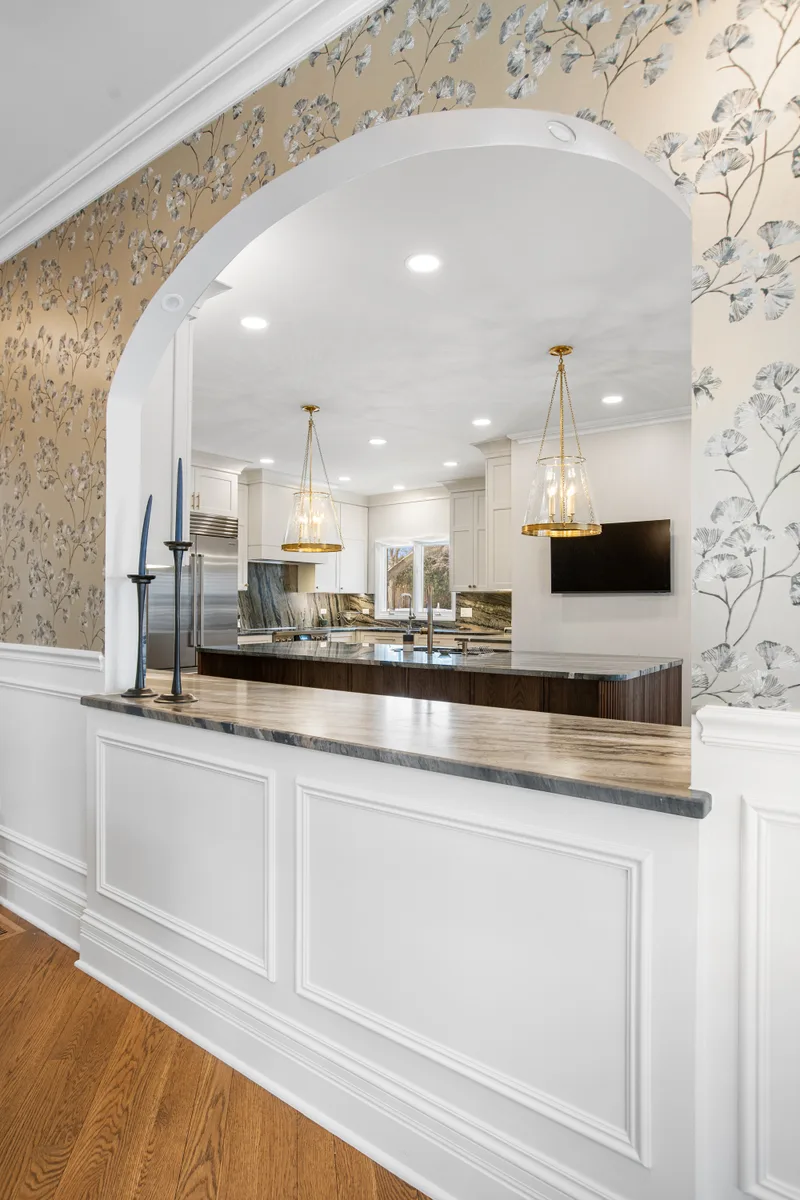
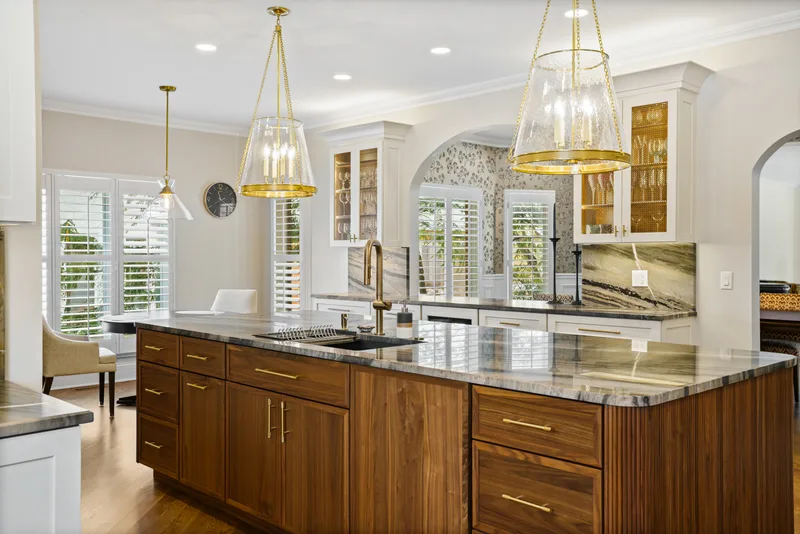
The reason Kenilworth kitchen remodels justify their scope is the home they are being built inside. A kitchen that matches the craftsmanship of a 1912 Arts and Crafts home or a 1925 Georgian estate - custom inset cabinetry, period-appropriate hardware, honed stone, integrated professional appliances - reads as original to the house. That integration is what distinguishes a well-executed Kenilworth kitchen from a generic remodel dropped into a historic shell.
The North Shore market has seen what happens to homes where the kitchen does not match the rest of the house. The gap is visible. Buyers notice. The investment in doing it correctly holds value in ways that a cost-minimized approach does not.
For a sense of what pre-1940 walls reveal during North Shore kitchen demolition, see what to expect opening walls in a pre-1940 North Shore kitchen. For the broader cost framework that Kenilworth figures fit into, see the North Shore kitchen remodel cost guide.
Schedule a consultation with Delta Remodels - an in-home visit is the only accurate way to assess conditions and scope in a century-old Kenilworth kitchen.
Frequently asked questions
How much does a kitchen remodel cost in Kenilworth, IL?
Kenilworth kitchen remodels typically run $80,000 to $200,000 or more. The lower end covers a mid-range gut with semi-custom cabinetry and standard appliances where walls stay in place and no knob-and-tube or galvanized pipe is discovered. The upper end reflects custom inset cabinetry, wall removal with structural engineering, full electrical and plumbing remediation, and high-specification appliances - a common scope in homes where those conditions are present from the start. A 15-20% contingency on top of any quoted budget is standard for pre-1940 Kenilworth homes.
Do Kenilworth kitchen remodels require permits?
Yes. Any work involving plumbing, electrical, structural changes, or layout modifications requires a building permit from the Village of Kenilworth Building and Planning Division (847-251-1666). Properties identified on the Village Historic Survey Key Findings list - updated with December 2023 amendments to the demolition ordinance - require Building Review Commission consideration before demolition or substantial work, with associated escrow fees. Delta Remodels coordinates all permitting as part of project planning.
Is knob-and-tube wiring always replaced during a Kenilworth kitchen remodel?
Not necessarily in the entire house, but any kitchen circuit opened during the remodel will require updating. Modern kitchens need grounded circuits and GFCI protection that knob-and-tube cannot reliably support. The sequence is: assess the panel and the kitchen circuits, replace what is necessary for the remodel scope and code compliance, and leave the rest of the house assessed but not automatically replaced. If the insurer has flagged active knob-and-tube, whole-house replacement may be separately required. Your electrician and insurer set those boundaries - not the kitchen contractor.
What is balloon framing and why does it matter for a Kenilworth kitchen remodel?
Balloon framing is a construction method common before the 1940s where wall studs run continuously from the sill plate to the roof rafters without the platform breaks used in modern construction. This creates open stud bays that act as vertical fire pathways when walls are opened. Building code requires adding fire blocking when balloon-framed walls are opened during a remodel. It also means load-bearing wall identification is more complex - an engineer should evaluate any wall before it is moved or modified in a pre-1940 Kenilworth home.
Ready to Start Your Project?
Schedule a free consultation. We bring design ideas, material samples, and honest answers.
Get Free Consultation