





Accessible Shower Conversion: Transfer vs. Roll-In Design for North Shore Homes
On this page
- Transfer Shower vs. Roll-In Shower: The Distinction That Changes the Design
- What Tub-to-Shower Conversion Requires
- What an Accessible Shower Requires Beyond Zero Threshold
- What Demolition Reveals in North Shore Homes
- Waterproofing: Where Conversions Succeed or Fail Long-Term
- Permit and Review Expectations
- The Conversion Sequence
- Independence as the Outcome
In a bathroom that has not been updated since the 1970s or 1980s - common across Northbrook, Glenview, and nearby northwest Chicagoland communities like Buffalo Grove - the tub is typically the problem. Stepping over a 14-16 inch curb, lowering into the basin, and reversing that process while surfaces are wet is the highest-risk daily task for someone with balance limitations or reduced mobility. An accessible shower conversion removes that obstacle.
North Shore pre-war homes (Kenilworth, Wilmette, Winnetka, Glencoe) add a specific structural layer: balloon framing means studs run full height from sill to roof without a mid-story platform break, and any wall modification for drain relocation or doorway widening requires confirming the load path before opening. Village-level permit differences also matter at this scope: Wilmette requires a licensed architect or engineer stamp on projects over $25,000 or involving structural work, per the Village of Wilmette Community Development Department.
What most homeowners do not know before starting the design conversation is that "accessible shower" covers two distinct configurations with different dimensional requirements, different grab-bar layouts, and different minimum floor areas. Using the right term matters because it determines the scope of structural work, the turning clearance that must be verified against the existing footprint, and whether the finished room will actually serve the person who will use it.
Our accessible bathroom design process covers the full scoping, permitting, and configuration work that a conversion like this requires.
Transfer Shower vs. Roll-In Shower: The Distinction That Changes the Design
These are not synonyms. They are different solutions to different problems.
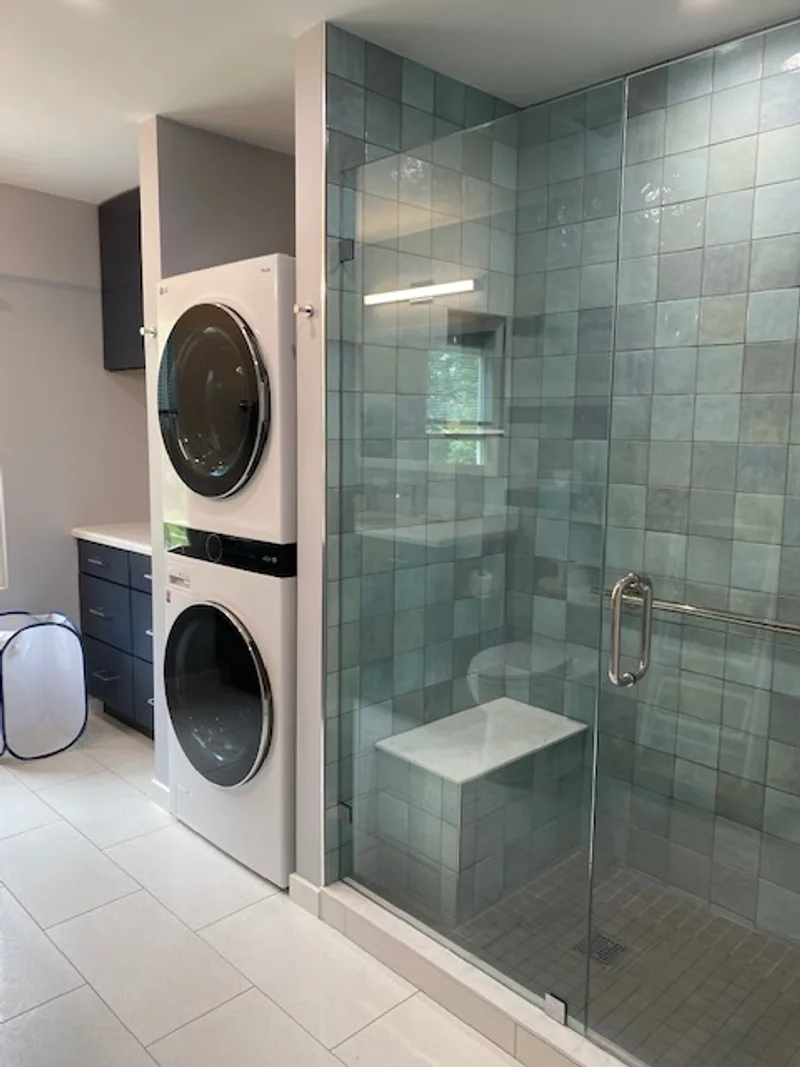
Transfer shower - designed for someone who transfers from a wheelchair or mobility device to a built-in bench, then bathes seated. ANSI A117.1 section 608.2.1 sets the minimum footprint at 36 by 36 inches with a seat on the control wall, grab bars on the back and control walls at 33-36 inches above the finished floor, and a fold-down or built-in bench at 17-19 inches seat height. The 36-by-36 minimum is tight. In practice, 36 by 48 or 36 by 60 gives more usable space for both the user and a caregiver.
Roll-in shower - designed for someone remaining in a wheelchair during bathing. ANSI A117.1 section 608.2.2 sets the minimum footprint at 60 by 30 inches, with at least 60 inches of unobstructed clear floor space adjacent to the shower entry to allow the wheelchair to maneuver into and out of the space. The entry must be completely unobstructed - no threshold, no door that reduces the opening. An alternate configuration (60 by 36 inches) is also code-compliant. Grab-bar placement differs from a transfer shower because the user is approaching from a different position.
The practical implication: if you do not know which configuration is appropriate at design stage, the project can proceed correctly through demo and rough-in and still produce a room that does not serve its intended user. The right question to ask at the outset is not "how big should the shower be?" but "what is the user's specific mobility pattern and what type of assist does the shower need to provide?"
What Tub-to-Shower Conversion Requires
Most North Shore accessible shower conversions start from a tub. The existing tub drain and supply rough-in are in a fixed location determined by the tub's footprint. Converting to a shower requires:
- Repositioning the drain to a linear-drain location or new center-drain position
- Modifying supply rough-in for a handheld showerhead on a slide bar (a fixed overhead showerhead is not accessible; a handheld unit adjustable from approximately 18 to 72 inches off the floor serves both seated and standing users)
- Rebuilding the shower base from scratch
The subfloor must accommodate the new drain location and provide proper drainage slope without a raised curb. For a linear drain, the required recess is approximately 1.5-2 inches; for a traditional mortar-bed center drain, closer to 3.5-4 inches. In homes with wood-frame subfloors - standard in pre-war Kenilworth (platted 1889-1890s), Wilmette (1920s-1950s), and Winnetka (1890s-1920s) - any joist cutting for that recess requires structural review before demo begins.
For the full technical discussion of subfloor recess options, the recess-vs-tray decision, and joist modification in pre-war North Shore framing, see our curbless shower conversion guide. That post covers the structural layer in depth. This post focuses on the accessible design requirements specific to transfer and roll-in configurations.
What an Accessible Shower Requires Beyond Zero Threshold
Both transfer and roll-in configurations require a curbless entry. Beyond that, the accessible design elements differ from a standard curbless shower in ways that must be resolved before walls close.
Grab bars in the right locations, properly mounted. This is the most frequently compromised element of accessible shower conversions because it requires planning before tile is set. ADA 2010 Standards section 609.8 requires bars and their mounts to withstand 250 lbs of force in any direction. Standard drywall and tile cannot hold this.
2x10 blocking must be framed into the wall before cement board goes up. That means the blocking plan must be determined during design, not after walls are closed. For a transfer shower, blocking locations are:
- Back wall: 33-36 inches AFF, extending from the seat to the far wall
- Control wall: 33-36 inches AFF, adjacent to the seat
- Entry: vertical bar at 18 inches minimum height, for entering and exiting
For a roll-in shower, blocking locations differ because the approach and movement pattern are different. An NAHB CAPS-certified designer or occupational therapist familiar with the specific user's mobility pattern should confirm bar placement before the blocking plan is finalized. The US Access Board guidelines on bathing rooms provide the dimensional reference.
For detailed guidance on proper grab bar blocking installation - including the cost difference between blocking during a remodel versus retrofitting later - see our grab bar installation guide.
Bench at correct height. ADA 2010 Standards specify a bench seat height of 17-19 inches above the finished floor. A solid tile bench on a properly blocked substrate is the most durable option. Folding seats that attach to tile without structural backing cannot be relied on for fall-prevention loads.
Storage within reach range. ANSI A117.1 reach range standards (section 308) place operable parts and storage at 15-48 inches above the floor for side-reach, and 15-48 inches for forward-reach in unobstructed conditions. Large recessed niches at 18-48 inches keep toiletries within reach while seated.
Slip-resistant floor tile. ANSI A326.3 specifies a Dynamic Coefficient of Friction (DCOF) of 0.42 or higher for wet areas. Not all porcelain tile marketed as "slip-resistant" meets this threshold. Verify the DCOF rating with your tile supplier before selection.
Doorway width. A 32-inch net clear width is the accessible minimum for a doorway; 36 inches is recommended for roll-in configurations. Pre-1980 bathroom doors commonly measure 28-30 inches. Widening a non-load-bearing doorway runs $600-$2,000; a load-bearing doorway requires an engineered header. In balloon-frame homes common throughout the North Shore pre-war stock, confirm load path before any wall modification.
What Demolition Reveals in North Shore Homes
Water damage and subfloor or joist rot under the old tub is the most predictable find in pre-war and mid-century North Shore bathroom demolition. Slow leaks at grout lines, caulk joints, and the tub-wall interface accumulate over decades. Bathroom subfloor replacement runs approximately $700-$3,500 depending on extent.
Pre-1980 North Shore bathrooms frequently have tile set over drywall rather than cement board - drywall behind tile was common before cement-board substrates became standard. Opening these walls during a conversion is the right time to rebuild the substrate correctly with cement board and a continuous waterproofing membrane.
Asbestos testing is required before demolition in any home built or last renovated before 1980. Pre-1980 floor tile and black mastic are common asbestos-containing materials in North Shore bathrooms. Testing costs $50-$150 per sample and is non-negotiable. Do not begin demo without it.
Waterproofing: Where Conversions Succeed or Fail Long-Term
Waterproofing is where shower conversions succeed or fail over the long term. The membrane covers the shower floor and walls, including cement board over blocking. Corners and penetrations are the failure points - they must be properly sealed, not just coated. Membrane systems require cure time of 24-72 hours before tile can be set, depending on the product. This is a real schedule item; rushing it causes lasting problems.
The Tile Council of North America (TCNA) Handbook for Ceramic, Glass, and Stone Tile Installation specifies method selection for shower installations. Ask your contractor which TCNA method is being used and how corners and penetrations are handled before work begins.
Permit and Review Expectations
An accessible shower conversion on the North Shore typically triggers permits at several points:
Plumbing permit: Any drain repositioning triggers a plumbing permit in every North Shore village.
Structural permit: Any joist modification triggers a structural permit and may require an engineer's stamp depending on the village.
Wilmette threshold: Per the Village of Wilmette, projects over $25,000 or involving structural work require a licensed architect or engineer stamp. A tub-to-accessible-shower conversion with drain relocation, joist review, and doorway widening in a pre-war home often exceeds both thresholds.
Evanston registration: Evanston requires all contractors to be registered with the City before pulling any permit, per the City's contractor registration requirements. This step differs from Wilmette and Skokie - confirm registration before signing contracts.
For a broader discussion of how permit requirements vary across North Shore municipalities for accessible bathroom work, see our accessible bathroom remodeling services page.
The Conversion Sequence
An accessible shower conversion in a pre-war North Shore home runs this sequence:
- Confirm which configuration is needed (transfer vs. roll-in) before design begins
- Camera inspection of existing drain lines before drain relocation is finalized
- Structural review of joist span if subfloor recess is planned
- Asbestos testing before any demolition of pre-1980 materials
- Permit submission including plumbing, structural drawings, and blocking plan
- Demo and subfloor assessment (rot and prior patching are found here, not before)
- Joist work and subfloor repair if needed
- Drain rough-in and supply modification for handheld showerhead
- Framing for blocking in all grab-bar zones, bench substrate, and doorway widening if needed
- Cement board and waterproofing membrane installation (24-72 hours cure time before tile)
- Tile installation on floor and walls
- Bench, grab bars, handheld showerhead on slide bar, and accessible storage
Independence as the Outcome
The goal of an accessible shower conversion is not primarily physical safety in the abstract - it is maintaining independent daily bathing without calculating risks or relying on assistance for a private task. A well-designed accessible shower, configured correctly for the user's actual mobility pattern, accomplishes that.
A transfer shower and a roll-in shower look similar from a distance. They are engineered for fundamentally different use patterns. Getting the configuration right at design stage costs nothing extra and produces a bathroom that functions as intended for years.
If you are thinking about a conversion in Lake Forest, Highland Park, Wilmette, or elsewhere on the North Shore, contact us to schedule an assessment. We will look at your existing bathroom, confirm the right configuration for your needs, and give you a clear picture of what the structural and permit scope will involve.
For cost planning, see our accessible bathroom cost guide. For the full scope of design standards involved, see our accessible bathroom design guide.
Delta Remodels serves homeowners across the North Shore including Lake Forest, Lake Bluff, Highland Park, Northbrook, Wilmette, and Glenview from our Lake Forest headquarters.
Frequently asked questions
What is the difference between a transfer shower and a roll-in shower?
A transfer shower is designed for someone who transfers from a wheelchair to a built-in seat - the minimum footprint under ANSI A117.1 is 36 by 36 inches, and the configuration includes a fold-down or built-in seat on the control wall with grab bars positioned to support the transfer movement. A roll-in shower is designed for someone remaining in a wheelchair while bathing - the minimum footprint is 60 by 30 inches (or 36 by 60 inches in alternate configurations), and it requires at least 60 inches of clear turning space adjacent to the shower entry so the wheelchair can maneuver. The two configurations have different grab-bar layouts, different seat requirements, and different minimum floor areas. Starting with the wrong configuration produces a room that does not serve the actual user.
What is the minimum size for an accessible shower?
It depends on which type is needed. ANSI A117.1 sets the minimum transfer shower at 36 by 36 inches - this is a constrained working space that many users find tight in practice. A roll-in shower minimum is 60 by 30 inches. If the footprint allows it, sizing the shower at 36 by 60 inches or larger gives enough room for seated bathing, a caregiver if needed, and better daily usability regardless of the users current mobility level.
Does removing a bathtub hurt home value?
In a home with at least one other bathtub, converting a primary bath tub to an accessible shower generally has minimal impact on resale value and is often offset by the appeal of a well-designed walk-in shower. In a home where the converted bathroom is the only full bath, some buyers with young children may see the absence of a tub as a limitation. A local real estate agent familiar with your specific neighborhood is the right person to consult on this before committing.
How long does an accessible shower conversion take?
A tub-to-accessible-shower conversion typically takes two to three weeks of active work, longer than a standard shower conversion because the accessible design requires a specific sequencing: structural review if joist modification is needed, drain repositioning, waterproofing cure time of 24-72 hours before tile can be set, and blocking installation before walls close. Do not schedule the project for a week before the bathroom must be back in service.
What do contractors commonly find under old North Shore bathtubs?
Water damage and subfloor or joist rot under tubs and showers is the most predictable find in pre-war and mid-century North Shore bathroom demolition. Slow leaks at grout lines, caulk joints, and the tub-wall interface accumulate over decades. Bathroom subfloor replacement runs approximately $700-$3,500 depending on extent. In pre-1980 homes, tile over drywall is also common - cement board substrates became standard later. Asbestos testing is required before demolition of pre-1980 floor tile, mastic, or joint compound.
Ready to Start Your Project?
Schedule a free consultation. We bring design ideas, material samples, and honest answers.
Get Free Consultation