





Washer & Dryer in a Bathroom: Guide
On this page
The starting scenario for this project type is almost always the same: laundry is in the basement or a closet on another floor, and the homeowner wants to consolidate, either to reduce stair trips, free up a room, or gain usable space when adding a second bathroom anyway. On the North Shore, where many homes were built before main-floor laundry was standard - Colonial Revivals and Tudors in Wilmette built in the 1920s and 1930s were designed with laundry in the basement as a given - this configuration lets owners add both functions without major structural changes.
Getting it right requires addressing four things before anything else: plumbing access, electrical capacity, ventilation, and appliance selection. All four are easier to plan when walls are already open during a remodel. Our bathroom remodeling services cover the full scope of projects like this, from plumbing access assessment to electrical and finish work.
When a Laundry-Bathroom Combo Makes Sense
The combination works best when:
- The bathroom is used primarily for utility rather than as a primary en suite
- The room is at least 60 to 80 square feet, allowing space for both functions without cramping either
- The plumbing stack and drain lines are accessible, which reduces the cost of adding laundry hookups
- The electrical panel has capacity for the dedicated circuits laundry appliances require (or an upgrade is already planned)
It is less practical in a small powder room, a primary en suite with no room to grow, or a bathroom where noise from laundry appliances would be disruptive.
If laundry is currently in the basement and relocating it upstairs is the goal, see our basement remodel planning guide for how to think through relocating utility functions during a broader renovation.
Plumbing Requirements
A washer requires hot and cold water supply connections and a standpipe drain. Most bathrooms already have hot and cold supply lines serving the sink and shower, so supply connections are often nearby. The standpipe drain is typically the more involved portion; it must be properly sized and vented to prevent siphoning.
The Northbrook slab consideration. A significant portion of Northbrook's housing stock, ranches built in the 1950s through 1980s, is built on concrete slabs rather than crawlspaces or basements. Adding a laundry standpipe drain in a slab-construction bathroom is possible but requires specialized techniques: either cutting and routing through the slab, or running supply and drain lines through adjacent walls at a higher elevation with an elevated drain point. A licensed plumber should assess the configuration before costs are estimated. This is not a detail to resolve during construction. Glenview's post-war ranch stock presents the same challenge for the same reasons - slab construction is common in both communities across the same building era.
Pre-war plumbing in Wilmette and Winnetka. In homes built before 1940, cast-iron drain stacks and galvanized supply pipes are the norm. Cast-iron drains are durable but can corrode at joints over decades; a camera inspection of the stack before connecting laundry drain lines is good practice and can reveal whether the existing drain system can handle the added flow. Galvanized supply lines narrow in bore over time from mineral buildup and may need replacement rather than simply adding new branches off them.
Gas dryers require a gas line to the location. If the existing bathroom is not near a gas line, an electric dryer is the simpler choice, especially if the panel has capacity for a 240V circuit.
Electrical Requirements
Standard washers run on 120V, but that outlet should be on a dedicated 20-amp circuit. Dryers require either a 240V outlet on a dedicated circuit (electric) or a gas connection with a standard 120V outlet for the motor and controls.
Adding dedicated laundry circuits during a bathroom remodel, when walls are open, is straightforward. Adding them after the fact in a finished bathroom is significantly more involved. This is one of several reasons why incorporating laundry into a bathroom makes most sense during a planned remodel rather than as a standalone retrofit.
Pre-1940 electrical reality. In Kenilworth, Evanston, Winnetka, and other North Shore communities where a large share of homes date to the early 1900s through 1930s, knob-and-tube wiring is still present in many homes. Knob-and-tube has no equipment ground and cannot reliably support the GFCI protection modern bathrooms require since 1975, let alone the dedicated 240V dryer circuit. Adding laundry appliances to a pre-1940 home with active knob-and-tube wiring means a panel assessment or upgrade is part of the scope, not optional. Many insurers will not write or renew policies on homes with active knob-and-tube, which becomes a pressure point when it surfaces during a project. Evanston, where the City requires all contractors to register before pulling any permit, processes these projects with that contractor qualification step in place - worth confirming early that your electrical contractor holds current City registration.
Ventilation: The Most Important Detail
Ventilation is the factor most often underestimated in a laundry-bathroom combination.
Bathrooms require exhaust ventilation to remove moisture from showers. The IRC requires a minimum of 50 CFM for any bathroom, vented to the exterior. Dryers produce significant heat and moisture that must be exhausted to the exterior through a separate duct; electric dryers cannot be vented inside a room, and gas dryers produce combustion byproducts that require exterior venting regardless.
These two ventilation requirements are separate and must both be addressed:
- A bathroom exhaust fan sized for the room's square footage, HVI-rated, vented to the exterior
- A dryer duct run to an exterior termination point using smooth-wall metal duct (not flexible plastic, which is a fire hazard and not code-compliant)
Balloon framing and duct routing in pre-war homes. In Wilmette, Kenilworth, Glencoe, and Winnetka homes built before 1940, balloon-frame construction means wall cavities run the full height from foundation sill to roof rafter without a floor platform interrupting them. Threading a new bathroom fan duct or dryer exhaust duct through these walls requires fire blocking to be added wherever the duct penetrates a floor level - this is a code requirement under IRC Section R302.11, not optional. A remodel that adds ventilation to a balloon-frame home without addressing fire blocking is incomplete. This is one of the reasons that adding laundry to a bathroom in a pre-war North Shore home costs more per fixture than the same project in a Northbrook ranch.
Condensing dryers as an alternative. Condensing (ventless) dryers do not require an exterior duct because they condense moisture from the exhaust into water and drain it. They are somewhat slower than vented dryers and typically cost more, but they eliminate the need for a duct run entirely. In a bathroom where routing an exterior duct is difficult - a basement, an interior room with no clear exterior wall, or a historic Glencoe or Kenilworth home where cutting through the exterior is constrained by preservation review - a condensing dryer is often the practical solution.
Appliance Choices for a Combined Space
Compact washers are 24 inches wide versus the standard 27-28 inches and work well in tighter configurations without meaningfully compromising capacity for most households.
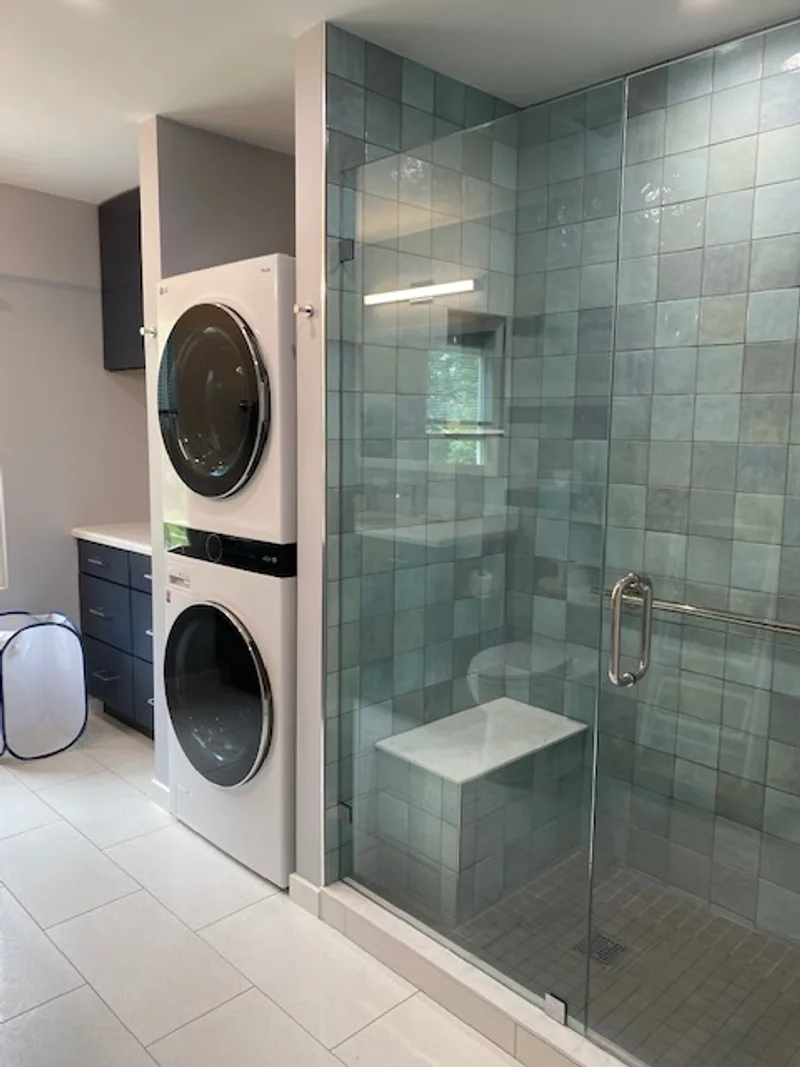
Stacked washer-dryer units occupy a single appliance footprint (the most space-efficient option), but the dryer loads and unloads at shoulder height or above, which can be inconvenient. For households with mobility considerations, side-by-side at a lower elevation is more ergonomic.
All-in-one combination washer-dryers wash and dry in a single unit occupying one appliance footprint. Cycle times are longer than separate appliances. In a true space-constrained situation where a stacked unit will not fit, they are the option.
Layout Approaches
Alcove installation. Washer and dryer (or stacked unit) in a dedicated niche or alcove, separated from the toilet and vanity. Folding or sliding doors close off the laundry zone entirely when not in use. This is the cleanest visual solution in a bathroom that needs to function as both.
Adjacent zones. In a larger bathroom, appliances against one wall near the entry or in a corner, with bathroom fixtures occupying the opposite end. Works when the room is large enough that the zones do not visually compete.
Dedicated utility room. In some floor plans, the laundry-bathroom combination is genuinely a utility room that happens to include both functions. Designing utility functions first, then integrating the bathroom fixtures, often produces a more logical result than starting with a bathroom and trying to fit laundry in.
In any layout, leave adequate clearance in front of appliance doors. Front-load machines require approximately 36 inches of clearance to fully open the door; top-load machines require clearance above the machine for the lid.
Storage and Finish
A laundry-bathroom combination benefits from more storage than a standard bathroom. Built-in cabinetry above the washer and dryer holds detergent, cleaning supplies, and linens. A countertop over a side-by-side pair provides a folding surface.
For flooring, porcelain tile is the right choice. It handles moisture from both the bathroom and laundry functions, is easy to clean, and durable enough for heavy-use utility areas. Vinyl plank and laminate are not suited to the sustained moisture exposure in these rooms.
Adding laundry to a bathroom remodel is a practical way to add function without adding square footage. The key is addressing plumbing, electrical, and ventilation requirements from the start rather than working around them later. For layout ideas in compact rooms, see our small bathroom remodel ideas guide, and for budgeting the project overall, our bathroom remodel budget guide covers what to expect.
Delta Remodels handles full bathroom remodels across the North Shore, including Northbrook and surrounding communities, including projects that incorporate laundry and multi-function layouts. Contact us to discuss your specific situation, or explore our bathroom remodeling services.
Frequently asked questions
What minimum square footage does a laundry-bathroom combination need?
The combination works best when the room is at least 60 to 80 square feet. Below that threshold, fitting both functions without cramping either becomes difficult. A stacked washer-dryer unit occupies a single appliance footprint and is the most space-efficient option in tighter configurations.
Do I need a separate dryer duct even in a small bathroom?
Yes, for vented dryers. Electric dryers cannot be vented inside a room, and gas dryers produce combustion byproducts that must also be exhausted to the exterior. The one alternative is a condensing (ventless) dryer, which condenses moisture into water and drains it, eliminating the need for an exterior duct run.
What electrical work is required to add laundry appliances to a bathroom?
Standard washers need a dedicated 20-amp 120V circuit. Electric dryers require a 240V outlet on a dedicated circuit. Adding these during a remodel when walls are open is straightforward. Adding them after a bathroom is finished is significantly more involved and costly, and in pre-1940 North Shore homes, may require a panel upgrade first.
What flooring material is best for a laundry-bathroom combination?
Porcelain tile is the right choice for any area combining bathroom and laundry functions. It handles moisture from both uses, cleans easily, and is durable enough for a heavy-use utility space. Avoid vinyl plank or laminate, which are not well-suited to the sustained moisture exposure in these rooms.
Ready to Start Your Project?
Schedule a free consultation. We bring design ideas, material samples, and honest answers.
Get Free Consultation