





How to Budget a Bathroom Remodel: Process, Contingency, and Scope Discipline
On this page
The first question most homeowners ask is how much a bathroom remodel costs. That answer belongs in our North Shore bathroom remodel cost guide, which breaks down what each budget tier actually delivers in 2026. This post answers the question that comes before the number: how do you build a budget that holds?
The gap between a project that finishes on budget and one that runs 30% over almost never comes down to contractor quality. It comes down to whether the scope was defined, whether contingency was treated as a real line item, and whether selections were locked before demolition started. Those are process decisions, and they are within a homeowner's control.
Define Scope Before You Ask for a Price
A quote for "bathroom remodel" is not a price for anything specific. It is a placeholder that allows budget-level comparisons between bids that may not include the same work. Two bids for the same bathroom often diverge by $20,000-$40,000 not because the contractors charge differently, but because one includes waterproofing, electrical updates, and plumbing line replacement and the other does not.
Before asking any contractor for a number, define these four things in writing:
1. Fixture locations: staying or moving? Moving a toilet, vanity, or shower to a new location requires new rough plumbing. In pre-war North Shore homes, including 1920s Colonials in Wilmette and 1900s-1940s homes throughout Winnetka and Kenilworth, that often means replacing cast iron drain lines that would otherwise stay untouched. A layout change that looks simple on paper can add $5,000-$15,000 once the wall opens. See the cost guide for how this affects price by budget tier.
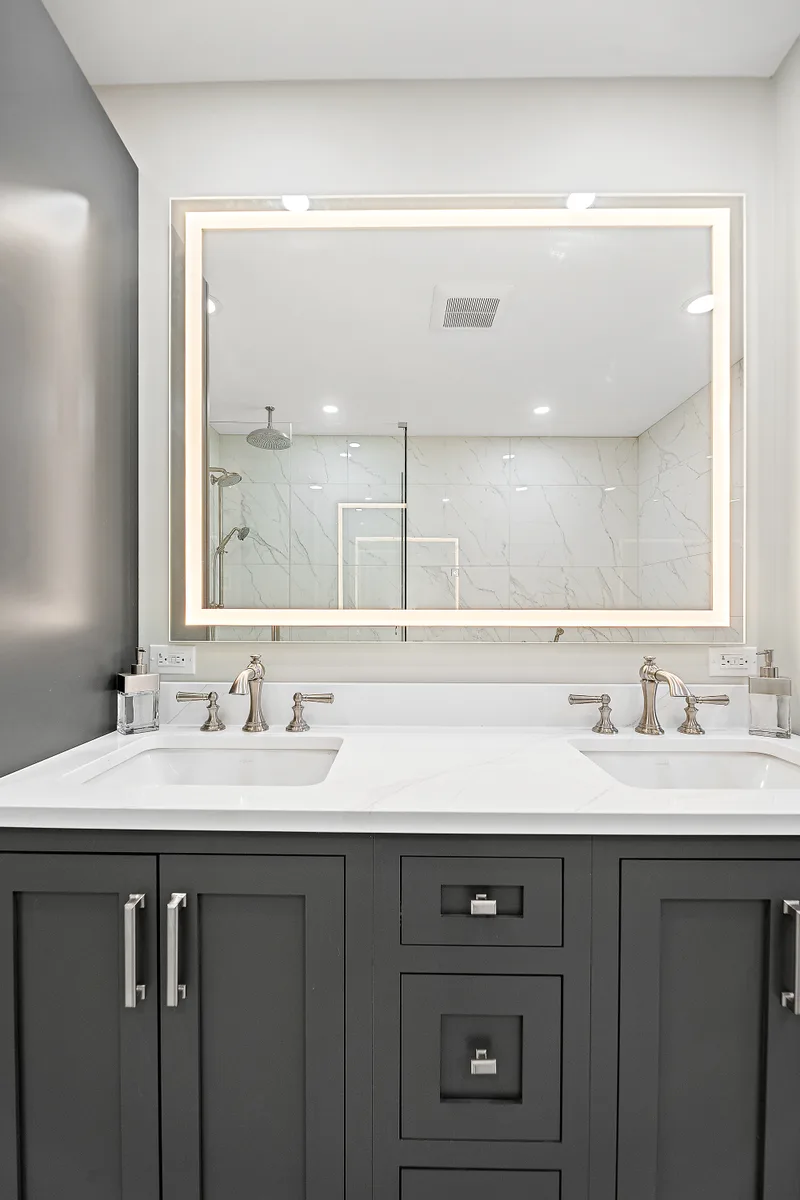
2. Vanity: production, semi-custom, or custom? Production vanities ship in 1-2 weeks and run a few hundred to a few thousand dollars. Semi-custom takes 4-8 weeks. Custom takes 6-10 weeks and costs significantly more. Lead time matters for scheduling; the vanity often gates the finish trades.
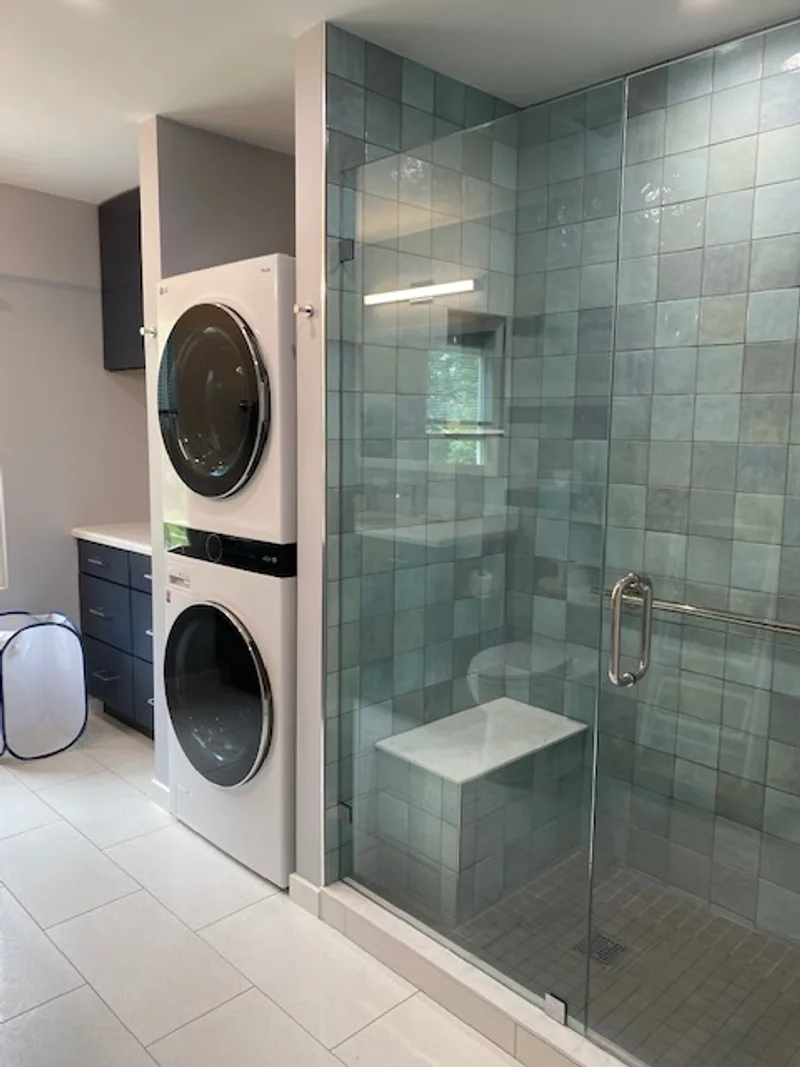
3. Tile: in-stock or special-order? In-stock tile is immediate. Special-order or imported tile runs 4-6 weeks; large-format specialty tile 8-12 weeks. Special-order tile arriving after the tile setter is booked pushes the schedule and usually incurs additional coordination costs.
4. Layout change or same footprint? A same-footprint remodel with no structural changes is the cleanest scope to price and execute. Any expansion, such as borrowing space from an adjacent closet, moving a wall, or adding square footage, involves structural review and permit work beyond the standard bathroom permit.
Once those four decisions are made, you have a scope. Bids against a defined scope are comparable; bids against "bathroom remodel" are not.
Size the Contingency for Your Home's Age
Contingency exists because pre-demolition conditions are not fully knowable from a walkthrough. This is true of all residential remodeling, but it is especially true on the North Shore, where a large share of the housing stock predates 1950.
Pre-1940 North Shore homes (the majority of Kenilworth, much of Wilmette, Winnetka, and Glencoe) commonly have:
- Cast iron drain lines that are functional until disturbed, then brittle
- Knob-and-tube wiring near wet areas, which is incompatible with the GFCI protection bathrooms have required since 1975, and often flagged by insurers
- Plaster-and-lath walls with horsehair binder (pre-1920) or potentially asbestos in joint compound (1920s-1970s)
- Subfloor damage under tub and shower areas from slow leaks; subfloor replacement runs $700-$3,500 depending on extent
1940s-1970s homes (Northbrook ranches, Deerfield split-levels, much of Highland Park) commonly have early Romex wiring, galvanized supply lines, cast iron drains, and asbestos-containing materials through the mid-1970s. The EPA RRP Rule requires certified contractors and lead-safe practices when disturbing more than 6 sq ft of paint in any pre-1978 home.
Recommended contingency by era:
- Homes built after 1980: 10-12%
- Homes built 1960-1980: 12-15%
- Homes built before 1960: 15-20%
Budget overruns are common on bathroom remodels. A named contingency line, not a mental note but an actual number in the budget, is what separates projects that absorb discoveries from projects that stall mid-construction.
Where to Spend vs. Where to Save
Not all dollars in a bathroom produce equal results. Labor is 40-65% of total cost in the North Shore market. Decisions that reduce labor hours save more than decisions that reduce material costs on the same item.
Spend here:
Waterproofing and the substrate. The waterproofing membrane and the subfloor beneath tile are not visible when the project is done, but they determine whether the bathroom holds up over 15-20 years. Membrane failures cause water damage inside walls and below floors, and that damage costs far more to remediate than the waterproofing cost. Waterproofing membranes require 24-72 hours to cure before tile can be set - a genuine schedule item, not a contractor preference.
Ventilation. IRC Chapter 15 requires a minimum 50 CFM exhausted to the exterior, not into the attic. Many pre-1970 North Shore bathrooms were vented improperly or not at all. Correcting this during a remodel, while walls are open, costs $800-$3,500. Doing it separately after walls are closed costs more. Inadequate ventilation is the root cause of the mold and finish failures that kill bathroom renovations within 5-7 years.
Fixture quality at the points of daily contact. Faucets and shower valves with ceramic disc cartridges last 15-20 years without dripping. Builder-grade ball-and-seat faucets often start leaking within 3-5 years. The cost difference per fixture is modest; the maintenance difference is not.
Save here:
Decorative tile on secondary walls. Decorative tile is often concentrated on the shower feature wall, where the visual effect is highest. Floor and secondary wall tile does not need to be at the same price point. A matte porcelain floor at $4-$8/sq ft is functionally equivalent to one at $15-$25/sq ft; the difference in performance over 20 years is negligible.
Fixtures you cannot see. The toilet flapper, the supply lines, the drain assembly: these have no aesthetic role. Buy quality here (not builder-grade), but do not match these to high-end plumbing fixture brands.
Accessories. Towel bars, robe hooks, toilet paper holders, and mirrors are inexpensive to replace as preferences change. Install them at a workmanlike quality level; save the higher finish budget for the vanity and shower hardware, which are harder to swap.
How to Read a Bid
A well-written bathroom remodel bid from a North Shore contractor should itemize these categories separately: demolition and disposal; rough plumbing; rough electrical; waterproofing; tile material and installation; vanity and countertop; fixtures and trim; lighting; hardware; final plumbing trim; and contingency. When categories are bundled as "labor and materials," you cannot evaluate where cost is concentrated or what is included.
Ask every bidding contractor these three questions:
"Does this include plumbing line replacement if cast iron or galvanized supply is found?" A bid that does not answer this explicitly will become a change order.
"Does this include waterproofing membrane?" It should. Omitting waterproofing to win a bid is common; discovering the omission mid-project is expensive.
"What is the payment schedule?" A reasonable schedule ties payments to defined milestones (rough-in complete, tile complete, finish trim complete), not to arbitrary calendar dates.
Permit Realities by Municipality
Every North Shore village issues its own permits and enforces its own adopted code edition. A full bathroom remodel involving plumbing, electrical, or layout changes requires a permit in every municipality in Delta's service area. Some specifics worth knowing:
- Wilmette requires a licensed architect or engineer stamp for projects over $25,000 or with structural work, per the Village of Wilmette Building Department
- Kenilworth has a Building Review Commission review requirement for properties on the Village's Historic Survey list, with associated escrow fees
- Winnetka operates a Landmark Preservation Commission and a demolition delay ordinance that affects projects on historically significant structures
- Evanston requires all contractors to be registered with the City before pulling any permit
For cost benchmarks by project tier, including what $25K, $50K, $75K, and $100K+ actually deliver in the 2026 North Shore market, read the detailed cost guide.
If you are ready to plan a bathroom remodel in Lake Forest, Highland Park, Wilmette, or elsewhere on the North Shore, contact Delta Remodels for a free in-home consultation. We have been working in North Shore homes since 1987 and can walk through your space, assess the conditions, and give you a clear scope before any commitments are made. For help deciding between a surface refresh and a full gut renovation, our cosmetic refresh vs. full gut comparison outlines when each approach makes sense.
Delta Remodels serves homeowners across the North Shore including Lake Forest, Lake Bluff, Highland Park, Northbrook, Winnetka, and surrounding communities.
Frequently asked questions
What contingency should I budget for a North Shore bathroom remodel?
Plan 10-15% for homes built after 1960, and 15-20% for homes built before 1960. North Shore homes built between 1900 and 1950, common across Wilmette, Kenilworth, Winnetka, and Glencoe, frequently reveal cast iron drain lines, deteriorated subfloor, or inadequate venting once walls open. Treat contingency as a named line item in the budget, not padding.
What is the most common reason bathroom remodels go over budget?
Change orders are the primary cause. Swapping tile, adding fixtures, or changing the vanity after construction begins triggers additional labor costs beyond the material difference. Every trade is coordinated to a schedule; when materials change mid-project, that coordination unravels. Finalizing all selections before demolition starts is the most reliable way to hold your budget.
Does moving plumbing fixtures significantly affect cost?
Yes. Relocating a toilet, shower, or vanity requires opening the rough plumbing and, in pre-war North Shore homes, often triggers replacement of cast iron drain lines that would not have been touched if the fixture stayed. Moving one fixture typically adds $2,000-$15,000 depending on how far it moves and what the drain line reveals. Keeping fixtures in their existing locations is one of the most effective ways to reduce scope cost without affecting the finished appearance of the bathroom.
Is a cosmetic bathroom refresh worth it compared to a full remodel?
It depends on the condition of the underlying structure. A cosmetic refresh makes sense when the layout works, plumbing is in good condition, and the goal is updated finishes. If the subfloor shows signs of moisture, the waterproofing has failed, or the plumbing is galvanized steel or deteriorated cast iron, a cosmetic refresh delays rather than resolves the real problem. The failure will cost more to fix later.
Ready to Start Your Project?
Schedule a free consultation. We bring design ideas, material samples, and honest answers.
Get Free Consultation