





Walk-In Shower for Aging in Place: Design Requirements and Cost in Chicago Suburbs
On this page
The shower conversion question for aging in place has two distinct answers depending on who will be using it and how. A transfer shower for someone using a walker is a different project from a roll-in shower for full wheelchair access. They have different dimensional requirements, different plumbing implications, and different costs. Starting with the wrong category wastes design effort and sometimes means building the wrong thing.
Our accessible bathroom services cover how we approach aging-in-place design in North Shore homes specifically.
Transfer Shower vs. Roll-In Shower: Which One Do You Need
The distinction between a transfer shower and a roll-in shower matters before any other design decision is made.
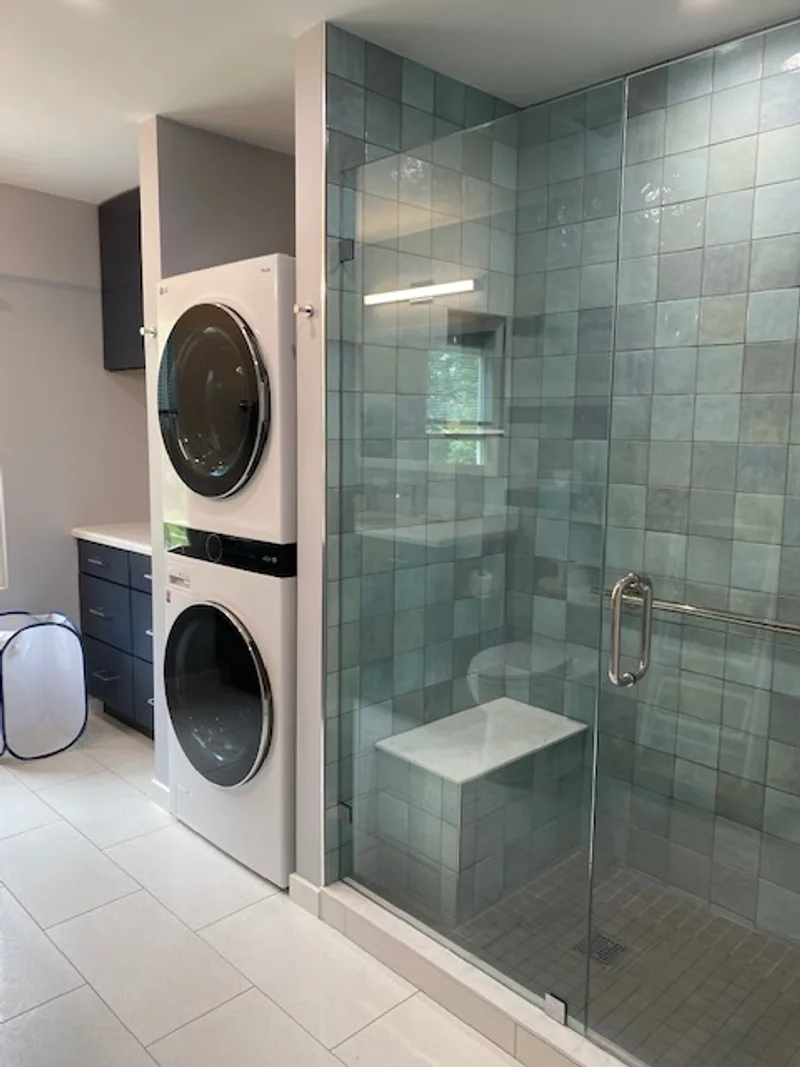
Transfer shower: 36 inches by 36 inches (exact, not approximate), per ADA 2010 Standards Section 608.2. The compact footprint allows a person to transfer from a wheelchair or mobility aid to a built-in fold-down seat at the shower entry. The user does not roll the chair inside; they transfer and close the door or pull the curtain. A transfer shower can often be achieved in an existing bathroom without relocating the toilet, because the 36x36-inch footprint fits within a typical tub alcove. The drain and subfloor still require modification for a curbless entry.
Roll-in shower: 60 inches wide by 30 inches deep minimum (again, exact per ADA 2010 Standards Section 608.3). The dimensions allow a wheelchair to roll fully into the shower with the occupant seated in the chair. A roll-in shower is the appropriate design for someone who cannot or prefers not to transfer out of their wheelchair during bathing. The 60-inch-wide footprint almost never fits within a standard tub alcove without removing a wall or relocating the toilet.
Private single-family homes are not legally required to meet ADA 2010 Standards - those standards are mandatory for commercial and public facilities. The standards are the residential design benchmark because they represent the most extensively validated set of accessible dimensions available. The NAHB Certified Aging-in-Place Specialist curriculum uses the same figures.
The Turning Radius Problem in Typical North Shore Bathrooms
Full wheelchair maneuverability requires a 60-inch diameter turning circle or a T-turn clearance. Per the NAHB aging-in-place standard, this is the floor area needed to reverse direction in a wheelchair without lifting the chair.
Most North Shore primary bathrooms built before 1980 have a 5x8 or 5x9 footprint. A 60-inch circle needs 5 feet of clear floor in every direction from its center. In a 5x8 bathroom, that circle cannot exist anywhere in the room without overlapping the toilet, vanity, or shower.
This does not mean aging-in-place work is impossible in these bathrooms. It means understanding the tradeoff clearly:
- Grab bars, a comfort-height toilet (17-19 inches versus the standard 14-16 inches), a curbless shower, and a fold-down shower seat are achievable in a 5x8 bathroom without touching any fixtures. These changes address fall prevention and ease of use for most aging-in-place scenarios.
- Full wheelchair maneuverability - rolling freely around the room - requires either relocating a fixture or expanding the footprint. Expanding into an adjacent closet is the most common approach.
Knowing which category applies to the homeowner's situation determines the scope, cost, and disruption level before any design work begins.
Plumbing Relocation: The Scope-Defining Decision
The threshold that separates a modest aging-in-place upgrade from a full gut renovation is, in most North Shore bathrooms, whether the plumbing moves.
When plumbing does not move. A curbless shower conversion using the existing drain location, a fold-down seat, blocking for grab bars (installed before tile), and a new mixing valve in the same rough location is achievable without a permit in some villages and with a straightforward permit in others. Subfloor modification for the curbless threshold is required and involves cutting joists, which triggers a structural review. But no permit-triggering plumbing move is required.
When plumbing moves. Converting a tub alcove to a shower that is large enough for a transfer configuration, when the tub drain does not align with the new shower pan drain location, requires plumbing relocation. Moving a drain in a concrete slab (common in Northbrook and Glenview ranch construction) involves saw-cutting and jack-hammering concrete - adds $3,000-$8,000 minimum. Moving a drain in wood-frame construction above a crawl space or basement is typically less expensive ($1,500-$4,000). Full plumbing relocation including supply, drain, and the toilet to achieve a turning-radius bathroom is at the upper end of the $2,000-$15,000 range typical for Chicago-area accessible bathroom work.
Grab Bar Blocking: The Hidden Prerequisite
A curbless walk-in shower without properly installed grab bars is an incomplete aging-in-place project. Grab bars in or adjacent to the shower - at the entry, along the back wall, and at a fold-down seat - are essential components of the system.
The structural requirement matters: ADA 2010 Standards Section 609.8 requires grab bars and their mounts to withstand 250 pounds of force applied in any direction. Standard drywall and the tile backer will not transfer that load safely to the framing. 2x10 horizontal blocking must be installed between studs before tile is set - this is why grab bar installation and shower tile work must be coordinated, not sequenced separately.
In a bathroom that already has tile on the walls, adding grab bars correctly requires opening the wall, installing blocking, and retiling. The cost of doing this after tile is complete is significantly higher than planning for it during a full shower remodel. If a shower remodel is already planned, blocking is the right time to install it.
What This Scope Costs in the Chicago Suburbs
National baseline averages for accessible bathroom remodels run approximately $8,400. That figure reflects national averages and does not account for the pre-war housing stock, cast-iron drains, or plumbing conditions common to North Shore bathrooms built before 1970.
A realistic range for accessible walk-in shower conversions in the Chicago suburbs:
- Curbless shower conversion, same drain location, grab bar blocking, fold-down seat, new mixing valve: $8,000-$15,000 depending on tile selection and subfloor condition
- Full accessible bathroom remodel with plumbing relocation, turn clearance, comfort-height toilet, blocking throughout: $25,000-$50,000
- Full gut accessible bathroom in a pre-war North Shore home (balloon framing, cast-iron drains, potential galvanized supply): $30,000-$60,000 and above
The full-gut range reflects the conditions that commonly appear in Winnetka, Wilmette, and Kenilworth homes built before 1940 and that are also increasingly common in the Glencoe and Highland Park housing stock from the same era. Plaster walls, cast-iron drains, and the subfloor conditions described above are expected scope items in pre-war bathroom remodels, not surprises.
North Shore Housing Stock Considerations
Bathrooms in North Shore homes built before 1980 almost universally have standard-width doors (28-30 inches) that do not meet the 32-inch clear minimum for accessible entry without widening. Widening a non-load-bearing doorway runs $600-$2,000; a load-bearing doorway requires structural engineering and an engineered header, which adds $2,000-$5,000 or more. Most North Shore pre-war bathrooms have load-bearing walls at the bathroom entry - a structural assessment is part of any doorway widening scope.
For the related how-to on curbless shower subfloor engineering specifically, see our curbless shower conversion guide and the accessible shower conversion overview.
Delta Remodels has completed accessible bathroom projects across the North Shore from Lake Forest to Winnetka to Northbrook. If you are planning an aging-in-place bathroom renovation, contact us to schedule an in-home assessment. We evaluate the specific bathroom dimensions, existing plumbing locations, and structural conditions before any design is proposed.
Frequently asked questions
What is the difference between a transfer shower and a roll-in shower for aging in place?
A transfer shower (36x36 inches per ADA 2010 Standards) is designed for a person who can stand or support themselves to transfer from a wheelchair or mobility aid to a built-in seat. The compact size makes a transfer shower possible in more bathrooms without relocating fixtures. A roll-in shower (60x30 inches minimum per ADA 2010 Standards) allows a wheelchair to roll fully inside, which requires a larger floor area. Most North Shore residential bathrooms built before 1980 cannot accommodate a roll-in shower without removing a wall or relocating the toilet.
Does an aging-in-place shower in a private home have to meet ADA standards?
No. ADA 2010 Standards are mandatory for commercial and public facilities, not for private single-family homes. However, they are the accepted design benchmark for residential aging-in-place work because they are the most thoroughly documented set of dimensional guidelines for accessible bathroom design. ICC A117.1-2017 is the technical standard used in residential accessible design. In practice, a well-designed aging-in-place shower follows these dimensions because they reflect genuine ergonomic and safety evidence, not because the law requires them in a private home.
What is a curbless shower, and how is it different from a standard walk-in shower?
A curbless shower (also called a zero-threshold shower) has no raised curb or lip at the entry - the floor transitions directly from the bathroom floor to the shower floor at or near the same level. This eliminates the stepping-over-a-curb movement that creates fall risk for older adults. A standard walk-in shower typically has a low curb or threshold. For aging-in-place purposes, curbless is the correct category. Achieving a curbless threshold requires either recessing the subfloor (1.5-4 inches depending on the drain system) or building up the bathroom floor to match the shower pan height, which has its own implications for door clearances and floor transitions in adjacent rooms.
Can a 5x8 bathroom be made accessible for aging in place?
A 5x8 bathroom can be significantly improved for aging in place - grab bars, a comfort-height toilet, a curbless shower - but it typically cannot achieve full wheelchair-maneuverability clearances without a layout change. A 60-inch turning circle requires floor area that a standard 5x8 bathroom does not have unless a fixture moves. The NAHB CAPS aging-in-place standard specifies a T-turn as an alternative to a full circle; this can sometimes be achieved in a 5x8 bath. An in-home assessment is the only way to determine what is achievable in a specific bathroom without fixture relocation.
Ready to Start Your Project?
Schedule a free consultation. We bring design ideas, material samples, and honest answers.
Get Free Consultation