





Doorless Showers: What They Require, What They Cost, and When They Make Sense
On this page
A doorless shower works when it is sized and built correctly. When it is not, the result is water on the bathroom floor every morning, a cold showering experience in winter, and a renovation that does not perform the way the renderings suggested. The design is appealing, but it requires more specific execution than an enclosed shower.
This post covers the practical side: what size you actually need, how drainage and waterproofing work, what pre-war North Shore homes require to make it happen, and the genuine trade-offs. These are the questions worth settling before committing to the layout.
What Defines a Doorless Shower
A doorless shower, sometimes called a walk-in shower or open shower, is a shower enclosure with no door or curtain across the entry. Water containment is achieved through design: adequate depth, correct floor slope, proper drain placement, and sometimes a partial glass panel or knee wall.
Common configurations:
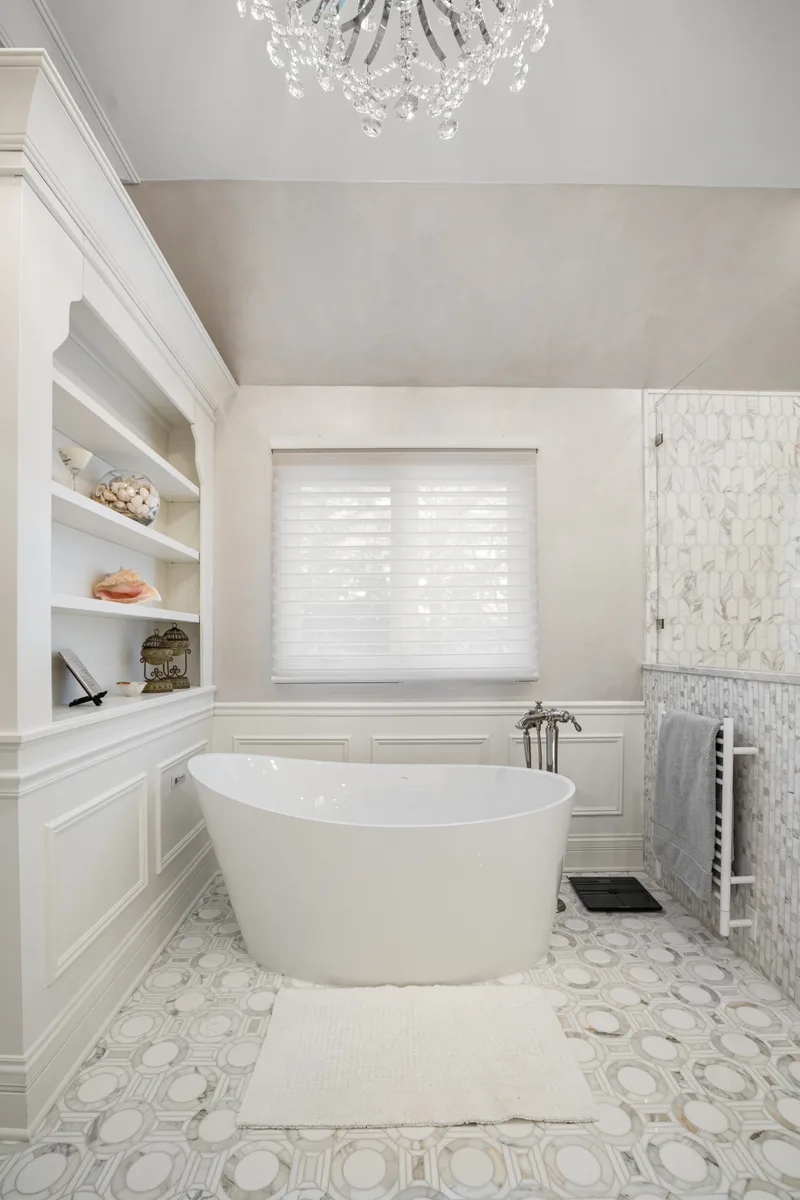
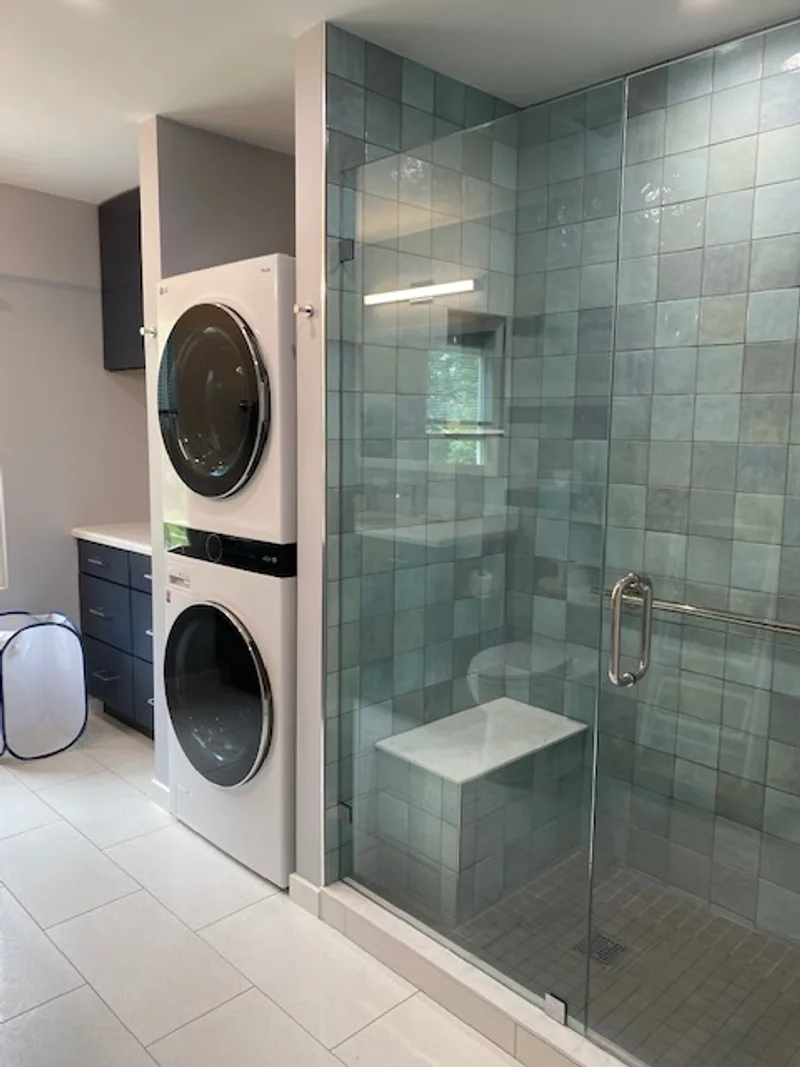
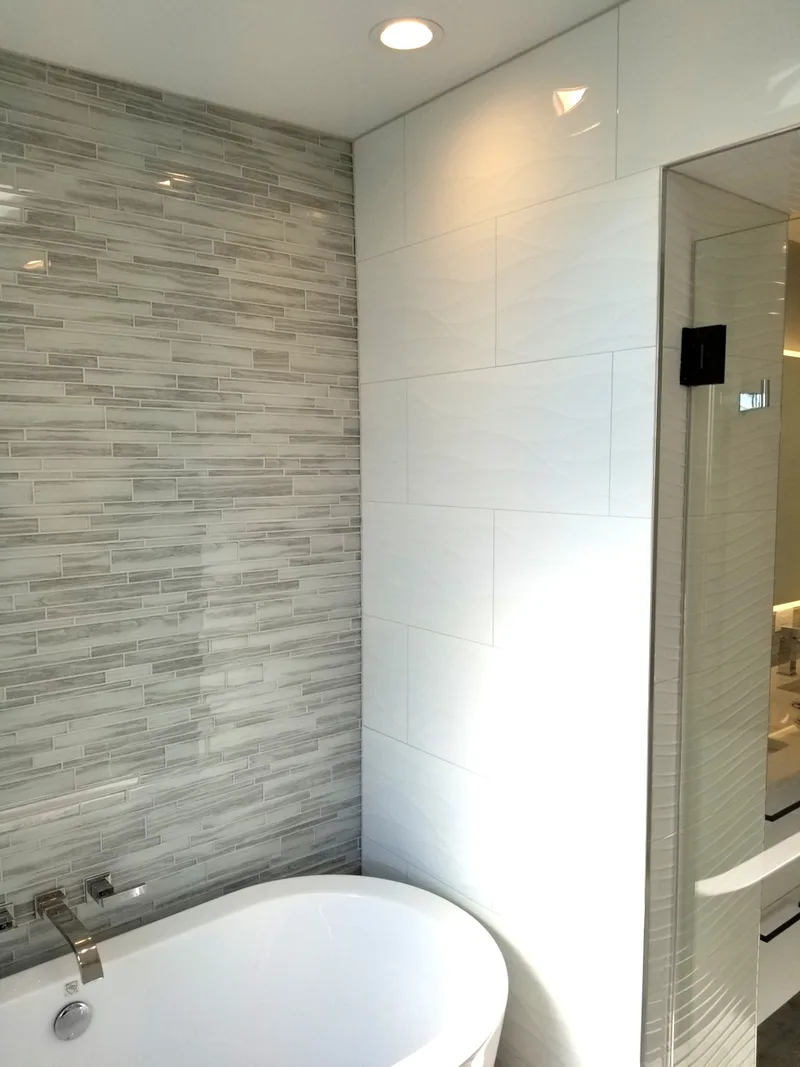
- Open entry with fixed glass panel: A fixed glass panel on one or two sides contains splash while leaving the entry completely open. This is the most common approach in primary bathrooms in Lake Forest, Highland Park, and Winnetka. A completed example: the Lake Bluff primary bathroom on Washington Avenue uses a frameless glass enclosure alongside a freestanding tub, with the glass panel providing containment without a door to negotiate.
- Partial knee wall: A tiled half-wall at the entry provides some privacy and contains water without a full glass enclosure. Useful in bathrooms where the layout makes a full glass panel awkward to frame.
- Corner walk-in: The shower is positioned in a corner so two walls naturally contain water, with an open entry facing into the room. Often the most space-efficient approach for bathrooms where square footage is limited, as it is in many pre-war North Shore homes and in Evanston Craftsman bungalows where bathroom footprints rarely exceed 5x8 feet.
Size: What Actually Works vs. What the Code Requires
This is where most doorless shower problems originate. The IRC building code sets a minimum shower compartment size of 36 by 36 inches, but that minimum applies to enclosed showers. A doorless shower needs meaningfully more depth to function correctly.
Practical minimums: 36 inches wide by 48 inches deep. Many work better at 42 by 60 or larger. The depth is the critical dimension; without a door to stop water, the shower must be deep enough that normal movement, turning, and rinsing at various spray angles does not send water across the entry threshold under typical use.
Corner placement. Positioning the doorless shower in a corner of the bathroom is the most efficient approach for limited square footage. Two walls naturally contain water, and the open entry faces into the room. A well-placed corner doorless shower can function in a smaller footprint than a freestanding open shower in the center of a wall.
Be honest about the space. In a pre-war Wilmette Colonial or a 1930s Winnetka Tudor, bathrooms were often designed at 5x7 or 5x8 feet. That footprint can accommodate a doorless shower if the layout is correct, but it cannot accommodate an undersized one and function properly. Northbrook ranches and Glenview split-levels from the 1960s typically have slightly larger bathrooms - 5x9 or 6x8 is more common - which gives more layout flexibility, but the same rule applies: confirm the depth before committing to the configuration. If the bathroom cannot genuinely support the depth a doorless configuration requires, an enclosed frameless glass shower is the better choice. An undersized doorless shower will send water onto the floor.
Permit implications. In Wilmette, projects over $25,000 or involving structural work require a licensed architect or engineer stamp per the Village of Wilmette Community Development Department. A doorless shower conversion that involves joist cutting, drain relocation, and doorway widening in a pre-war home commonly exceeds both thresholds. In Evanston, all contractors must be registered with the City before pulling any permit. Confirming requirements with the relevant village or city building department before design is finalized avoids permit surprises mid-project.
Structural Realities in Pre-War North Shore Homes
For a pre-war North Shore home, a doorless shower with a curbless entry involves structural considerations that are not present in newer construction.
The curbless floor. A curbless entry requires the shower floor to be recessed below the main bathroom floor by roughly 1.5-4 inches, depending on the drain system. A linear drain pan needs less recess than a traditional mortar-bed sloped to a center drain. Either way, the subfloor must be lowered, which typically means cutting into the floor joists. Any joist cutting requires structural review and, in many cases, sistering the cut joists. This is a meaningful scope addition and should be confirmed with your contractor before the layout is committed.
Pre-1940 balloon framing. Many pre-war North Shore homes in Kenilworth, Winnetka, Wilmette, and Glencoe have balloon framing, where studs run the full height from sill to roof plate. In balloon-framed homes, open wall cavities act as fire chimneys, and fire blocking must be added whenever walls are opened. This applies to any remodel that opens the shower surround walls, not just doorless configurations specifically. Post-war ranch homes in Northbrook and Glenview use platform framing, which does not present the same fire-blocking complication, though those homes have their own conditions including slab foundations and dated cast-iron drain lines.
Subfloor condition. Subfloor damage under existing tub and shower areas is among the most predictable finds in a full gut renovation of a pre-1970 North Shore bathroom. For a curbless shower, the subfloor must be in sound condition before it is lowered. Discovering rot or structural damage at that stage adds cost and schedule; building a 15-20% contingency into the budget for pre-1960 homes is the correct approach. Our bathroom remodel budget guide covers contingency sizing by housing era.
Drainage and Waterproofing
A doorless shower requires more careful drainage design than an enclosed shower. The floor slope must direct all water to the drain before it migrates toward the open entry.
Linear drains. A linear drain positioned along the wall opposite or adjacent to the entry is the standard approach for doorless showers. It handles water efficiently, allows for a large-format tile floor without a center-drain medallion interrupting the tile pattern, and sits flush with the tile surface. Frameless glass is measured and fabricated after tile is complete, typically adding 2-4 weeks to the punch-list phase - the glass template cannot be taken until tile and grout are set.
Floor slope. The IRC requires a minimum slope of 1/4 inch per foot toward the drain. For a doorless shower, the slope near the entry is often specified slightly steeper to ensure water moves away from the opening under all use conditions.
Waterproofing membrane. The shower pan and walls require a properly installed waterproofing membrane behind the tile in any shower type. In a doorless shower with a wider splash zone, the membrane is sometimes extended further onto the adjacent bathroom floor. Most waterproofing membrane products require a full cure period before tile can be set - manufacturers typically specify 24-72 hours depending on product and conditions. This is a real schedule item, not a contractor preference; it must be planned into the project timeline. Membrane failures are the most common source of bathroom water damage, and they are not visible until the damage has already progressed.
Waterproofing over plaster-and-lath. In pre-war Kenilworth, Wilmette, and Winnetka homes, shower walls are often plaster-and-lath rather than drywall. Waterproofing membrane cannot be applied directly and reliably over plaster. The correct sequence is to remove the existing plaster wall substrate in the wet area down to the framing and install cement board or an approved waterproof substrate before the membrane goes on. Projects that skip this step - applying membrane over intact plaster - tend to fail within a few years as the plaster behind the membrane absorbs moisture at joints and edges.
The Honest Trade-offs
What works well:
A doorless shower with no door to clean, no track to scrub, and no hardware to replace is genuinely lower maintenance than a door-and-track enclosure. For accessibility, eliminating the step-over threshold and the door to negotiate makes entry and exit meaningfully easier for people with limited mobility. The ANSI A117.1 accessible design standard sets dimensional requirements for accessible shower compartments, including minimum entry widths and turning clearances. See our accessible bathroom design guide for the specific figures.
A large, well-executed doorless shower with quality tile work and proper glass panel placement photographs well and reads as a considered design choice in a primary bathroom.
What does not work well:
A doorless shower does not retain heat the way an enclosed shower does. Steam disperses into the bathroom rather than staying contained. In a Chicago-area winter, with outside temperatures routinely below freezing, this is noticeable. Anyone who runs cold in the morning will feel it. This is not a design flaw; it is physics, and it matters more in some households than others.
For shared bathrooms with multiple users at different temperature preferences or spray settings, the lack of containment can be a practical issue. Privacy is also reduced compared to a fully enclosed shower.
A properly executed doorless shower costs more to build than an enclosed shower of the same footprint, because the tile work, drainage, and waterproofing all have to be executed precisely for the design to function.
The resale question. A doorless shower in a well-executed primary bathroom reads as a desirable feature to most buyers. The calculation changes if it replaces the only bathtub in the home. Buyers with young children typically want at least one tub. If the home has only one full bathroom and removing the tub eliminates the last tub in the house, discuss the resale implication with your contractor before proceeding.
When a Doorless Shower Makes Sense for a North Shore Home
It is the right choice when:
- The bathroom has enough square footage to support a properly sized enclosure (at least 36x48, ideally larger), or the layout can be reorganized to create that depth
- The shower is in a primary bathroom where it will not be the household's only bathing option for younger children
- Accessibility is a factor: doorless designs accommodate mobility aids and aging-in-place needs better than any other configuration
- The overall bathroom renovation includes quality tile work, correct drainage design, and proper waterproofing that gives the open shower a finished, intentional result
It is the wrong choice when the bathroom is too small to support the required depth without significant layout changes, when it would replace the home's only tub, or when the household's showering preferences favor a steam-retaining enclosed experience.
For North Shore homeowners considering a doorless shower as part of a full bathroom remodel, our bathroom remodeling page covers the full design-build scope. Contact Delta Remodels if you want to discuss whether your specific floor plan can support a doorless configuration. We serve homeowners in Northbrook, Winnetka, Highland Park, and across the North Shore, and we will look at the actual dimensions and give you a direct answer about what it would take structurally to make it work correctly. If accessibility is a key factor, our accessible vs. standard remodel comparison outlines the differences in scope and cost.
Frequently asked questions
What is the minimum size for a doorless shower to function correctly?
A doorless shower needs to be at least 36 inches wide by 48 inches deep to work without sending water onto the bathroom floor. Many function better at 42 by 60 inches or larger. The building code minimum of 36 by 36 applies to enclosed showers and is not adequate for an open configuration.
How does a doorless shower contain water without a door?
Water containment in a doorless shower depends on three things: adequate depth so spray does not reach the entry under normal use, proper floor slope toward the drain, and correct drain placement. A linear drain positioned along the wall opposite or adjacent to the entry is common and handles water efficiently without a center-drain medallion interrupting the tile pattern.
Does a doorless shower affect resale value?
In a well-executed primary bathroom, a properly sized doorless shower is generally viewed as a desirable feature. The calculation changes if it replaces the only bathtub in the home, since buyers with young children typically want at least one tub. Discuss the resale implications with your contractor before removing a tub that is not easily replaced.
Is a doorless shower easier to use for accessibility purposes?
Yes. A doorless shower eliminates the step-over threshold and the door to negotiate, which makes entry and exit meaningfully easier for people with limited mobility. The ANSI A117.1 accessible design standard sets out the dimensional requirements for accessible shower compartments, including minimum entry widths and turning clearances. See our accessible bathroom design guide for the specific requirements.
Ready to Start Your Project?
Schedule a free consultation. We bring design ideas, material samples, and honest answers.
Get Free Consultation